Showing posts with label birding. Show all posts

Saturday, May 9, 2026

Texas 2026 Part 2 - Birding Top 5s


After the Texas Library Association Conference I talked about in Part 1 it was time for some bird-finding. Texas has one of the biggest bird lists in the country, and my friend Brendan and I had five whole days to check it out. 

I've birded southern Texas a bunch of times but Brendan had never been, so much of our trip was spent pursuing lifers for him. There were a couple of new ABA birds I could get, but that wasn't really the focus. We left Houston before dawn on March 31 and picked down the Gulf coast, then across to the Rio Grande and Lower Rio Grande Valley for a few days, then up to Hill Country and back to Houston. In total we saw 206 species, a pretty damn good number for a few days in a single state. Here's the trip report if you're interested. 

I don't have time to go into a whole narrative! Sorry to the zero people who would read it! But I do like doing Top 5 lists on this internet website, so lemme do some of those.

Top Five Best Birds

5. Stilt Sandpiper

No no I know it's not the craziest bird or anything but I feel like I rarely ever get to see Stilt Sandpipers, but we saw some at the Leonabelle Turnbull Birding Center in Port Aransas. We went for other reasons (more in a moment), and it was one of those times in birding where you go to a spot that you know nothing about and it's awesome. The Leonabelle Turnbull Birding Center, at least in early April at the start of a good migration, was crammed with shorebirds. Crammed! And it was one of those boardwalk spots you see in the south (like Wakodahatchee Wetlands in Florida) where all the birds were super up close. It was awesome. Here's the checklist. 

4. Elf Owl

It was well known among birders in the Lower Rio Grande Valley that there was an Elf Owl nesting in a telephone pole just outside the entrance to Bentsen-Rio Grande Valley SP. Folks had been winking and "hey didja know"-ing about it during our visit in the morning, and so we returned at dusk and waited for it to pop its little face out of its hole. Groups of birders and photographers wandered up around the time and got in place and then there it was. My photo stinks because it was dark, but you can see it in there. 

3. Golden-cheeked Warbler

I just love Hill Country, really. It's really pretty up there, and such a welcome change of scenery after spending time in the Lower Rio Grande Valley. I've been to Lost Maples SNA once before, and Brendan and I returned to go after his lifer Golden-cheeked Warbler (and others). We saw a couple in one of the stream valleys on the way up the main trail, and they're just cool.

2. Crimson-collared Grosbeak

I only got two ABA birds on the trip, and so all things considered I count those as my "best" birds. No big deal. There's been a Crimson-collared Grosbeak hanging out for a bunch of weeks at the Edinberg Scenic Wetlands / World Birding Center, and we went to see it. We arrived and had that terrible birder experience when you get to a spot that a million people have seen a bird at but you just don't see it. You follow all the directions to the letter but either the directions are wrong or the bird's just not there. We were annoyed, but it ain't the World Birding Center for nothing. We went over to the front desk and a naturalist named Will took us right over to where the bird was just hanging out in a tree eating leaves. They eat leaves. Good bird. Thanks, Will!


1. Mottled Owl

A major focus of the trip was a couple of guided trips down into Santa Margarita Ranch looking for Brown Jays and the long-staying Mottled Owl. The owl is the first living individual ever seen in the ABA area - they're usually found no closer than Mexico. We joined a small group and headed down to the banks of the Rio Grande and, after just a moment, there it was. Incredible. 


Five Biggest Misses

5. I can't really think of any 

4.

3. Red-footed Booby

We didn't really even know there was a Red-footed Booby in the waters around Corpus Christi until we were driving through. We stopped for a bit and looked but couldn't find it. No worries. We didn't even bother looking for the Cattle Tyrant because we didn't have time. 

2. American Flamingo

I've never seen an American Flamingo but there had been one hanging out at the Leonabelle Turnbull Birding Center all winter. Except for, like, a day before we showed up. No dice.

1. Brown Jays

This one hurt. It's the only one, really. I've wanted to see a Brown Jay in the U.S. forever, and have been a bunch of times town to Salineño Wildlife Preserve -- where they used to be seen reliably before I was a birder -- but no luck. They'd been gone for years, after a flood or something. Some are back, just south of Salineño along the river at Santa Margarita Ranch. They were seen reliably at the tour we booked (both the evening and the daytime one) but BUT but BUT BUT BUT BUTUTTTTTTT we missed them. We missed em! They might have been building a nest nearby, or something, the guide said. Ugh. They were seen the days before and the days after and every friggin day of all time but not the day we were there. It's fine. 

Five Best Meals

I am not ranking these in order, but just listing all the five star meals (not a real rating) we had during the trip. I fuckin love the food in south Texas.

  • El Angel Food to Go. Salineño. Simple, delicious Mexican food we ate from styrofoam containers on the hood of our rental car. Tough to beat. 

  • Carne Asadas Don Omar. Rio Grande City. Good god these may have been the best tacos I've ever had. Hit the spot so hard after a long day of travel. 

  • Rudy's BBQ. Brownsville. This is a chain I guess with a bunch of restaurants across the southwest but it was fantastic! Everyone was super friendly and there were really cold beers. 
  • Rocha's Restaurant. Mission. I'm not generally super anal about what's "authentic" or not. I don't really even know what that means, but it's fun sometimes to feel like you're in a new place. I feel really guilty about not being able to speak Spanish, and we were certainly the only people here who didn't speak Spanish. We didn't feel unwelcome, or anything, but it was just kind of a rush to have that kind of cultural experience in the U.S. It was great. There was a lady softly singing from her table and when she was done she walked around and we all gave her a few bucks. 
  • Lost Maples Cafe. Utopia. Southern comfort food -- pies, hush puppies, fried catfish, etc. -- was a welcome change of pace from the food in the Valley and we filled up.  
  • The Bungalows on Shary. Mission / Mcallen. This wasn't a meal but a hotel. Brendan found it, somehow, and it was so cheap that we were suspicious, but we loved it. Right near a whole bunch of birding hotspots, and with access to a pool and a great bar. The best deal of the whole trip, I can't recommend it enough.

Things About Texas

2. The Wall. The border wall sucks so hard. It's stupid as shit. It's ugly, and tons of the gates and lights don't work already. It's keeping construction companies in business, I guess, and scams are good for that kind of thing, but it was so pathetic and sad to see it everywhere. 

1. No Subarus. Haha we counted like 3 total Subarus our entire time in Texas. 


Monday, June 16, 2025

Tufted Puffin in the Gulf of Maine


Warming temperatures in the Arctic are keeping the Northwest Passage open longer, making it easier than ever for seabirds to move between the Pacific and Atlantic oceans. It's happening in drips and drabs (is that the expression? what the hell is a drab? No, I will not look it up), but it's happening. There's been a Northern Gannet on the Farallones. Ancient Murrelets have been seen off the coast of Maine and Iceland. 

There's also been a Tufted Puffin in Maine. First seen in June 2022, the single bird has spent summers bouncing around various of the Gulf's seabird nesting islands, including Petit Manan, Seal Island, Machias Seal Island, and Eastern Egg Rock. The entire rest of its population spends the summer nesting in the Pacific Northwest and Alaska, but this individual spends its breeding season wandering around Maine looking for a familiar face. In the winter, it presumably migrates with other Atlantic Puffins to the open waters off southern New England and the mid-Atlantic.

It's a mega rarity, and one that Maine birders would love to see. But the unpredictability of its movements and the difficulty of getting out there to even take a look (you need to pay to join a whale watch boat), means that very few folks outside island-based researchers have been able to see it.

I've tried at least three times. (One of those whale watch trips was free because we didn't see any whales the trip before and they give you a coupon when that happens.) No luck. But, the bird keeps coming back. It was first seen in late May, with a mind-blowing from-land record near Portland. [It's worth lingering on this record for a moment. It's crazy. Despite how famous Atlantic Puffins are in Maine they are NEVER seen from the mainland. I don't think I've ever heard of one seen from shore, though I'm sure there are records. The fact that Noah and Stacey spotted not just a puffin but THE Tufted Puffin -- the only individual in the entire Atlantic Ocean -- from shore is just bonkers.]

My family told me that I should go birding on Father's Day (love them), and so I booked a ticket on Cap'n Fish's Whale Watch out of Boothbay Harbor, which visits the Atlantic Puffin colony at Eastern Egg Rock. The Tufted Puffin had been seen a couple of days before by researchers at Seal Island NWR, about 40 miles away, so I didn't really think I'd see it at Eastern Egg Rock. Still, you can't win if you don't play, and I always love getting out into the Gulf, so it was worth the effort.

I was rewarded. Almost immediately after the boat arrived to the island (we don't stop and debark, only bird from the boat) I spotted a larger, all-black-looking bird flying down the island. It was the Tufted. I gasped, and fired off some out-of-focus photos (even more out-of-focus than normal). I alerted the crew, who were thrilled, not having seen this famous bird yet despite daily trips to the island. The boat also let the island's research staff know, who hadn't apparently seen the bird yet either. 

It was awesome. The bird was almost constantly on the move, perching for a few moments on the highest rocks with Atlantic Puffins, then appearing -- almost if by magic -- in rafts of birds in front of the boat on both sides of the island. Great bird! Great day! 

The first view of the Tufted Puffin, in flight past one of the island's bird blinds. I can't believe I managed to get any images at this moment, I was so excited.

The bird seemed to appear everywhere - including at one moment in the water on the west side of the island.

My favorite view of the Tufted Puffin - hanging out with Atlantic Puffins on the south end of the island. 

Tuesday, May 20, 2025

Somerset County (Maine) Big Day 2025


[Adopted from a post I sent to the Maine Birds listserv]

Every year a group of us tries to spend an intensive day of birding in a county outside our Cumberland County homes. This year we set our sights on Somerset County. Yesterday, Monday May 19, a group of us including Doug Hitchcox, Ed Jenkins, Brendan McKay, Michael Tucker and Franklin County guest star Tim Flight worked to find as many species as we could within Somerset County lines.

Somerset is an interesting county. It's the longest north-south county in the state--stretching from Fairfield all the way up above Baxter SP to meet Aroostook County--but offers very little east-west movement. That orientation makes a day's birding pretty straightforward: start in either the north or the south and head in the opposite direction. Our accommodations were at Sugarloaf (in Franklin Co.), so we started in the forests around Flagstaff Lake and worked our way to the extreme south of the county. 

Starting out just east of Stratton, ME

Being a bunch of dudes with jobs and families meant that we didn't have the luxury of choosing the "best" day to bird, and the weather was a constant annoyance. We didn't see a ray of sun all day, and were constantly plagued by drizzle, rain, and at times gusting winds. But things never got nearly bad enough to quit, or anything, and while the weather certainly contributed to some misses, there are so many damn birds in northern Maine right now that we couldn't miss. We had 10 species of warbler in the drizzle at our first stop of the morning on just over the Somerset line near Stratton, and songbirds were abundant at every stop as we made our way along Big Eddie Rd. up and over Flagstaff Lake towards Long Falls Dam. Despite dedicated effort, though, we were unable to connect to any of the boreal specialties -- Boreal Chickadee, Black-blacked Woodpecker, Canada Jay, or Spruce Grouse -- that we hoped to find up there. More scouting would have helped, but those birds are tough to find. Rising winds and the drizzle kept things pretty quiet around the lake, though we did have some nice surprises, including a flock of 22 White-winged Scoters migrating north, a pair of American Bitterns, and an American Herring Gull on the lake. We headed south, out of boreal habitat.

Great Moose Lake

We were invigorated by our next stop, an out-of-the-way boat launch at the north end of Great Moose Lake, near Hartland. That place was great, and featured about a dozen birds that we didn't see anywhere else in the county, including Black Terns, a majestic Sandhill Crane flyby, Northern Harrier, Pied-billed Grebe, and more. Any future Somerset County listers need to make sure this site is on their radar.

We kept moving south. A coffee break at a convenience store in Athens yielded a silent Black-billed Cuckoo in a tree across the street, reinforcing the truism that there are no bad birding spots in mid-May. We hit our first eBird hotspot of the day (and just one of three total) at 3:13pm, getting skunked in the rain at Lake George State Park. A steady diet of passerines and sharp-eyed pick-ups got us to the KVCC Alfond campus just north of Fairfield at 95 species, where we picked up Savannah Sparrow, Rose-breasted Grosbeak, Baltimore Oriole, Wood Thrush, and our century-mark clinching Willow Flycatcher.

Celebrating 100 species at Kennebec Valley Community College

We got ice cream and celebrated with one last stop on Libbey Island in Fairfield. It was really birdy, though, and we ended up adding birds like Tufted Titmouse, Red-bellied Woodpecker, Tennessee Warbler, and Blackpoll Warbler. (Those last two brought our day's total to 22 warblers, missing only Prairie, Mourning, and Louisiana Waterthrush for Maine breeders.) We ended the day with 109 species in Somerset County.

We left a LOT of birds on the table -- Indigo Bunting, House Sparrow, House Finch, Great Blue Heron, etc. -- so another attempt with better weather and more efficient routing would certainly result in more birds. But we had a hell of a lot of fun, and saw a lot of beautiful places we'd never seen before. Until next year!


Our checklists overlaid on a map of Somerset County. Courtesy Doug Hitchcox


Tuesday, May 14, 2024

Birding the Azores in April


The first thing that made me want to visit the Azores was a computer game, Indiana Jones and the Fate of Atlantis. Indy and his friend visit the islands to try to track someone down or something ... I don't remember much except thinking "whoa that place looks pretty nice."

The second thing that made me want to visit the Azores was Google Street View Birding, where I'd digitally-explored the islands looking for the Azores Bullfinch. I never found the bird on Street View, but I found views beyond belief. Massive, verdant, rural hillsides leading down in every direction to glistening blue waters - what was this place?? 

The third thing was my family. I can't just "go on vacation" with my non-birding family in a place that has a bunch of new birds. I'd go insane. Every second taking selfies or touring the cheese factory or whatever while life birds flitted around outside, unseen, is pure panic. Can't do it. The Azores, with just a handful of endemics and just a couple dozen resident species, are a great compromise. I could do a little birding, but I wouldn't be worried about missing everything. 

Plus, a direct flight from Boston. We hit the road over my son's April vacation from school.

Island Background

The Azores are an archipelago of volcanic islands in the middle of the Atlantic. Culturally and politically the islands are Portuguese -- they are officially called the Autonomous Region of the Azores -- and the islands' villages showcase the narrow streets and white buildings of Portugal. It's really beautiful. There are nine main islands, and we traveled to the two most populous: Terceira and São Miguel.

Traveling around the Azores is very easy. We were able to rent an automatic car (I know, I know), and the roads are excellent around the island, though narrower than what's in the U.S. The islands we traveled to are very well set up for tourists, and most everyone speaks English. The currency is the Euro, but most everywhere (except for one or two places) takes debit cards. 

The food is so damn good, and relatively cheap (especially in grocery stores). Surprisingly, for its location, seafood plays second fiddle to locally-grown meat and cheese. Fine with me!

Bird Background

Centuries of human habitation have greatly changed the Azorean landscape. The majority of the islands have been cleared for agriculture -- much of it in the form of a, frankly, beautiful checkerboard of small cattle pastures bordered by walls of volcanic stone -- and very little native vegetation remains. What's left is mostly at high elevation or in inaccessible areas. There were likely multiple bird species endemic to the Azores before humans arrived -- here's evidence of at least one additional bullfinch -- but for now there are only three: the Azores Bullfinch, closely matching the plumage of a female Eurasian Bullfinch but limited to about 1,400 acres of native vegetation on the slopes of Pico de Vara mountain on São Miguel; the Azores Chaffinch, a widespread bird recently split from Common Chaffinch; and Monteiro's Storm-petrel, a close relative of the Band-rumped Storm-petrel that nests on a few islets off Graciosa island.

There are a host of subspecies on the islands as well, each with varying cases for full specieshood. Island subspecies include Azorean Common Buzzard; Yellow-legged Gull; several subspecies of Goldcrest; Blackcap; Quail; Blackbird; Starling; and more. 

True excitement, though, may be the vagrants. Situated as they are right in the middle of the Atlantic, the islands are a magnet for wayward migrants moving along both the North / South America and Europe / Africa flyways. Though I didn't plan it this way, my trip at the early stages of peak migration meant that vagrants could show up anywhere, and they certainly did. More on that later. Let's get into some specific spots.

Terceira - Paul do Cabo da Praia

Well, I told my family that this wasn't a birding trip but I'll be damned if I wasn't out with the bins at this spot about 15 minutes after getting off the plane. It's a former quarry off an industrial area that is renowned for attracting shorebird species from both sides of the Atlantic. It didn't disappoint. There were a ton of birds here, including my lifer Kentish Plover and Common Greenshank, alongside Red Knots, Curlew Sandpipers, a ton of Sanderlings, a Dunlin, Common Ringed Plovers, and even a vagrant and very out-of-place-looking Long-tailed Duck at the back. There were also apparently Semipalmated Plover and Whimbrel around, though I wasn't able to find them. I was only about to spend a half hour here before my family got eager to get on with the trip, but it was unforgettable. Here's the list. 


And we weren't even done! My wife and son were playing on a nearby seawall while I birded, and I took a peak over into the water when I went to meet them before heading out. Immediately I saw something I knew I shouldn't: a diving bird swimming in the water. There aren't cormorants or sea ducks or alcids on the Azores, and so I knew this was something good. Thankfully, the dagger bill and body posture were immediately recognizable: it was a Common Loon! Vagrants abound!

Terceira - General

After the quarry the plan was to just circumnavigate the island to see the sights. It's only a few kilometers around, so it doesn't take long. We slowly made our way around, stopping at various viewpoints and tourist type places.

I was immediately impressed at how birdy everything was. Everywhere we went there were birds flying around - out of and into fields, off rock walls, overhead. Most of these birds were birds introduced from Europe -- House Sparrows, European Starling, Eurasian Collard-Doves; Common Wood-Pigeon, etc. -- but also plentiful Azores Chaffinch, Island Canary (endemic to just these and some other Atlantic islands), and welcome birds like Eurasian Blackcap, Eurasian Robin, and Eurasian Blackbird. It was nice.

One especially nice stop was Miradouro da Ponta do Queimado, a lighthouse and overlook on the far west side of the island. We were just there for the views, but I noticed some birds riding high on wind above the cliffs. First, Barn Swallows (from the European "White-bellied" subspecies), a not-unexpected vagrant to the islands and a pleasant surprise. Then, something better: a large, dark swift. The only bird I'd ever seen like it were some Black Swifts back in Colorado, but I knew that this weren't them: this was either a Common or a Pallid swift, a much less common vagrant from Europe. Yeah! I stopped the car in the middle of the road and jumped out with my camera but only managed a single terrible photo before the bird disappeared. Still, not at all a bad first day in the Azores.


On day two we climbed Monte Brasil, a major volcano peninsula dominating the landscape above the largest city on the island, Angra do Heroísmo. Climbing Monte Brasil is a primary goal for tourists during the summer high season, I'm told, but it wasn't very crowded at all for us. The birds were just OK -- there were plenty of the regular blackbirds, blackcaps, greenfinches, goldfinches, and others -- but the highlight was seeing some nice low-soaring individuals from the Azorean race of Common Buzzard at the caldera. Here's the eBird list.

Terceira - Pelagic

The Azores are famous for whale-watching, with dozens of different marine mammals seen. Some are residents, like Sperm Whales and a few dolphin species. The islands are also a hotspot for migrating whales, including my absolute dream species: the Blue Whale. I booked two different whale watches during our trip -- the middle of the high season for baleen whale migration -- in hopes of catching up to a Blue Whale. 

It wasn't meant to be. Strong storms for the week before we arrived were just dissipating, and our trip was the first our tour company, OceanEmotion, had been able to run in several days. We did not get lucky. For whatever reason, most of the whale watch folks we spoke to said that the baleen whales had moved past already, even though most sources say that the season runs through June. I guess March is really a better time if you want to see a Blue Whale. 

The birding was, frankly, not very exciting. Though one would expect that these waters would support all kinds of seabird species there was only one around this time of year: the Cory's Shearwater. We saw them by the hundreds, and they were visible any time I could get bins on the ocean. I had some good looks, but after a while hoped for something different, even if it were a Scopoli's Cory's Shearwater from the Mediterranean. There are storm-petrels around, apparently, but I didn't see any, and the endemic Monteiro's Storm-petrel does not breed near Terceira. Still I got a couple of decent photos.


Terceira - Paul da Praia da Vitória

Our final stop on the third day was Paul da Praia da Vitória, a park and small wetland lake near the airport. Lots of different vagrant birds had been reported here. I didn't have a whole lot of time, and didn't really walk in the right direction, I think, (should have crossed the bridge on the side away from town), but did manage to see some Western Cattle Egrets, a Great Egret, and a Bank Swallow. There was more there, I think, but I missed it. Next time.

São Miguel - Lagoa das Sete Cidades

We left Terceira and flew to São Miguel. The largest of the Azorean islands, and the most populated. But, similar in all ways, including its beauty. Our first stop was the Lagoa das Sete Cidades, a beautiful set of lakes set inside a dormant volcano on the west side of the island. The views are extremely Instagrammable, and the hikes above the lake were the most touristy things we did during the trip. I can't imagine how much busier it must be during the summer - though the crowds petered out a lot just a few feet away from the main parking lots.

There weren't many birds to speak of on the top, but things picked up a little bit down by the lakeshore. Again, as with any freshwater water body on the islands, any type of vagrant water bird would be possible. I didn't see anything particularly great, though there were apparently some good birds on other parts of the lake. Family time overruled birding time, but I was after some good stuff in the morning. 

São Miguel - Azores Bullfinch

Aside from the recently-recognized Azores Chaffinch, the Azores Bullfinch is the only endemic passerine on the islands. I wonder if there were more before the arrival of humans, like Hawaii, or if science will recognize island subspecies as full species in the future. For now, though, the bullfinch, called the Priolo, is the major birding draw on the island.

It's pretty amazing the bird is still with us. The island's native forests have been decimated by agriculture and the takeover of invasive plant species like Japanese cedar. Only small areas of its preferred habitat, mostly Macronesian Holly, remains on the steep slopes of Pico de Vara on the island's west end. It's believed that the bird's entire range is barely more than 1,400 acres. 

Restoration efforts have helped bring the bird back from the brink, thankfully, from just 30-40 pairs in the 1970s to more than 700 pairs today. Still, that's not very many, and the bird is somewhat notoriously difficult to find despite its limited range. My understanding was that weather was a major factor in a successful chase, with the mountain's frequent rain, wind, and fog often thwarting hopeful birders. 

I watched the eBird reports in the weeks leading up to my trip and saw that there are basically three areas most people find the bird: the southern slopes, the northern slopes, and the eastern slopes / Interpretation Center of Priolo. We were staying the night in Furnas, on the southwest side of the mountains, but eBird convinced me to try the roads along the northern end. A major help were some reports from Maine young birder extraordinaire, Matthew Gilbert, who happened to be vacationing with his family just a week before my arrival. Matthew kindly shared some good advice about where to look for the bird, but his eBird checklist comment -- "Finally!" -- wasn't reassuring. Apparently he looked three separate times for the birds, all in foul weather, before finally hearing them at this spot. I only had one morning to search, and would have to take whatever weather I was given. 

I was up at dawn and driving up out of the caldera and around towards the north side of the island. The mountaintops were shrouded in fog when I left our apartment, but I continued along the island ring road until turning off on M1033 and heading up. Things were looking calm and clear. Perfect birding weather. I was feeling good. 

But, no birds at the first stop, including down the little side road that Matthew had heard his birds. The roads here are dirt but are wide and of good quality. It's a little unclear whose property things are, though the first set of buildings I parked at appeared to be owned by the government. There was no one around, and I had the gorgeous tropical mountainside morning all to myself. 

I headed further up and parked off the side where a couple of roads diverged, then began slowly walking up the road. With the weather so nice, I knew it was now just a matter of getting lucky and bumping into some birds. I strolled around a tight corner and spied a pair of chunky white birds flying across a field and into a group of bushes. I knew immediately I had found my birds. Here is the exact point. 

The pair (there was a third further down) fed in the bushes for about twenty minutes while I watched. It was perfect: me, alone on a stunning morning on a mountainside in the middle of the Atlantic with a pair of birds who beat the odds to survive. They didn't make a sound the whole time, just fed until they were full then popped up into a cedar, and then headed out back across the field. A perfect morning, and I was back at home before my family had finished breakfast. Here's the final checklist. 


São Miguel - Lagoa de Furnas

Furnas is a lovely little town in the mountains famous for its hot springs. There is an impressive collection of fumaroles downtown, and a really fancy hotel and grounds, the Terra Nostra, with a geothermal pool open to the public. I recommend it. 

We also took the short trip down to the nearby lake, which is bordered on one end by a geothermally-active field where local restaurants bury pots of meat and vegetables to cook their famous stew known as cozido das Furnas. We strolled along the lake sipping freshly-made rum and pineapple drinks and, what do you know it, like every body of fresh water in the Azores, there were rare birds around. Specifically, a spotted vagrant American birds, a Pied-billed Grebe and a Glossy Ibis against the sure. I'm sure there could be other birds if I had spent more time and looked over more of the lake. A fun visit. 

São Miguel - Pelagic

My family was reluctant to take another pelagic after our bouncy ride on the rubber boat on Terciera, but I can be very convincing. This would be our last chance to see a Blue Whale! We signed with Terra Azul, leaving from the port in Ponta Delgada, and left on board a real, actual boat with a top deck and seats and everything. We had a much smoother ride this time (because the seas had calmed in the intervening days, mostly), but didn't fare any better with pelagic birds. Got a Ring-billed Gull for the trip (there is really good gulling in the Port), but otherwise just the now-standard truckload of Cory's Shearwaters. I'm not complaining, but hoped for some more diversity. Same on the marine mammals side. We had some nice looks at the resident Sperm Whales and more Common Dolphins, but nothing with baleen. I'll have to return.

São Miguel - Boca de Ribeira 

I wanted to swim at some point, but swimming isn't super easy in the Azores. Lots of the coastline is sheer cliff, and the ocean is rough, cold, and unforgiving. Some towns have built public pools right at the edge of the sea that constantly refill with seawater washing in from the waves. It's pretty gnarly, and we found our way to one such pool in the northeast corner of the island, pretty much the closest spot in the Azores to Europe.

After descending a crazily-steep road we parked at the pool. There were only a few others around, it was a really nice scene. I took a very quick dip into the icy water and was pretty pleased with myself. Things got even better when I glanced up towards the high cliffs above us and along the nearby ravine. A bunch of birds were foraging right at the top -- Barn Swallows, Western House-Martin, and ... large swifts! Looking closely, there were both all-dark Common Swifts and the white-bellied Alpine Swifts, both rare visitors from Europe. Alpine Swifts had just a few records in eBird for all of the Azores. What a treat! I highly recommend a visit to this pool, and bet that it's a regular vagrant trap despite it not even being a hotspot in eBird.

___

Alright, that's what I've got. I had such a fun time with the family on the Azores. I didn't spend nearly as much time birding as I could in another part of the world, but it was thrilling to find so many vagrants and to see such a rare endemic. I highly recommend a visit to these beautiful islands.


Monday, April 1, 2024

Cumberland County March Madness


March is usually the boring-est birding month. You've seen all the wintering birds, or they've left already, and (at least in Maine) spring migration is really only in its earliest stages. 

March is a slog of a month, and consequently one that, along with February, usually sees my lowest birding effort of the year.

I wanted to change that, for no real reason other than birding is fun. I challenged myself to see 100 species of birds in my home county, Cumberland County, Maine, in March 2024. I had seen just 47 in each of the previous two years, and a personal record of 58 during that first pandemic March in 2020 when there was nothing else to do than bird all day long.


Here's how it went:

March 1 - Clearwater Drive, Falmouth.

1. American Woodcock. 

I left a restaurant in Falmouth with my family and heard the distinctive PEENTing. An early record for sure, but in an area that I've seen woodcocks before. A good omen, and a great start to the month.

March 2 - Prout's Pond, Scarborough

2. Canada Goose

3. Gadwall

4. Mallard

5. American Black Duck

6. Ring-necked Duck

7. Hooded Merganser

8. Common Merganser

9. Mourning Dove

10. Herring Gull

11. Red-tailed Hawk

12. American Crow

13. Black-capped Chickadee

14. American Robin

15. Northern Cardinal

Some friends and I took a trip down to Kittery, in York County, to see the long-staying first state record Spotted Towhee that's been there all winter. We got good looks, then stopped at some spots on the way back home. 

March 2 - Spurwink River Crossing

16. Bufflehead

17. Turkey Vulture

The big push of TUVU into Maine doesn't start until later in the month, but there are some around all winter these days. 

March 2 - Route 1

18. Pileated Woodpecker

A flyover, but you never know when one's gonna show up otherwise.

March 2 - Dyer Point, Cape Elizabeth

19. Common Eider

20. Harlequin Duck

21. Surf Scoter

22. White-winged Scoter

23. Black Scoter

24. Long-tailed Duck

25. Common Goldeneye

26. Black Guillemot

27. Great Black-backed Gull

28. Common Loon

29. European Starling

30. Northern Mockingbird

31. House Sparrow

32. House Finch

33. Song Sparrow

March 2 - Kettle Cove, Cape Elizabeth

34. Brant

35. Horned Grebe

Brant are another easily miss-able species.


March 2 - Mill Creek Cove, Portland

36. Red-breasted Merganser

37. Ring-billed Gull

38. Glaucous Gull

White-winged gulls are really hit-and-miss, especially later in the winter, and so it was nice to see this bird which I think was the only one regularly reported in the county all month.

March 2 - My house, Cumberland

39. Eastern Bluebird

March 2 - Winslow Memorial Park, Freeport

40. Barrow's Goldeneye

41. Red-bellied Woodpecker

42. Blue Jay

43. Common Raven

44. Tufted Titmouse

The same day I was down in York County with pals I knew I needed to see some of the less-common species in the county before they left. Barrow's is at the top of the list, so I picked up my son from home and drove him up to this park where they're regular. We played football on the trail all the way up and back from where the ducks are.

March 3 - My house, Cumberland

45. Pine Siskin

Absent from my yard all year, but they hung out most days this March.

March 3 - Brunswick

46. Rock Pigeon

Got em!!!!!

March 3 - Wharton Point, Brunswick

47. Bald Eagle

March 3 - Broad Cove Reserve, Cumberland

48. Cooper's Hawk

49. Northern Harrier

Really luck to snag these two raptors here, though I'd see plenty over the rest of the month. Beat my previous two years' species counts by March 3.

March 4 - Gilsland Farm Audubon Center, Falmouth

50. Wild Turkey

51. Downy Woodpecker

52. White-breasted Nuthatch

53. Cedar Waxwing

54. American Goldfinch

55. American Tree Sparrow

56. White-throated Sparrow

My office. A great birding spot. The friendly flock of turkeys has inspired thousands of kids to a love of nature, and it's probably the state's most reliable spot for American Tree Sparrows.

March 4 - Canco Woods, Portland

57. Eastern Screech-owl

The coolest bird. Screech-owls are slowly but surely expanding their presence in Maine, and this is the first reliable bird I'm aware of in Cumberland County. It's been nesting at a publicly-accessible area and been enjoyed by many birders. I waited until after dark and heard him trilling, but never got a glimpse. 

March 5 - My house, Cumberland

58. Dark-eyed Junco

March 6 - My house, Cumberland

59. Common Grackle

Broke my previous record by March 6!

March 10 - My house, Cumberland

60. Red-breasted Nuthatch

61. Carolina Wren

62. Fox Sparrow

63. Red-winged Blackbird

Singing Fox Sparrow in the yard! Nice!

March 13 - Pownal

64. Northern Saw-whet Owl

65. Barred Owl

What a fun night. We were hanging at my buddy Ian's house to drink some brews and help him plan for a quick trip to Arizona. The hangout spot is this little yurt he's got deep in the backyard, and on the soggy walk out we wondered if we could conjure any owls out of the woods. We played a quick Saw-whet owl call from one our phones (I know playing calls is controversial but it's really not a big deal if used sparingly for any one individual!), and a bird immediately began responding from the trees. I'd never actually heard the "saw-whet" toot toot toot call before. Magic. "Well, how about a Barred, too?" we thought. We played another call and stared into the darkness. Again, almost immediately, I could make out against the slightly-less-dark of the path ahead and distinct from the very-much-black nighttime trees around us a gigantic dragon flying directly at me. I ducked, and the dragon / Barred Owl wooshed right over our heads and into a nearby tree. So so so so awesome. 

March 14 - Gilsland Farm Audubon Center, Falmouth

66. Brown Creeper

March 14 - Scarborough Marsh, Pelreco Building

67. Great Egret

68. Green-winged Teal

The egrets were super early and tripped a filter on me. Later seen by a few others.

March 15 - My house, Cumberland

69. Red Crossbill.

Never a sure thing, but I've had several Red Crossbill sightings in my yard this winter.

March 18 - Yarmouth

70. Merlin

March 19 - Florida Lake, Freeport

71. Eastern Phoebe

The weather was really balmy in the middle of the month, and everyone was expecting an early spring. This phoebe was an absolute treat, unexpectedly early and a sure sign of warm weather on the way.

March 20 - Thornhurst Farm, Yarmouth

72. Killdeer

I'd dipped a couple times on Snow Goose at this spot near by house. Alas.

March 22 - Dyer Point, Cape Elizabeth

73. Great Cormorant

74. Red-throated Loon

March 22 - Prout's Pond, Scarborough

75. Mute Swan

Rare and unwelcome in Cumberland County.

March 22 - Grondin Pond, Scarborough

76. American Wigeon

77. Greater Scaup

March 22 - My house, Cumberland

78. Brown-headed Cowbird

March 24 - Portland

79. Northern Flicker

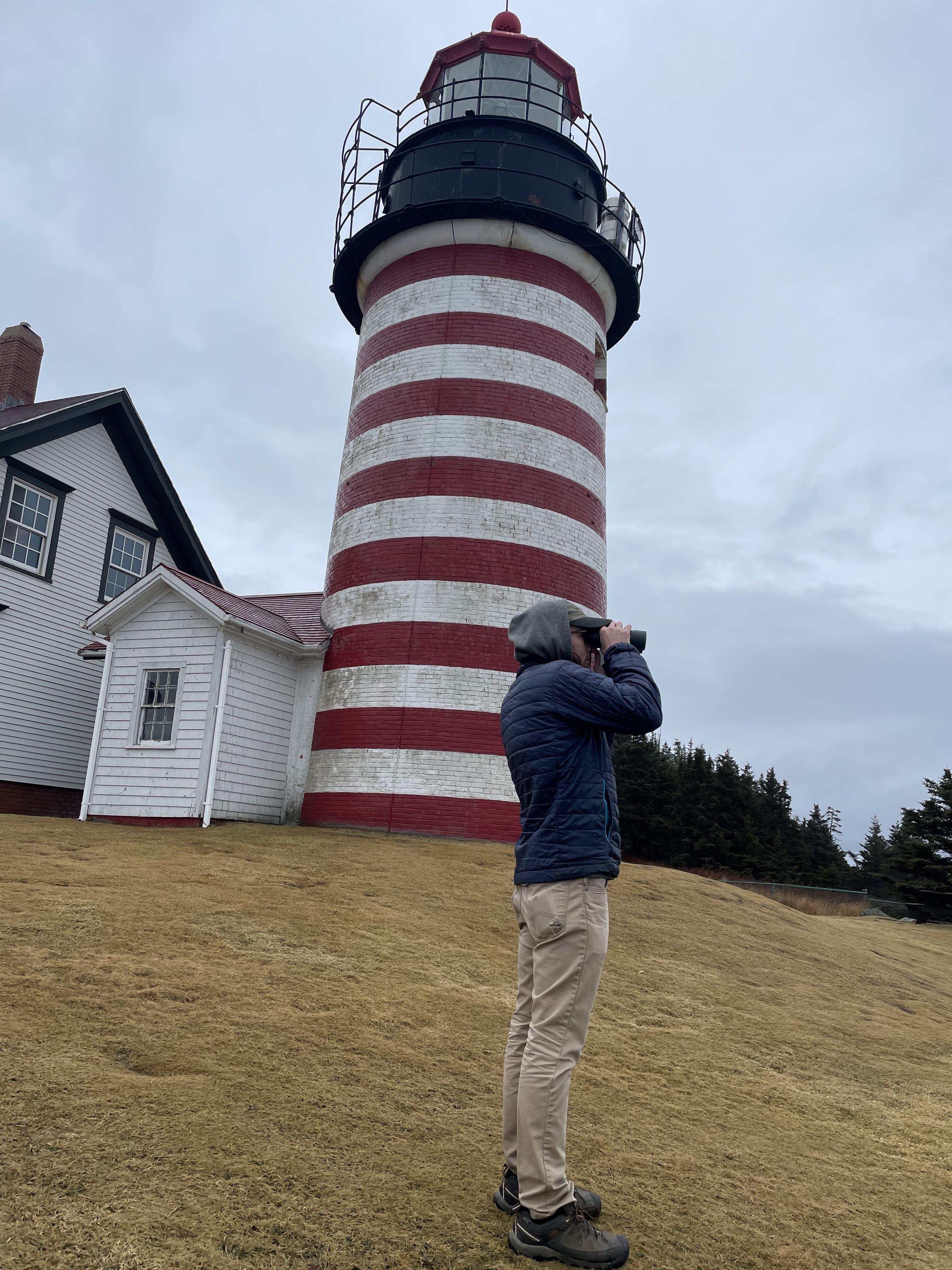
OK, here's where the ish hit the fan a little bit. After a few weeks of nice weather, Maine got absolutely slammed by a ice and snowstorm. Up north it was pure snow, so things were fine, but along the coast it was snow and then rain and it froze overnight. We woke up to no power and everything coated in ice. Thousands of trees and limbs were down across the state, and everywhere you go there are branches and things across the road. People are still cleaning up. I didn't have any way of making coffee, so I took off across multiple towns and eventually found a gas station by the Portland airport. But I saw a few birds along the way.

March 24 - Greely Rd., Cumberland

80. Wilson's Snipe

A bunch of early migrants were really put off by the snow and ice. I drove past a field that Killdeer love and found them all just standing there on the ice, not sure of what to do. A mile or so later I passed a little wetland that sometimes holds ducks and herons, and spotted this Wilson's Snipe -- a good bird for March -- flying around and standing on the shore. Good bird.

March 24 - My house, Cumberland

81. Dickcissel

The bird of the month. The feeders in my backyard were bumping that Sunday, as is typical after a big snowfall when all the other food is covered up. I was stocking lots of seed and mealworms, and took a few minutes to stand in the frame of my back garage door to enjoy the flock. I happened to glance up into the top of this Alder Buckthorn at the side of my yard and saw a yellow and black bird sitting toward the back. A Dickcissel! Yard bird! Completely unexpected, and I wouldn't have seen it at all if I hadn't been standing exactly where I was - a place I never stand. I couldn't have seen it from inside, I don't think. I had my camera with me because I was shooting the flock, and so managed a couple of terrible, obscured photos. The bird left after just a few seconds. It never came to the feeders at all that I could tell, and I never saw it again. 

March 25 - My house, Cumberland

82. Hairy Woodpecker

March 25 - Higgins Beach, Scarborough

83. Piping Plover

It's always amazing to me that Piping Plovers return in March. 

March 25 - Portland

84. Fish Crow

I was at Dick's Sporting Goods getting something for my son's birthday and heard this bird calling from the corner of a building.

March 30 - Gray

85. Horned Lark

I sped up to Gray quickly to try to see a pair of Sandhill Cranes that had been hanging out for a few days. I pulled up to see my friend Michael's truck pulled over to the side of the road! He was also looking! The goddamn cranes weren't there! Dang! But we got some Horned Larks.

March 30 - North Yarmouth

86. Bohemian Waxwings

On the way home from the crane dip I saw a flock of Bohemian Waxwings at the side of some random road! I slammed on the breaks and pulled over in front of some house to confirm the ID!

March 30 - Highland Rd. Brunswick

87. Northern Pintail

88. American Kestrel

March 30 is crunch time. I had a bunch of birds left to get to 100 and no time to get them. I emailed a friend in Brunswick, Gordon Smith, and he sent me a bunch of good recommendations for his area for some final birds. These two were good pulls just a few hundred yards from each other.

March 30 - Brunswick Executive Airport

89. Eastern Meadowlark

March 31 - Dyer Point, Cape Elizabeth

90. Red-necked Grebe

91. Double-crested Cormorant

The last day of the month and 11 birds to go. My birthday. My wife let me take the entire day off, and friends agreed to join me to help me get the remaining species, if we could. 11 is a LOT for one day this late in the month, and we were really hoping that some migrants had come in overnight. Ed and I started in Cape Elizabeth at 6:30am, and got these two birds. The hunt was on.

March 31 - Trundy Point, Cape Elizabeth

92. Purple Sandpiper

Dipped on these birds several times this month, but finally caught up to this flock at a lovely spot I'd never been to before. 

March 31 - Kettle Cove, Cape Elizabeth

93. Golden-crowned Kinglet

94. Great Blue Heron

March 31 - Black Point Rd., Scarborough

95. Belted Kingfisher

March 31 - Scarborough Marsh

96. Savannah Sparrow

97. Glossy Ibis

98. Tree Swallow

The sparrow and the ibis were great spots by Ed. Wind was picking up at this point and birds were slow, but these were huge to get us to 98. Striking distance, but few reliable options left. Northern Shoveler? Not reported in days. Peregrine Falcon? No good single spot. Purple Finches? Absent this winter. Pine and Yellow-rumped Wablers? Still a few days away. We decided to drive up into Falmouth for a reliable Wood Duck spot and hoped to get lucky on a final species.

March 31 - River Point Conservation Area - Falmouth

99. Wood Duck
100. Sharp-shinned Hawk

I showed up to River Point after than Ed and Michael because I'd stopped in Cape Elizabeth on a fruitless search for Ruddy Ducks. As I was walking down to meet them a Wood Duck buzzed overhead. Number 99, and one that only I saw. We were close, but had few ideas. We poked around for Winter Wren, Yellow-bellied Sapsucker, and Hermit Thrush. Nothing. We were exhausted and wanted to go take naps. I was searching eBird and considered heading out to check out a Red-shouldered Hawk report in some random yard in Yarmouth. We paused on the bridge over the railroad and scanned the skies. All day we'd been looking for migrating raptors, but the wind picked up from the north and seemed to quiet the skies. But then there it was - an accipter in the distance. It looked small, small-headed, and flappy. We agreed: Sharp-shinned. Number 100! We'd done it! We celebrated and went home to relax for a few minutes before all joining again for a birthday dinner. What a fun day to cap a fun month.


Friday, April 15, 2022

700 Quest! Part II: 700 Quest!


Click here for Part 1 of 700 Quest!

I came home from Texas with 699 ABA birds and with no idea how long I'd have to wait for 700. What could it be? Would I make a trip to Canadian breeding grounds to finally connect with a Connecticut Warbler? Could I talk my wife into taking our son on a one-in-a-lifetime vacation to Oklahoma to see a Lesser Prairie-chicken? When and how??

The answer, it turns out, was six days.

On the afternoon of Thursday February 17, a text message from my ol buddy and Maine Audubon colleague Doug Hitchcox popped up in the group thread. He asked a simple question, about whether I'd ever seen a Common Gull. No, I replied, I had only seen a Short-billed Gull, the American species that was recently recognized after splitting Mew Gull into Short-billed and Common. Oh, he replied, well a Common was just seen in Washington County, Maine. Eyeball emojis followed. If I could connect, it'd be 700.

My god. Despite the fact that this bird was just a few hours' drive away, I was on the fence. I'd have to take a day off work, and I'd just cashed in some "Can you please take care of our son while I go chase birds" chips the week before with my Texas trip. Looking back through the text messages I wasn't sure I could or should go. I had plenty of excuses: the weather was going to be crummy; the bird probably wouldn't stick around; it was too far; maybe waiting another day until the weekend was a better idea. Etc.

But this is why Doug is the best. Doug was the first birding friend I ever made - the only other person under the age of 50 at Evergreen Cemetery when I met him by the ponds in 2008. We bonded immediately and began chasing birds together - first to Massachusetts for an Ivory Gull, and later to Florida, Texas, and all across Maine. In that time I've watched him grow from a bird (and beer) obsessed kid to a bird-obsessed professional, one of the best and most respected and without a doubt the most beloved birder in Maine. 

Plus he's dedicated to chasing birds, and as a result is just two birds away from hitting 400 in the state, an incredible milestone only achieved by one or two people in history. Much of that success, I think, is because Doug has a simple but effective rule for chasing: go, and go now. Don't wait around. Don't wait for a better or more convenient day. Go get the bird as soon as you can.

And that's what he did to me. From our texts: "But would it return there in the rain?" I asked, cowardly. "I don't know. Gulls will keep foraging in the rain." He replied. "Hahaha I don't know either. I'd love to get 700 with you but everything else about this bites," I said, stupidly, using a term from, what, 1992? "Let's just go for it." He said, smartly. "fuck ok" I capitulated. It was on.

We met at the wretched hour of 4:30AM at an unremarkable park-n-ride near Gray, Maine and headed north. The bird had been spotted in Eastport, the absolute furthest eastern town - Downeastern, really - on Maine's map. We set off in the rain and drive into the dawn, quickly and painlessly making our way to the spot where the bird had been seen the day before.

The weather was not helpful. It was howling wind, like a can't-open-my-eyes-or-the-car-door type wind. Rain was pelting us sideways. Gulls were swirling all around us, riding the wind in huge messy flocks, mostly distant and out of view. For a bird like a Common Gull, which looks remarkably like a Ring-billed Gull, picking it out of a flock like that -- if it even was still around -- would have been impossible. 

(I should say that a species is a species is a species, but Common Gull isn't exactly the most exciting bird there is as far as 700s go. It is a recently split, and looks for all the world like a stunted Ring-bill, which is perhaps the boringest bird on the planet with all due respect. Some friends urged my not to go after a Common Gull for 700 because it's so lame. But it's a species, and a cool vagrant, and a perfect representation of life on Earth! Let's go!)

Doug and I scanned the small flock of Ring-billed on the grassy lawn where the bird had been seen the day before but didn't see anything. We weren't sure what to do, but then a car parked a ways up ahead of us turned around and drove down towards us. It was a birder. "You're the Birdist, right?" the driver said. "Do you see it? It's that one right there, right?" He pointed to a bird we must have scanned over towards the back of the flock, and we took a closer look. Sure enough. Common Gull, ABA 700.


We watched the bird for as long as we could tolerate the wind and rain. I got some terrible pictures, and Doug (as always) got some better ones, found here. We did it.

The birder in the car was none other than Seymore Gulls, aka PDXbirder, the birder, artist, and field guide author from Portland, Oregon. He was in town to see the Steller's Sea Eagle, which was still present off and on in the Boothbay area. But the eagle was unreliable and a Common Gull was probably less likely to show up in Oregon, so he bombed up from the Midcoast even earlier than we had. 

And thank goodness for it. 700! It felt good. A relief, mostly, that I didn't have to be nagged by getting to this big number, or felt obligated to spend time and money chasing some bird that I didn't really care about, and could focus my attention on birding in places I really want to. Mission accomplished, and now time to start some new missions.

We bid farewell to the bird and kept going. Seymore wanted to try to find a Spruce Grouse and I'm always down for that, so we checked Boot Head Preserve but came up very empty (raven, BCCH, and HERG and that's it). Seymore headed south to find the eagle (successfully!), and Doug and I checked around a bit. 

We found ourselves at Quoddy Head State Park, a Maine landmark that I'd somehow never visited before. It's the easternmost point of land in the US, and just a gorgeous spot. The birding was OK, but the scenery was amazing -- the waves were huge and dramatic. It was a nice moment for me, and reminded me of just what I love the most about birding. It's not necessarily the birds themselves, it's the places they take me. Just a week before I was standing on the banks of the Rio Grande among palms and mesquite near the southernmost point in Texas, and here I was a week later breathing the salt air looking across a wintery bay towards Canada. Birding is an adventure, from number one through number 700 and beyond. I can't wait to keep going.


Thursday, March 24, 2022

700 Quest! Part I: 699 Quest


For as long as I've been birding in the U.S., 700 was the number. Hitting 700 meant that you'd been everywhere, and seen most everything. I've been on a slow march towards 700 for a long time now, but, as any birder knows, it gets harder the closer you get. I saw 500 species in my first 5 years of birding, getting a Kentucky Warbler for my 500th ABA species in north Mississippi in early 2011. 600 was two years later -- still a pretty good clip -- a Gray Vireo in southern California. 

Things slowed after that. I got 12 ABA birds in 2016, 11 in 2017, 1 in 2018, 0 in 2019, 3 in 2020, and 3 in 2021. There just weren't a lot of birds I could see without a lot of effort and expense, two things in short supply with a youngster in the house. At the beginning of 2022 I was sitting at 697 ABA birds and after two years of pandemic madness I was itching to get moving.

Plus, I wanted to hit 700 so I could start focusing elsewhere. In my younger birding days, international birding seemed somehow impossibly complicated and exotic. The U.S. was big enough. But that's changed, and the lure of totally unique birds and big trip lists has overtaken everything else. 

But I was within striking distance of 700, and wanted to cross that finish line. Texas obliged, and at the beginning of 2022 there were 4 lifers hanging around the Lower Rio Grande Valley pretty regularly - a Bat Falcon (!), Social Flycatcher (!), Golden-crowned Warbler, and Crimson-collared Grosbeak. I could do it in a long weekend, I thought. My wife acceded, and I booked it. 

I texted my birding dudes in case anyone wanted to join. They couldn't. I prepared to go alone. (I love birding alone and was fine with it, and it felt actually like a full-circle completion to U.S. listing, where I birded alone for years before meeting birding friends.) But the day before I left I texted the group again and talked about my preparations. My friend Ed texted back - wait are you actually going? I thought you were joking. No, I'm going. Want to come? Leaving tomorrow. Yes. Incredible. Ed's a great birder and one of the best guys and had never been to Texas before, and all of a sudden this trip just got a lot more fun.

The flights down were uneventful, and we met in San Antonio at about the same time despite taking different airlines. We grabbed a car and drove the always-long-than-you-remember trip straight south to McAllen. We headed straight to Santa Ana NWR hoping to catch the Bat Falcon at dusk, but missed. No matter, we were suddenly among the palm trees and cacti in South Texas and life was good. That night we dined at a auto-mechanic-turned-taco-shop, giddy that this was actually happening, happy to be out of the Maine winter, and ready to get some good birds. 

Bat Falcon at Santa Ana

We were up at dawn and headed back to Santa Ana. The Crimson-collared Grosbeak hadn't been seen for a few weeks, so now I needed hit all 3 of the remaining birds to make 700. A tall order, but they'd all been reliable. We waited along the entrance road in front of the Bat Falcon's favorite perch -- a telephone pole above a noisy road -- and - there it was. No one even saw it fly it, it was just there, suddenly, perched on the pole. 

Black-necked Stilt in the morning light at Santa Ana

An incredible bird. The first ABA record, and just an attractive species. We were pleased because sometimes it wasn't cooperative at the telephone pole and birders had to chase it all over the Refuge, but not us. We were in good spirits, and now had time to kill. The Valley Nature Center, where the Golden-crowned Warbler had been hanging out, didn't open for a few hours, so we explored Santa Ana.

young Gray Hawk at Santa Ana

We had the place to ourselves, and spent a beautiful morning walking the trails past spoonbills, stilts, pelicans, kingfishers, woodpeckers, Green Jays, Long-billed Thrashers, Gray Hawks, and a bunch of south Texas specialities. Ed saw the Rio Grande for the first time, and we pondered over this sleepy stretch of river that caused so much heartburn and heartache. 

We made the drive to Valley Nature Center, and walked to the back section into one of those scenes you hate to see as a twitcher: a bunch of birders aimlessly walking around shrugging, saying "haven't seen it yet, not sure where it is." Oh. We poked around for a few minutes and then -- there it was. This tiny warbler came chipping through the dense vegetation, briefly posing for good looks. Golden-crowned Warbler is rare but regular in the LRGV, and I was thrilled to connect. Sitting now on 699.

Golden-crowned Warbler at the Valley Nature Center, ABA 699

We had hit two of our three targets and it was Saturday at noon. We figured we'd walk right into the Social Flycatcher at the University of Texas RGV campus and then have a whole extra day to explore. Our minds raced. Should we head up to Laredo and get the seedeater? Should we go to Aransas NWR and get Whooping Crane, Ed's number one most wanted bird? We were dizzy.

We rolled up the campus and walked to the beautiful resaca habitat. There were a ton of birds around in what proved itself to be a perfect migrant trap, including my lifer Texas Black-throated Gray and Black-throated Green Warblers, and Fulvous Whistling-Duck. But ... there was no flycatcher, and no one had seen it that day. We waited, and walked around. The weather worsened. Brownsville is much closer to the Gulf than McAllen, one of the local birders said, and it's often much windier. It was howling, and raining. We spent six hours at the campus, and left birdless.

We were back at it the next morning, but decided to make a stop at dawn at nearby Eserto Llano before making the hour plus drive back to campus. EBird checklists showed that the Social wasn't really a morning bird, and we wanted to pick up Buff-bellied Hummingbird and White-tipped Dove so we stopped and enjoyed those birds and more before heading back south. 

We arrived to find another stomach-dropping scene: a bunch of birders celebrating and high-fiving after seeing the Social Flycatcher and then seeing "We just saw it, but it's not here now." We had missed it by maybe 10 minutes. At least it was around. We settled in with our hopes renewed.

the best sighting at UTRGV

Six hours later we still hadn't seen it. We'd seen every goddamn bird (and Bobcat) in every goddamn bush in the whole park, but not the Social. Our legs were sore from walking laps. We wanted to do something else. So, stuck on 699 and with no clear next lifer in sight, we bailed. I was so ready. 

Unburdened from the wait, we have a great afternoon of birding. We drove out to Old Port Isabel Rd. and got distant looks at Apolomado Falcon, as well as a number of trip birds including Long-billed Curlew and a bunch of waders. Then we scooted up to a Red-crowned Parrot roost in Brownsville and reveled at the squawking mass on telephone wires right over our heads. We listened to the Super Bowl in Spanish on the way back to the hotel, reveling in the not-Maine-ness of it all. 

Green Jay /heart eyes emoji

We got up early the day of our flight out but didn't have time to head back down to Brownsville, so cranked up towards San Antonio, stopping at a few out-of-the-way places en route. We scored some distant Mountain Plovers (only my second ever) at a random farm field in Frio County, and picked up some nice little common state birds in a park in Castroville. 

I left Texas sitting on 699 with no clear answer for 700. How long would it take? What bird would it be? Connecticut Warbler was the most likely possibility - though would still require a ton of effort - and everything else was a wild card. I'd have to wait and see. 

Turns out, it didn't take long at all. TO BE CONTINUED!

About Us | Site Map | Privacy Policy | Contact Us | Blog Design | 2007 Company Name