Showing posts with label gulls. Show all posts

Friday, April 15, 2022

700 Quest! Part II: 700 Quest!


Click here for Part 1 of 700 Quest!

I came home from Texas with 699 ABA birds and with no idea how long I'd have to wait for 700. What could it be? Would I make a trip to Canadian breeding grounds to finally connect with a Connecticut Warbler? Could I talk my wife into taking our son on a one-in-a-lifetime vacation to Oklahoma to see a Lesser Prairie-chicken? When and how??

The answer, it turns out, was six days.

On the afternoon of Thursday February 17, a text message from my ol buddy and Maine Audubon colleague Doug Hitchcox popped up in the group thread. He asked a simple question, about whether I'd ever seen a Common Gull. No, I replied, I had only seen a Short-billed Gull, the American species that was recently recognized after splitting Mew Gull into Short-billed and Common. Oh, he replied, well a Common was just seen in Washington County, Maine. Eyeball emojis followed. If I could connect, it'd be 700.
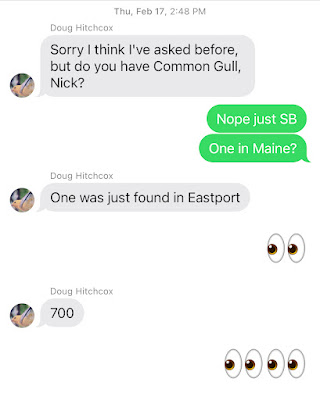
My god. Despite the fact that this bird was just a few hours' drive away, I was on the fence. I'd have to take a day off work, and I'd just cashed in some "Can you please take care of our son while I go chase birds" chips the week before with my Texas trip. Looking back through the text messages I wasn't sure I could or should go. I had plenty of excuses: the weather was going to be crummy; the bird probably wouldn't stick around; it was too far; maybe waiting another day until the weekend was a better idea. Etc.

But this is why Doug is the best. Doug was the first birding friend I ever made - the only other person under the age of 50 at Evergreen Cemetery when I met him by the ponds in 2008. We bonded immediately and began chasing birds together - first to Massachusetts for an Ivory Gull, and later to Florida, Texas, and all across Maine. In that time I've watched him grow from a bird (and beer) obsessed kid to a bird-obsessed professional, one of the best and most respected and without a doubt the most beloved birder in Maine. 

Plus he's dedicated to chasing birds, and as a result is just two birds away from hitting 400 in the state, an incredible milestone only achieved by one or two people in history. Much of that success, I think, is because Doug has a simple but effective rule for chasing: go, and go now. Don't wait around. Don't wait for a better or more convenient day. Go get the bird as soon as you can.

And that's what he did to me. From our texts: "But would it return there in the rain?" I asked, cowardly. "I don't know. Gulls will keep foraging in the rain." He replied. "Hahaha I don't know either. I'd love to get 700 with you but everything else about this bites," I said, stupidly, using a term from, what, 1992? "Let's just go for it." He said, smartly. "fuck ok" I capitulated. It was on.

We met at the wretched hour of 4:30AM at an unremarkable park-n-ride near Gray, Maine and headed north. The bird had been spotted in Eastport, the absolute furthest eastern town - Downeastern, really - on Maine's map. We set off in the rain and drive into the dawn, quickly and painlessly making our way to the spot where the bird had been seen the day before.

The weather was not helpful. It was howling wind, like a can't-open-my-eyes-or-the-car-door type wind. Rain was pelting us sideways. Gulls were swirling all around us, riding the wind in huge messy flocks, mostly distant and out of view. For a bird like a Common Gull, which looks remarkably like a Ring-billed Gull, picking it out of a flock like that -- if it even was still around -- would have been impossible. 

(I should say that a species is a species is a species, but Common Gull isn't exactly the most exciting bird there is as far as 700s go. It is a recently split, and looks for all the world like a stunted Ring-bill, which is perhaps the boringest bird on the planet with all due respect. Some friends urged my not to go after a Common Gull for 700 because it's so lame. But it's a species, and a cool vagrant, and a perfect representation of life on Earth! Let's go!)

Doug and I scanned the small flock of Ring-billed on the grassy lawn where the bird had been seen the day before but didn't see anything. We weren't sure what to do, but then a car parked a ways up ahead of us turned around and drove down towards us. It was a birder. "You're the Birdist, right?" the driver said. "Do you see it? It's that one right there, right?" He pointed to a bird we must have scanned over towards the back of the flock, and we took a closer look. Sure enough. Common Gull, ABA 700.


We watched the bird for as long as we could tolerate the wind and rain. I got some terrible pictures, and Doug (as always) got some better ones, found here. We did it.

The birder in the car was none other than Seymore Gulls, aka PDXbirder, the birder, artist, and field guide author from Portland, Oregon. He was in town to see the Steller's Sea Eagle, which was still present off and on in the Boothbay area. But the eagle was unreliable and a Common Gull was probably less likely to show up in Oregon, so he bombed up from the Midcoast even earlier than we had. 

And thank goodness for it. 700! It felt good. A relief, mostly, that I didn't have to be nagged by getting to this big number, or felt obligated to spend time and money chasing some bird that I didn't really care about, and could focus my attention on birding in places I really want to. Mission accomplished, and now time to start some new missions.

We bid farewell to the bird and kept going. Seymore wanted to try to find a Spruce Grouse and I'm always down for that, so we checked Boot Head Preserve but came up very empty (raven, BCCH, and HERG and that's it). Seymore headed south to find the eagle (successfully!), and Doug and I checked around a bit. 

We found ourselves at Quoddy Head State Park, a Maine landmark that I'd somehow never visited before. It's the easternmost point of land in the US, and just a gorgeous spot. The birding was OK, but the scenery was amazing -- the waves were huge and dramatic. It was a nice moment for me, and reminded me of just what I love the most about birding. It's not necessarily the birds themselves, it's the places they take me. Just a week before I was standing on the banks of the Rio Grande among palms and mesquite near the southernmost point in Texas, and here I was a week later breathing the salt air looking across a wintery bay towards Canada. Birding is an adventure, from number one through number 700 and beyond. I can't wait to keep going.


Monday, February 8, 2016

Birds at Large: Apartments.com Super Bowl Commercial and a Huge Revelation


Everyone, even birders, watches the Super Bowl. And everyone who watches the Super Bowl watches the commercials.

So, lots of birders saw the Apartments.com commercial starring Jeff Goldblum. If you missed it, here it is again.  Pay particular attention to Jeff Goldblum's piano as it's being pulled up the side of the building.


Yep, a gull. Here are some screenshots, in case you missed it.


When happening in real time, it was hard to get a good look at the bird and figure out what it was. It was small, but not immediately familiar. Of course, the Bird Internet being as it is, we were on the case immediately.

I sent out a quick tweet:


Responses started flying. The red bill was something that stood out in people's minds, so...black-headed gull? Laughing? But there was no black on the head, even smudges or spots. My buddy Doug Hitchcox was on the case, too, as birders started to look internationally for an answer:


Within four minutes of the ad being shown, we came to a conclusion: a Silver Gull, the most common gull in Australia. A text from my friend Jason assured me that the North American Gulls Facebook Group - I would link but it's a closed group - had reached the same conclusion even more quickly.

So, how'd the get an Australian gull? Not sure. The ad was created by the RPA agency, based in Santa Monica. No help there.

But some easy Googling helped me to an answer. I did a quick search for companies in LA that lend animals for entertainment productions. A couple click's took me to the website for Benay's Bird and Animal Rentals.  I clicked over to the Wild/Backyard Type Birds page and scrolled down to gulls and, there you have it: a silver gull.  Mystery solved. 

But wait, there's more. 

Complaining about the miscasting of birds in television and the movies is a foundation of what I do here. I'm constantly annoyed that non-native birds are being passed off as the real deal. So, I wasn't really prepared to read this disclaimer at the top of Benay's Wild/Backyard-Type Birds page:
Due to the Migratory Bird [Treaty] Act, it is ILLEGAL to use our native birds in the United States. So, in order to abide by this FEDERAL law, and also provide man types and varieties of birds that could be used for shots that require birds that look native, we have the LARGEST collection of working, non native species [of] birds to fill that void. To the average person, the birds we have ... would not be odd to see in their backyards. Some of these look similar to our native species!
Holy. Shit.

So, despite my giving grief to what I just figured were careless directors, native birds couldn't be used as actors no matter what!  The apologetic wording of that disclaimer also tells me that directors clearly are looking for native birds, and these guys have to just steer them elsewhere.

I ... I am reeling here. My life has been a lie, a mean lie.  I need to apologize.

Apologies to you, Big Bang Theory.  Sorry, Dos Equis. Mea culpa, Mountain Dew.  Apologies to anyone I've insulted in my long history of insulting for using a non-native bird in something set in the U.S.

Of course, it's not illegal to use the sounds of a native bird. There's still no excuse for that (it's even easier to get right than using animal actors), so y'all still on watch.

Sunday, February 9, 2014

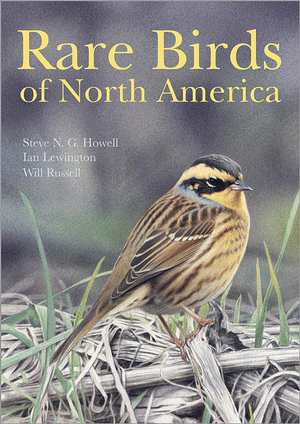
Book Review: Rare Birds of North America


I've never met Steve N. G. Howell, but if I had the opportunity I think I might be too intimidated, and beg off with a fake illness or a made-up death in the family.  You think you're a good birder?  Well, this guy wrote the book on molt.  He literally wrote a book about molt.

At a time when most field guide authors are aiming for the sweet-spot middle with general American bird guides, Howell has cast off ornithological (and financial?) conventions and found a niche taking on especially difficult or outlier birding topics: gulls; petrels; hummingbirds; molt.  He's a bird guide writer's bird guide writer, someone who seems to feel no need to dumb things down for new birders.  He's back at it with Rare Birds of North America, a guide to avian vagrants and vagrancy.

It's mouthwatering ground to cover.  Howell, along with coauthors Ian Lewington and Will Russell, cover 262 species of American vagrants, detailing their plumage and habits, of course, but more importantly the potential reasons behind their vagrancy patterns.  In fact, the "Migration and Vagrancy in Birds" chapter at the beginning is worth the sticker price all by itself.  For hardcore birders, it's the kind of book that makes you want to stop reading, and I mean that in a good way.

But it ain't perfect.  As with some of Howell's other titles, especially Gulls of the Americas, it's organized fairly unhelpfully.  [A quick note on Gulls of the Americas: can we please get a reworked and updated edition?  No group needs a comprehensive ID guide more than gulls, but GotA needs a lot of fixing.  My two cents: better photos (with illustrated plates for guidance), better organization, and drop the South American birds.] In Rare Birds, species are broken up into groups, such as Wading Birds or Aerial Landbirds, and then those groups are typically broken up again into those species originating in the Old World and the New World.  The effect of the New World/Old World split is disorienting - for example, there are sections of flycatchers separated by 58 pages of Old World robins, warblers and wagtails - without being useful.  Additionally, the book lacks usefulness as an identification guide because of its sparse treatment, both in plates and in print, of "similar species."

Rare Birds of North America continues Howell's brave exploration into areas of birding heretofore unknown in print.  Though this book is imperfect, and will likely become outdated as a reference as new records pile up, it's a bold examination of the science behind vagrancy, and will hopefully push some birders to find noteworthy additions of their own.


Monday, February 2, 2009

Dog Bar Gulls


Okay here's a look at the gulls I see on this breakwater. Click on the picture to enlarge.


Friday, January 30, 2009

What Gulls Do You See?


This is a picture of the Dog Bar breakwater, outside of Gloucester, Mass. As a guy used to seeing only white-winged gull at a time, I as amazed at how many were on this single breakwater. How many white-winged gulls can you find? (Click to enlarge)


While I'm at it, here are a lot of other, better pictures taken by Doug Hitchcox from our Mass/Ivory Gull trip last weekend. Why are there no Ivory Gull pictures? Because when we finally got to Plymouth, the bird was, like, a mile out and the arctic wind was blowing at 400 miles per second, slicing through my skin and turning my marrow into icicles. Hey, we saw it, though. Other than that slight disappointment, it was a great day.

Sunday, November 2, 2008

Birds at Large VI: Mark Trail


The other day I broke down and bought the Peterson Gulls of the Americas book (review to come later, probably).  I've looked through the thing a ton of times since it arrived, and darn if I can't find either of the two gull species that appear in the above Mark Trail strip.  

I mean, let's think about it.  It looks like the two birds on the left of the second cell (the detailed ones, not the faraway ones above the people) appear to be the same: white-headed gull, no black on the wingtips, unmarked bill.  What could that be?  The lack of color on the wingtips could indicate an adult Iceland Gull or Glaucous Gull, but both of those species have bright red gonys spots.  

As for the rightmost gull, the one with the black head (or, as Peterson puts it, the "masked" bird), the combination of black head, black bill and unmarked wingtips leaves an adult Little Gull as the only possibility.  

So Mark Trail has apparently found himself on a pier with two aberrant-billed white-winged gulls and an unusually large Little Gull.  Holy Moses, Mark!  Alert someone!  Ditch that boring chick and put something out to the listserv!  If you want to protect natural resources for future generations, you better start with this magical, rare-gull attracting pier!

Much more probable is my assumption that Jack Elrod just drew generic gulls thinking that no one would notice.  Well, guess what, I noticed.   Mr. Elrod, I implore you, as this nation's preeminent naturalist/cartoonist you have a duty to present your drawings with the highest of accuracy!  How are kids going to know to value our national resources when they're presented inaccurately?  

I mean, how hard is it to stick a little gonys spot on there?  

Wednesday, January 23, 2008

Interview with Clare Kines of Arctic Bay, Nunavut


I live in Maine. It's cold. Clare Kines lives in Arctic Bay, Nunavut, Canada. It's very cold. Arctic Bay makes Maine look like Ecuador. But, Arctic Bay's got birds.

And you can go to Clare Kines on your way to find them. In addition to being the author of The House blog, Clare and his wife run a bed and breakfast from which you can launch tours into the bird-laced tundra.

Clare and I talked about life above the Arctic Circle, the wonderful assortment of birds to be found near Arctic Bay and, sadly, Clare's first-hand account of global warming.

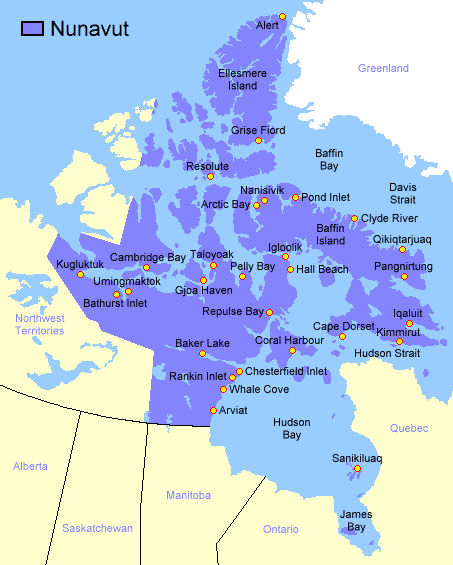
Map of Nunavut

On the map above, look at the northwest tip of Baffin Island for the town of Arctic Bay.

Where exactly are you located, and how long have you been leading birding tours there?

I live at the north end of Baffin Island, in Canada's High Arctic, in a beautiful little hamlet called Arctic Bay. It's about 700 kilometres north of the Arctic Circle at 73 degrees north. Truly one of the magical places in the world. I've lived up here for going on 9 years. I'm a retired member of the Royal Canadian Mounted Police and I was posted here for the last four years of my service. I met my wife here, and love is as good a reason as any to settle in a place.

I don't really lead bird tours per se. Leah and I own and operate Kiggavik Bed and Breakfast. I'm "the bird guy" around town and so I end up facilitating people who are interested in birds or birding. Originally we intended on offering some package tours to the Floe Edge, and a Wildflower/Cultural tour but the B&B has taken more of our energies than we anticipated. There haven't been a lot of visitors up here specifically seeking birds but when there are, we provide advice, point them in the right directions or take them to good locations, and make arrangements for guides to the Floe Edge in the right season. In general those that have come up here for birds have been professional cinematographers or photographers.

What birds are those pros looking for?

It depends. Some people come up looking for Arctic Gulls, some just general Arctic fauna/scenery.

Arctic gulls like Sabine's and Arctic Terns? What others can be seen up there?

Sorry, havn't had my coffee yet. IVORY GULLS not Arctic Gulls.

Ha I see. Sorry, I forgot that you're a couple hours behind the US east coast. How easy is it to find Ivory Gulls on the north of Baffin Island?

Ivory Gulls are a pretty rare bird, but they can usually be found in the spring on the ice. The numbers vary from year to year. Three springs ago a group that spent a lot of time on the sea ice reported seeing many birds, and had as many as 12 at their camp at once. The following year they only saw three the entire season. They are a bird of the sea ice though and I've only ever seen one from land, about a week after a film crew trying to find them left after failing to. They are a very curious bird and will usually come check you out when you are out on the land.

Anecdotal evidence suggests that their numbers are dropping. About fifteen years ago people would see them often in town here at Arctic Bay and at the dump. That never happens now. A search for a known large nesting colony on the Brodeur Penisula about five years ago failed to find any birds.

Do most of the birders come looking for nesters in the spring/summer? What other unusual birds can be found in the north of Baffin Island?

I don't think most are looking for nesters. There is quite a range of Arctic species up here. Depending on the location and the time of year. Out at the Floe Edge one could typically encounter, Ivory Gulls, Black-legged Kittiwakes, Common Eider, King Eider, three species of Jaeger with Pomerine Jaegers being less common, Brant Geese, Glaucous Gulls, Iceland Gulls (I've yet to see a Sabine's Gull here but they are a possibility as they nest not too far from here near Pond Inlet), Thayers Gulls, Guillmots and Thick-billed Murres. Shorebirds include Red Knot.

In Sirmilik National Park on the cliffs north of here there is a very large nesting colony of Northern Fulmer. Closer to home there are the small passerines such as Snow Bunting, Lapland Longspur, Horned Lark, American Pipet, and Northern Wheatear. We of course have Raven up here. We see both Gyrfalcon and Peregrine Falcons here, both nest in the vicinity of Arctic Bay. Rough-legged Hawks can also be found here.

Hmm what else? Red-throated Loon are common here, Yellow-billed Loons farther south, near the base of Admiralty Inlet. Long-Tailed Ducks are common. Ringed Plover are pretty easy to find. Vagrants have included Barn Swallows and White-throated Sparrows. Farther afield one can find Snowy Owls. One can also see Snow Geese and Sandhill Cranes here.

Ivory Gull

Wow I read that list and my mouth starts to water! It is easy to travel to see birds? Is there permanent snow and ice?

No, it just seems that way at times... eight months of winter and four months of poor snowmobiling. We generally lose our snow late May, early June. Sea ice break up starts around mid-july until the first week of August, although it has started happening sooner of late. We can expect the snow to arrive and stay anywhere from the end of August to the beginning of October. Freeze up of the ocean begins around mid-October, although again the last couple of seasons its been happening later and later.

Travel to birds all depends on species and time of year. Earlier trips to the floe edge are easier as there are less and smaller cracks to cross. We have about 40 kms of roads here and there are great spots for some species that have very easy access.

Some species, like Yellow-billed Loon would require travel by boat, or late season travelling by snowmobile which can be very adventurous.

So you've noticed later freezes and earlier thaws. Am I correct in assuming that these are related to global warming? How, in your estimation, has this warming already effected birds in your area?

I'm assuming that the later freezes and earlier thaws are related to climate change. I suppose that the biggest effect that climate change has been with Ivory Gulls. At least some scientists blame part of their decline to a reduction in multiyear ice, something they are closely allied to.

We've seen some unusual birds, but that happens everywhere, and it would be folly to say that that is the effect of climate change. I mean it might be, but it could just be another lost bird. Elsewhere in Nunavut, such as Baker Lake, they are seeing species, such as magpies, that they've not seen before.

Is the warming having an effect on other non-birding aspects of life Arctic Bay?

Well, people are having to wait longer to get out on the ice for hunting and travel, and leave the ice earlier in the spring. Elders say that they can no longer predict what the ice is going to do. There is the risk of the loss of permafrost, and the resultant shifting of the land, along with the houses on it (That hasn't occurred here, but it has in the western arctic I understand).

And if the loss of ice cover continues, the Northwest Passage becomes a viable trade route, which will have a profound effect on the north.

If I were to come on a birding trip to your neck of the woods, what would a day in the field look like?

That would depend greatly on what time of the year it was and what the target species were. A trip in late April, early May, for instance, would probably be a trip by snowmobile about 10 kms from Arctic Bay to 600 foot vertical red cliffs (The St. George Society Cliffs to look for Gyrfalcon, then a further snowmobile ride out into Admiralty Inlet in the hopes of finding Ivory Gulls. It would be cold, but bright, as we would have 24 hour light (24 hour sun arrives around the 7th of May). There wouldn't be a lot of species found at that time of the year. Later on, say late June early July, a trip to the Floe Edge would have to be an overnight trip, it would be an extremely long tiring day trip. Depending on conditions and how far out the Floe Edge would be it would involve a 6-8 hour snowmobile/komatik ride to the Floe Edge. Along the way we'd stop at the nesting colony of Northern Fulmars (something in the neighbourhood of 30,000 to 50,000 pairs). We'd spend time along the Floe Edge, common species would be King Eider, Black-legged Kittiwakes, Glaucous Gulls, Raven, Thick-billed Murres, Black Guillemots, Ivory Gulls (not common but likely), amongst others. Hopefully there would also be Polar Bear and Narwhal.

In mid July land trips would involve driving to some prime areas, (there is an abundance of wildflowers then), nesting Red-throated Loons, Ringed Plover, the smaller passerines. A day hike out to pre-contact Inuit dwellings and above the cliffs would net most of the small passerines, probably Rough-legged Hawk and others. ΓΈ

About Us | Site Map | Privacy Policy | Contact Us | Blog Design | 2007 Company Name