Wednesday, July 18, 2012

Birders: The Central Park Effect


I was finally able to watch the new HBO documentary about birding, Birders: The Central Park Effect, and I just want to say that it was lovely.  It's honest about birding and birders, it's environmental without being preachy, it's celebratory and it's fun.  It's basically the opposite of The Big Year, and, unlike that movie, it made me want to get outside and find some birds.

I've been engaging in some debate in the comment section of 10,000 Birds regarding an article about the movie written by Laura Helmuth that appeared on Slate.  I wrote most of those comments before even seeing the movie (not usually a good idea), but after watching it I feel even more strongly that Helmuth's piece was petty, unnecessary and sensationalist.  You can read my comments on there if you're interested, but my overall point is that Franzen echoes sentiments expressed by several others in the film, and if you leave Birders: The Central Park Effect thinking about anything other than how much you wish it were May 15, you've really missed out.

Monday, July 16, 2012

Birds At Large: The New York Times


The most shamefully-satisfying quirk of birders is pointing out bird-related mistakes in popular culture or media.  We take a perverse pride in our mock-outrage when - for example - we see movie's shot of a bald eagle accompanied by the screaming call of a red-tailed hawk.  It's a phenomenon I like to point out from time to time in these Birds At Large posts.

While the targets of these posts are frequently hurried advertisers or unconcerned sound-effects men, no one is immune.  Not even the New York Times, that pillar of "respectable journalism."  Reprinted below is a screencap from a July 13, 2012 story the Times did on a new HBO movie called Birders: The Central Park Effect.  Notice anything amiss (click to enlarge)?


Yup, the bird in the lower left isn't the Northern mockingbird as identified in the caption, but a gray catbird. 

I don't know what lesson to take from this: I could bemoan the quality of journalism in the world today; I could offer an electronic clap-on-the-back to beleagured ad-men out there and tell them they're not alone in their bird-identification-related challenges; or I could just offer-up a high five to the blogosphere (likely half-swung and mistimed, because we're uncoordinated nerds) for pointing out an error in the great and mighty Times. 

Or I could just get back work.

UPDATE: The caption has been corrected.  I should also point out that the documentary has been getting great reviews, so go check it out.

Saturday, July 14, 2012

Birding Is Like Real-Life Pokemon - And We Could Market It To Kids That Way


I often get asked what drew me to birding.  Other outdoor pursuits like hunting or fishing or snowmobiling don't seem to require an explanation for participation, but people are perplexed by birding.  You just go and look at them?  Have you always wanted to fly?  Are you some sort of scientist?

No, I'm not a scientist.  The reasons why I love birding are many, but the "goal" of it - as I explain it to those inquiring minds - is "to see all the different kinds of birds there are."

"You mean like Pokemon?" One of my delightfully-nerdish friends responded.  "You've 'Gotta Catch 'em All?'"

Now, I don't know anything about Pokemon and didn't know what the hell she was talking about.  But you know what?  Birding is a LOT like a real life version of Pokemon - a worldwide entertainment sensation that is played by, like, a billion kids.  Making that connection explicit to the kids of today - and to the young adults who've outgrown Pokemon's demographic - may be the ticket to get a lot more people participating in and caring about birding.

Pokemon started in 1996 as a video game for Nintendo's Game Boy (n00b alert - I'll be cribbing from Wikipedia for this paragraph).  The game's creator, Satoshi Tajiri-Oniwa, was inspired by his childhood passion of collecting insects.  The thrust of the game is that characters named Trainers walk around in a landscape hoping to encounter - and then capture - wild creatures called Pokemon.  Other stuff happens (apparently) once you have these guys captured, but seeking out all the different iterations of Pokemon is the focus.

Sound familiar?  It sounds a lot like birding to me.  One major difference I can see between birding and Pokemon is that kids around the world have bought more than 200 million Pokemon video games, watched 15 different Pokemon movies, played a trading card game, watched a TV show and generally gone bananas for Pokemon...popularity not at all shared by birding.

Seems like an opportunity to me.  The "nature and environment" aspect of birding is essential, but I am still most attracted to the adventure of it.  I think kids might be too, and if we can draw the comparisons.  There are lots of organizations out there who are encouraging young people to start birding, maybe connecting birding to this Pokemon phenomenon is a good idea.  Who knows, but at the very least, if a kid asks you why you like birding so much, just say Birding - Gotta Catch 'Em All!

Monday, July 2, 2012

How To Make A "Where I've Birded" Map Using Your eBird Data


I've always wanted a map showing just the areas I've birded, but didn't know how to get one.  LONG STORY SHORT: I figured it out.  Check it:

Click on it to make it better (but remember this is just a screenshot, not the interactive Google Map that is actually is).

Want one?  Here's what I did:

  1. Go to eBird > My eBird > Manage My Locations
  2. Make sure you hit "Show All" in the lower right so all of your locations are on one page
  3. Select all the text, and copy it into an Excel spreadsheet
  4. Delete the "in my locs?" "Type" and "# checklists" columns (and any other stray stuff that got in there).
  5. Make sure you have "Location" "Country" "State/Province" and "County" as Row 1 in your spreadsheet, or else insert a new column and add them.  It'll look something like this:
  6. Go to www.BatchGeo.com
  7. Copy your spreadsheet into the big "paste here" box at the BatchGeo homepage.
  8. Go to Validate & Set Options > Advanced Options and make sure that "Enable clustering for high density markers" is NOT checked.
  9. Make the map!  Check it out!
It's pretty cool to see where you've been spending all your birding time (and where you haven't been).  The maps isn't foolproof, and I'm still working out some of the details stemming from oddly-named or inputted eBird checklists (i.e. Washington County, IL shows on the map as Washington, IL - a very different part of the state).  I'm sure you can do a better job than I have, but it's a great way to visualize your birding.

Wednesday, June 20, 2012

How Do Birders Handle High Lists?


Almost as soon after we returned from Arizona, my birding friend and I began plotting our next trip.  He had hit the 600 ABA mark on the trip (the Miller Canyon Spotted Owl), and he confessed to me early in our planning that there weren't a whole lot of places left for him to find a bunch of ABA lifers.  Almost no regular birds remain for him in the eastern U.S., and he's left with planning expensive trips to remote Alaska or guiltily wishing for a major hurricane.  He's 32.

Though I'm still 40 birds and 3 years behind him, I, too, am starting to feel the pressure.  The only regularly-occurring birds in my area are Connecticut Warbler, Long-eared Owl and Little Gull.  Where the world of ABA birds was not long ago something that felt larger than my reach and comprehension, it is now starting to feel like something precious.

I am and always have been an unapologetic lister.  The birding fire was sparked in me not by science (as so many other young birders) but by the promise of adventure and discovery I found inside a used Peterson Field Guide I browsed off a bookstore shelf.  For me, the study of birds and the acquisition of scientific knowledge has always been to serve my drive: to see as many different birds as I could. 

Some birders are ashamed of their listing, but as the engine that has driven my learning, my travel, my experience, my conservation and - really - my life, I am thankful for it.  Now, though, and too soon, I am facing the slowdown of listing.  There are fewer and fewer new birds left, and those are harder (and more expensive) to find. 

Of course, I am not - by the longest of longshots - saying that I have learned all I can learn from birding.  I have a lot to learn from the common birds around me and a long way to go before I would consider myself an "expert" birder.  Likewise, I still love birding even when I don't have lifers to find.  It's just that life birds are the things that keep me dreaming at night.

So, I'm looking for advice.  Obviously I am not the first lister faced with a dwindling pool of new birds.  How do birders cope with it?  Keep perfecting their birding?  Save up and spend on international trips?  Get into photography?

Does it work?

Thursday, June 14, 2012

Aztec v. Inca Dove


There is a very interesting post from David Ringer on 10k Birds right now about the proposal from the famous Dr. Van Remsen to the American Ornithologists' Union's North American Classification Committee to change the common name of the Inca Dove to the Aztec Dove.  The bird's current name, Dr. Remsen argues, is the result of a mistake by the French ornithologist Rene Primevere Lesson, who mixed up the Aztec (who lived in Mexico where the dove is found) and the Incas (who live in South America, where the dove ain't found).

The resulting name of Inca Dove, then, according to Dr. Remsen, is "dumb," "meaningless," "misleading," "ignorant," and "only confirms to Latin Americans how ignorant most Americans are of anything beyond our borders."

I agree with Dr. Remsen to the extent that the name is dumb and meaningless, but I disagree in that I don't think bird names need to be smart and meaningful.  Second, even if we agree that the name should be changed from Inca Dove, I don't think Aztec Dove is the best one to choose.  I want to address just that second point now.

The internet says that the current range of the Inca Dove is approximately this:
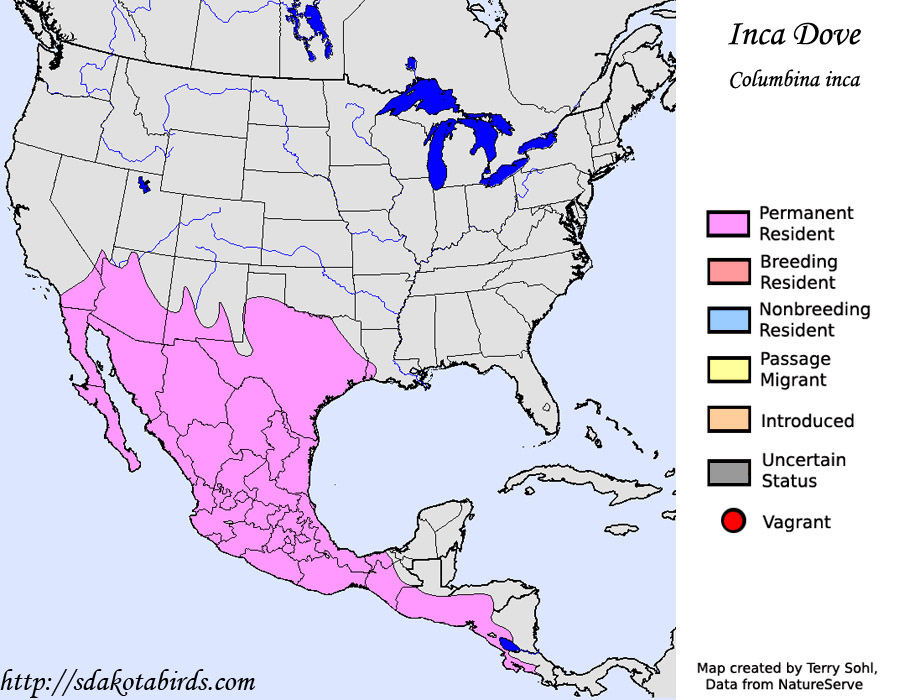
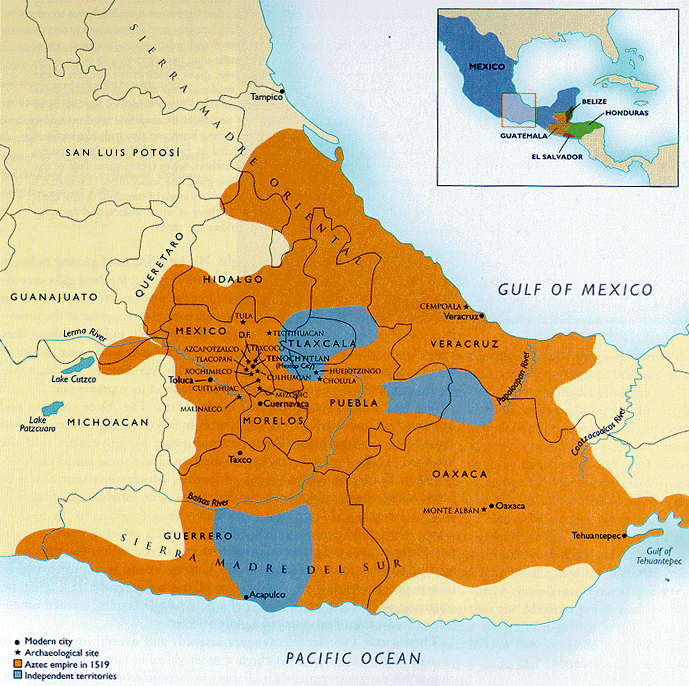
According to the very same internet, the maximum range of the Aztec Empire was this:

So, while the Aztecs ranged over a relatively small area in what is now southern Mexico, the Inca Dove ranges over a much larger area, including all of Mexico, parts of the southern U.S., Guatemala and El Salvador.

Though it is certainly more accurate to call the bird an Aztec Dove than an Inca Dove, calling it an Aztec Dove seems no more accurate than naming it for any of the ancestral people who lived in Inca Dove range, such as the Zacateco, the Tepecanos, the Guachichiles, the Charrizo, the Concho or the Chiricahua.  The reasons given for choosing "Aztec" -- range overlap; it's what Dr. Lesson probably meant; Inca Doves may have been present in Aztec gardens; and, the complex patterns on the dove's back are reminiscent of Aztec art -- seem half-baked, especially when correcting the mistake apparently means proving to Latin Americans that Americans aren't ignorant of everything beyond our borders.

I don't know what a better name for the Inca Dove is, but if we are going to change the name of the Inca Dove to something more accurate and more culturally sensitive, I'd like to make sure we're actually being accurate and culturally sensitive. 

Thursday, June 7, 2012

Southeast Arizona 2012


I typically don't post trip reports, but Arizona was just too good not to.  My buddy Jake and I got over 170 species during the week, including many many lifers (he broke ABA 600 and I broke 550).  Instead of boring you with text, I'll just share some of the pictures I took. 

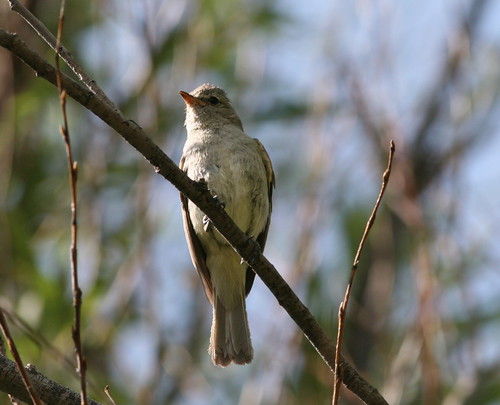
Northern Beardless-tyrannulet - Sycamore Canyon, AZ
Northern Beardless-Tyrannulet

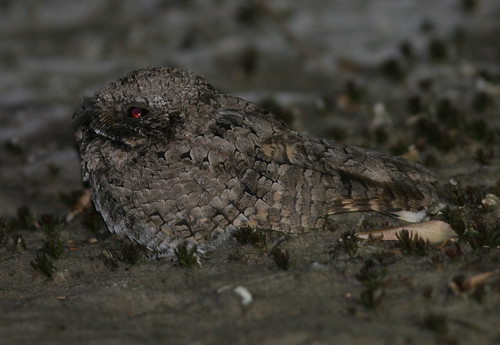
Common Poorwill - Ruby, AZ
Common Poorwill

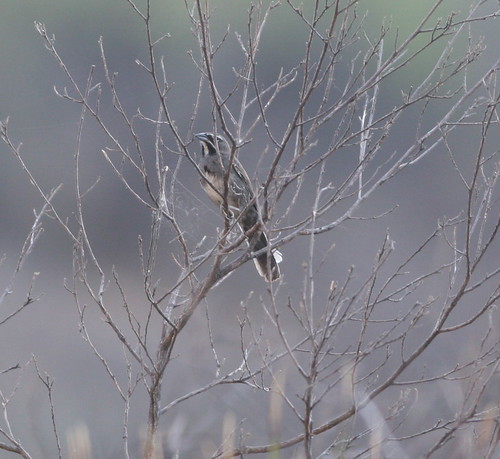
Five-striped Sparrow - California Gulch, AZ
Five-striped Sparrow

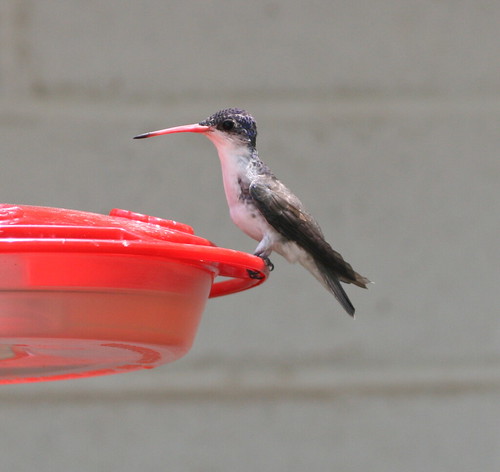
Violet-crowned Hummingbird - Paton's feeders, Patagonia, AZ
Violet-crowned Hummingbird


A BUNCH MORE PICTURES CLICK BELOW

About Us | Site Map | Privacy Policy | Contact Us | Blog Design | 2007 Company Name