Tuesday, July 9, 2013

A WORD ON THE CAPITALIZATION OF BIRD NAMES


It's always bothered me that most media outlets don't capitalize the common names of birds.  I've just never understood why.  It's unnecessarily confusing  - does "I saw a yellow warbler" mean you saw the species Setophaga petechia or that you saw a warbler of the color yellow, like a Prothonotary or Pine Warbler?  

It also strikes me - as a birder - as disrespectful.  Birders are a species-centric bunch.  Field guides are divided into species, each one seeming to be its own separate brick - distinct but accommodating - in the birdlife structure.  Our lists are built by species one-by-one; the Carolina Chickadee only counts once no matter how many individuals you've seen.  To us, the combination of words creating a species' common name is the carrier of meaning, it's the it, it creates - quite literally - a proper noun. (Sometimes even capital letters at the start of the words aren't enough, and we distinguish species in bold or in all-caps.)

To cast that combination of words back among the unwashed lower-case, then, is to rob it of its magic.  To a birder it seems undignified.  To a scientist, though, treating species not as icons but as data (or, more likely, with a much better understanding of the muddy fluidity that is the "species" concept), or to a layperson, who couldn't give a crap either way, the common name is meaningless,  unworthy of extra typeface.

An English professor would explain that the difference is common vs. proper nouns.  The argument is that, basically, the common name of a bird species is not capitalized because there are lots of individuals of that bird.  So, while the words Eastern Bluebird refer to a unique species, they don't refer to a unique bird, and it should be just eastern bluebird.  

I think this is garbage.  Say what you will about common nouns, but there's nothing common about Common Goldeneye: the uncommon combination of those words means the author wasn't referring to some common goldeneye but a Common Goldeneye, an uncommon bird among all birds but one distinct from - and more common than - the uncommon Barrow's Goldeneye.  The "common-ness" of a common noun falls away when it refers to something specific.  

The academic distinction erodes further when talking about brand names.  Under most style guides, Jeep Golden Eagles and Plymouth Road Runners get the royal treatment but golden eagles and greater roadrunners don't.  Why is that?  Like a bird's common name, saying "Plymouth Road Runner" doesn't refer to a single car but a group of alike cars that are somehow distinguishable from others.   You're telling me that some stupid marketer's focus-grouped baloney gets capital letters but living creatures that have literally reshaped their own bodies over thousands of years to better survive harsh and changing environments are "common"?

Look, just capitalize your common species names, OK?  Show a little respect.
Tuesday, June 25, 2013

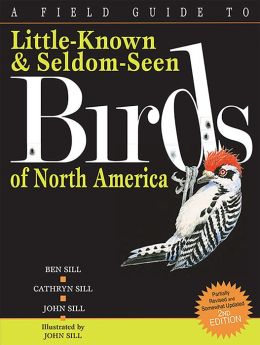
Book Review: A Field Guide to Little-Known and Seldom Seen Birds of North America


A Field Guide to Little-Known and Seldom Seen Birds of North America is just a damn funny, well-observed, thorough and insightful parody, a book that rolls gleefully rolls in the mud of birding nerdiness and comes out squeaky clean.  It's a book seemingly borne out of that familiar feeling of not birding - of being stuck behind a desk or in a classroom thinking about birds and doodling them in the margins of your notebook.  It's imaginative, is what I'm saying, exploring the same sense of wonder that makes birders birders in the first place.


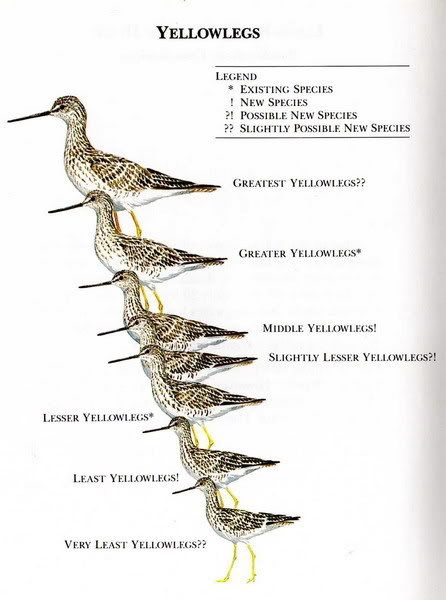
If you hadn't figured it out, it's a field guide to fake birds. Beautifully illustrated by John Sill and authored by John and his almost-certainly relatives Ben and Cathryn Sill (their relationship isn't made clear anywhere in the book), the bulk of the book is made up of fully-fleshed invented species.  Comedically, the species run the gamut from keen birding observations (see: the Middle, Least and Very Least Yellowlegs complex, or the Small Flycatcher) to plumage jokes (see: Military Warbler or Texas Warbler) to straight-up, satisfying puns (see: the Spring Kite, a raptor with a long tail and a diamond shape that perches by tangling in a tree).


It's tempting to skim through and laugh at the illustrations, but the book rewards cover-to-cover reading (or punishes, depending on your stomach for worn-out groaners including the "Under the Bleachers by I.P. Freely" family).  Good riffs on field guide self-seriousness and biologic mumbo-jumbo are there for the taking.  Buy this book and give it to a birder friend of yours, they'll recognize it as the work of kindred spirits.

Tuesday, June 18, 2013

Birds at Large: BBC's Life of Mammals


I am not a religious man but I do have sacred texts. Like the Christian Bible, my texts are comprised of chapters and help explain the origins of life. Unlike the Bible, though, my texts are produced by the BBC and are only available on DVD. They're the series of nature documentarties produced by the God-like David Attanborough: Blue Planet, Life of Birds, Life of Mammals, Life in Cold Blood and Life in the Undergrowth (there are others, too, but those are the ones sacred to me).

In all seriousness, I cannot understate how wonderful these documentaries are. They have absolutely shaped how I view the world. Frankly, it's another post for another time.

I am posting here because I believe there comes a time in every young person's life where be begins to question his beliefs. Perhaps the world he or she is experiencing simply isn't meshing with what is he reading in his or her particular religious text. Questions creep in, faith is tested.

I am not questioning the accuracy of these BBC documentaries, but something is undoubtedbly lost when you hear the ol' "Red-tailed Hawk Noise Used for an Eagle" trope. See the Vine below, for the exact moment.


Sunday, June 16, 2013

Is This Bird ABA Countable?


Hi friends.  There are complicated rules governing whether a bird you've identified in the American Birding Association area is actually countable on your official life/state/patch/whatever list.  I've made a helpful spreadsheet you can use to determine* whether or not your bird counts.


*This is meant for humorous purposes, please work your way through the ABA's rules for countability and exotic populations to determine whether or not you're actually looking at something countable. 

Thursday, May 30, 2013

Raising Money for Bird Conservation - Maine Birder Bands


When the USFWS announces that there are more than 22 million "away-from-home" wildlife watchers in the country - ten million more than there are hunters - the calls for a change in the structure of how federal funding for conservation is directed are becoming harder to ignore.  But just what that change will look like - whether it's a conservation stamp or Administrative directives to wildlife agencies or (slimmest of slim possibilities) federal legislation directing a new or rechanneled source of revenue - is still up for debate, and will take a long time to resolve. 

In the meantime, though, some states have taken the initiative.  A few months ago I received my fifth annual Maine Birder Band.  The program was started by the Maine Department of Inland Fisheries and Wildlife to establish a dedicated revenue stream to protect Maine's birds, bird habitat and access for birders.

The idea is simple.  For $20 the state will send you a colorful metal band (like a bird's leg band) to attach to your binocular strap.  If you lose your binoculars, the good citizen who finds them can call the number on the band, and the state can contact you to let you know they're found.  Everyone wins - the state gets money for bird-related conservation, I get some security for my binoculars and a conversation starter when I'm standing at some feeder with a stranger waiting for the vagrant to show back up.


The Maine Birder Band website lists Kennebunk Plains (best place in Maine to find Upland Sandpipers), Brownfield Bog (ditto for Yellow-throated Vireo) and Messalonskee Lake (ditto for Black Tern and Sandhill Cranes) among the locations where funds have been deployed - and I couldn't be happier.  There isn't much in the way of hunting at these locations, and they could easily be overlooked by a game-oriented wildlife agency.  So, kudos for the Great State of Maine, and get your birder band today.

Birds at Large: Dos Equis


I don't always fly with geese, but when I do, they're Barnacle Geese.


whole commercial here.


Wednesday, May 22, 2013

Visions of Birding's Unchanged Past and Unrealized Future


I had the opportunity tonight to riffle through some old copies of Audubon magazine tonight, and I especially enjoyed the old advertisements. Birding always seems to be an underdog, on the cusp of mainstream acceptance - "one of the fastest growing activities!" they say - and so it was nice to see these old magazines and remember that this is a hobby with a full-bodied history.

The magazine I was looking at was from 1960, and featured a beautiful cover design (and the black-and-white photo was apt for the Gray Jay on the cover):


There were a couple of ads that I liked because they're still products that birders buy all the time. The problem of keeping squirrels off feeders will never go away, though I don't know how much I'd want my bird feeders making loud buzzing noises all the time...


About Us | Site Map | Privacy Policy | Contact Us | Blog Design | 2007 Company Name