Showing posts with label audubon. Show all posts

Sunday, October 10, 2021

Interview with Birder / Pro Skateboarder Dave Mull


Skateboarding is the best thing in part because I don't know what kind of thing it is. A sport? Not really. A hobby? Doesn't seem strong enough. A ... thing?

Whatever it is, it's the best. It's athletic, but not competitive. It's as technical as gymnastics and as dangerous as football, but isn't full of meatheads. It's artistic, in that there are different ways to execute the same thing and each skater has his own style, or take on the same trick. Plus, as artists do, skaters look at the world differently than the rest of us - seeing the inescapable built environment as things to slide down or jump over or whatever. I just love it.

My brother, Alex, is a great skateboarder. Always has been. I am not, because I have no balance. But we've always enjoyed skateboarding together, and he regularly sends me videos and clips to watch to keep my appraised of the latest. A couple of years ago he started sending me clips from a company called Worble, who was putting out videos based around a dude named Manramp: an anonymous guy in overalls who carried around a piece of plywood to act as a moving feature. A man ramp. They videos ruled, and had a great soundtrack, and featured a long-haired skater named Dave Mull.

Alex sent me a couple more Worble videos and Dave Mull clips and I kept noticing something: there are, like, a bunch of birds in here. There was that Manramp intro where he's got a hawk on his arm. There was an Acorn Woodpecker in the stump jump B-side video, there was a young Red-tail ... I am used to seeing 0 birds in skate videos but now I am seeing birds. Then, Alex send a 2018 interview Mull did with Thrasher (uh, the skate magazine, not the Mimidae), and my suspicions were confirmed: Dave Mull is a birder.

I immediately knew I needed to interview him for Audubon, as I firmly believe in the mission of frantically pointing and waving when I find a birder who is outside whatever you want to think the traditional stereotype of a "birder" is. Dave Mull, pro skateboarder, is certainly outside it. I really enjoyed interviewing him for the National Audubon website.

<iframe width="560" height="315" src="https://www.youtube.com/embed/kWhyPZgiXI8" title="YouTube video player" frameborder="0" allow="accelerometer; autoplay; clipboard-write; encrypted-media; gyroscope; picture-in-picture" allowfullscreen></iframe>


Tuesday, May 14, 2019

Birding Game of Thrones


Wanted to make sure you all saw my recent post on birds seen and heard (mostly heard) in Game of Thrones. It was a lot of fun to write, especially because I was able to connect with the show's Supervising Sound Editor, Tim Kimmel.


As a cursed soul who spends more time than maybe anyone else thinking and getting upset over birds singing in the background of TV and movies (see Birds at Large), hearing from Kimmel about his process on the show was a revelation. 

A lot more effort and thinking goes into the background birds in Game of Thrones than it may seem. With so few people paying attention to those noises, it was easy for me to think that their inclusion and selection was a real afterthought for the production team. It certainly seems that way for other show and movies. Game of Thrones has always been different -- even though it's set in a fantasy world the birds are pretty good fits for the scenes: night birds singing at night, prairie birds singing in prairie habitat etc. 

Those things don't happen by accident, of course. Kimmel told me that he sits down with the show's producers and thinks about the setting and mood of a scene, and then finds background noise to match or enhance it. He'll do research on what birds should be where. When there isn't a noise that the producers feel fits, Kimmel will sometimes digitally alter sounds to create new bird songs. (That bit was amazing to me, and made be feel better about all the bird songs I couldn't recognize!) 

I enjoyed writing this piece, and have of course enjoyed watching Game of Thrones. It's set to end this weekend, but hopefully Tim Kimmel will move on to grace other productions with his birds!


Wednesday, February 21, 2018

Swans and Robots


Do you think the words "swan" and "robots" have ever been used in the same sentence before? I can't imagine in what context. Well, there's a first time for everything: I've published two recent articles, one on swans and another on robots, for Audubon.org, and wanted to share them here.


First, with incredible custom artwork by Lilli Carre, is a very silly piece I wrote about the modifications I'd have if I were a birding cyborg robot.


Next, with an image from Lynn Long / Audubon Photography Awards, is a piece encouraging birders to seek out wild swans -- not domesticated pond floaties.

Enjoy!!!

Tuesday, March 14, 2017

Cool Snowy Egret Behavior in Florida


I was down on the west coast of Florida for work a couple weeks ago and had time before my flight on Saturday to sneak out to the Audubon Corkscrew Swamp Sanctuary. It's famous, and so I wanted to check it out.

I had a goddamn blast. It was such a nice departure from the March birding blues here in DC to see tons of warblers, sandhill cranes, crested caracara and a whole bunch of up-close wading birds. March is the height of the dry season, and a lot of the deeper water at Corkscrew -- and all the birds that wade in that water -- were concentrated in just a few pools. Lots of species in close proximity: white ibis, wood stork, roseate spoonbill, and herons and egrets of all kinds.

I was particularly impressed with some Snowy Egret feeding behavior I had never seen before. The Snowies I'm used to fish with what I consider a pretty standard hunt-and-strike heron technique, which includes everything from just standing and waiting for a fish to actively hunting around using those cool yellow feet as stirrers or lures.

But a group of Snowies around one pond were feeding from the wing, flying low across the surface, dragging their toes into the water, and picking up fish that hopped out in front of them. I'd never seen anything like it. Here's are a couple videos (if you listen with sound don't mind all the shutter snaps, there were a lot of photographers on the boardwalk with me):


Cool, right? I had a blast there.

A quick stop later on in Naples for some sought-after Snowy and Wilson's Plover showed my something else I'd never really appreciated before: how well-camouflaged these birds are. I had seen lots of bird reports from this particular beach but didn't seen any birds at all until I stopped at an area sort of scattered with shells and sticks on other debris. "This looks like a perfect place for some birds to hide themselves," I thought. And I was right. There were a whole bunch of each species. Check out these pics to see how well they blended in. The top photo shows the area, and all of the birds are somewhere in there, Where's Waldo? style.


All of those images have two birds in them, can you find 'em?

Southwest Florida birding is the best, man.


Thursday, February 25, 2016

New Audubon Column!


Hi folks! I am excited to announce that I'll be writing a new column, The Birdist's Rules for Birding, to run weekly on Audubon.org. It's aimed at newish birders, and the "bird curious" among us who want to figure out what this hobby is all about. I want to thank my editors over there for giving me this opportunity, it's going to be a blast!

I don't post here too often, I know, but I will continue when I can, or when I have something to say that ain't right for Audubon. Thanks for reading all these years!


Friday, September 18, 2015

Couple things for you to read & enjoy


Thanks to Audubon for letting me do these:
Wilson's Phalarope: The Rebel


John James Audubon: Crazy, Wrong, or Neither?


Monday, August 3, 2015

Black Skimmer and Wilson's Storm-petrel on Audubon Website


I recently posted a couple articles to the ongoing The Sketch series on Audubon.org highlighting quirky, cool birds, this time featuring the Black Skimmer (the only bird with cat eyes!) and the Wilson's Storm-petrel (fishes with its little feet!). Enjoy!


Friday, July 10, 2015

House Sparrows are Little Troopers


I did another piece for Audubon's The Sketch series, this time about the militaristic tendencies of house sparrows. Enjoy!


Monday, June 29, 2015

Audubon's The Sketch: Monk Parakeet


Hi Friends-

The first of a few pieces I am doing for Audubon's new The Sketch series is up, this one about the Monk Parakeet. They're little features about quirky birds, accompanied by a drawing from artist Jason Polan.  A piece on House Sparrows is coming soon, and I'm working on a couple more. Stay tuned, and enjoy!

Sunday, October 7, 2012

Birds at Large Update


It's time for a quick Birds at Large update to show a couple ways birds are being used - and misused - in regular culture.  Yes?  OK.

Maine State Lottery card


The Black-capped Chickadee is Maine's state bird.  The state bird!  And this is how they reproduce it?  Gray flanks?  Black back?  Maine - my beloved home state - should be ashamed of itself.  How are folks going to respect a vaunted institution like gambling if they can't get the details right?

Song Sparrow Interrupts Red Sox - Yankees game

This dazed and confused sparrow made headlines this week by showing up on the Yankee Stadium infield and not leaving. Good way to save $2,600, I suppose. Hope the guy's OK. In other baseball news, the Baltimore Orioles - the team I've long trumped as the best bird-related team in pro sports - is in the playoffs for the first time in over a decade. Good luck, Os!

Anti-Audubon Sign on the Outer Banks

There is a big fight on the Outer Banks these days about limiting the use of off-road vehicles on the beaches where they might interfere with nesting birds. This sign I saw on my way back from a Hatteras pelagic is in reference to the conflict.  Classy stuff!

Monday, January 12, 2009

Interview with Peter Vickery on Ptarmigan in Maine


I was messing around on the internet yesterday and came across the 1905 Journal of the Maine Ornithological Society.  It's pretty interesting reading, both because it's nice to see that people a century ago were just as passionate about birds as we are, and to compare what birds were being seen then and now (check out the writer on page 11 excitedly relating the increasing numbers of Mallards).  


I paused, though, at a sentence on page 3 discussing the taxidermy collection of Mr. Manly Hardy: "Among the Maine novelties is the specimen of Willow Ptarmigan taken at Kenduskeag..."

Iiiiinteresting, I thought.  I had thought before about ptarmigan in Maine and wondered whether they could, or had ever, been established in the state.  Researching a bit more, I discovered a quote from none other than John J. Audubon claiming that Theodore Lincoln of Dennisville (the father of Thomas Lincoln, for whom the Lincoln's Sparrow is named) had shot several ptarmigan in the state and knew where to find others.  


Friday, May 23, 2008

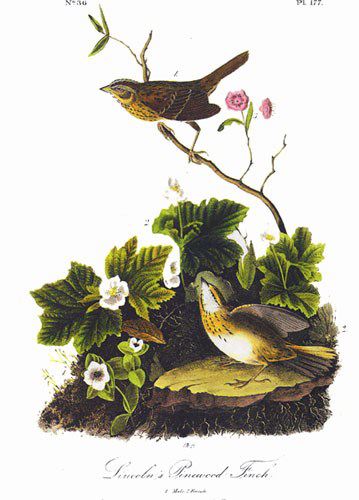
Guys That Birds Are Named After #2: Thomas Lincoln


Ah, Wikipedia! Scourge and savior!

I love Wikipedia and am quick to defend it against those who say it's uncertain or incomplete. Sure, I say, it may not be the best reference for controversial topics like George W. Bush, or the Arctic Refuge Drilling Controversy or Barry Manilow (Trust me, it's true), but what reason could there be to lie about mundane things like Sibbach v. Wilson or, say, Lincoln's sparrow?


No reason that I can think of. Yet, there it was. While I was doing research for this post I clicked on the link (now changed, by me) for Thomas Lincoln, the man James Audubon named Lincoln's Sparrow after. The link brought me here. Lincoln's sparrow named after the future estranged father of Abraham Lincoln?! That's blogger gold!

Fool's gold, however (I'm a great writer). Wikipedia led me astray. Further research - something every good journalist (and me) must always do - allowed me to discover that Audubon's friend who first shot the sparrow that would later bear his name was not Thomas Lincoln, father of Abraham, but Thomas Lincoln of Dennysville, Maine.

Turns out: still gold. Thomas Lincoln was a cool guy. Plus, he's from Maine. Here's what I could find out about him:

According to page 109 of this book, Thomas Lincoln was born in 1812. Thomas came from successful stock, his grandfather being Benjamin Lincoln, a Revolutionary War general, a fatso, the recipient of the sword of surrender at Yorktown, and a friend of George Washington (I knew presidents would be involved somehow). Benjamin's fifth child, Theodore, was Dennysville's first settler, a Harvard graduate, a Judge, and Thomas' father.

Coming from such a prestigious family, it's amazing to me that Thomas is most responsible for the Lincoln (of Dennysville) family name being remembered. While I couldn't find a whole lot about the man himself, what I could find painted a portrait of a man who wasn't quite as exciting as his relatives. According to this page, Thomas was "a successful farmer, taciturn neighbor and a staunch abolitionist." A taciturn neighbor! If, in a hundred years, the only thing people remember me for is being shy around the people who live nearby I'm going to spin in my cremated remains.

Regardless of how infrequently he spoke to his neighbors, Thomas Lincoln will be always be remembered as the man the Lincoln's sparrow is named after. The story is short and sweet: Lincoln, a friend of Audubon's son, hopped aboard Audubon's 1833 trip to Labrador in search of new bird species. One day in June, Audubon heard a song he didn't recognize and challenged his crew to find its singer. Lincoln, being an excellent marksman, shot the little bugger and presented it to Audubon, who named it "Tom's Finch" (or "Lincoln's Pinewood-Finch" as it appears on Audubon's first sketch of the bird) on the spot. Audubon wrote that he named the bird for Lincoln because he was a favorite among the crew, and Thomas was given three cheers for the honor. Good times!


So that's the story of Thomas Lincoln. Being a good Mainer, I wondered whether other "Lincoln" named things in Maine were named for Thomas or the Dennysville Lincolns. Turns out: No. The Town of Lincoln and Lincoln County were named for Enoch Lincoln, Maine's first governor. Also, Fort Gorges, that beautiful creaky deathtrap in Casco Bay, was engineered by a man named Thomas Lincoln Casey. Thanks for all your help, Wikipedia, I'll never say a bad thing about you again.

Friday, January 18, 2008

Interview with Kathryn Burton of Save Our Swans


The Connecticut Audubon is considering asking the State to cull its mute swan populations, claiming that the birds are non-native and are causing damage to coastal environments.

Kathryn Burton, president of Save Our Swans, disagrees with the science behind the CT Audubon's claims, and is ready to fight any effort to control mute swan populations.

Do you believe the Connecticut Audubon's claim that Mute Swans are "wreaking havoc" on coastal ecosystems?

No, and its just not belief, it is verified by a lack of data promised year after year. There certainly has been enough time for Maryland and/or Connecticut to do the studies. Maryland has the USGS and a variety of other experts and Connecticut has University of Connecticut. The "bird man" there, Chris Elphick, who was editor for the new Sibley handbook of birds, sent me an email, which I'll attach. It says he has "read no studies that show major problems with the swans, but if the feds are hell bent on a killing program, then they must do it, quickly." Grant receivers sometimes sell their souls for that money and throw ethics out the window. This is a fact S.Dillon Ripley, who headed Smithsonian and the bird department at Yale, was afraid was happening in the environmental movement and he was right.

As president of a coastal land conservation trust, I am a member of Wetlands International, and a RAMSAR (a U.N. org) associate, also British and American Ornithological Unions and I am very involved in the health of bodies of water, worldwide. On the east coast, we have two bodies of water that are the "poster children" for abused watersheds and dieing coastal areas, the Chesapeake Bay and the Long Island Sound, both suffering from almost four hundred years of abuse from man. Maryland has its chicken and hog farms immediately adjacent to the shore, as well as chemical, paper, and industrial facilities and Connecticut has, I'll name just one company, Pfizer, which dumps 600,000 pounds of solid and liquid waste into the Sound and we have ancient infrastructure that allows non-point pollution to seep into every creek, stream, lake and river unabated, because the state cannot deal with making the citizens do what's right...as usual the problem is both about money and politics.

Because after thirty years of grants being poured into the Chesapeake the situation has never improved, the Federal government, under NOAA, will be taking it over in two years. The problems should not be blamed on any of the more than two million birds that fly through or overwinter there and eat the grasses. It is what birds do and if we had kept it clean both birds and people would be better off.

There are no problems with Mute Swans anywhere else in the seventy countries in which they are found, in fact little England and Holland each have more Mute Swans than we have, here, 20,000 without problems. England, in fact, has created laws to get rid of the degraded lead shot that has been killing off birds for many years and are delighted to announce more swans are there now than before the program started.


Why would Connecticut announce plans to control populations of Mute Swans - a beloved bird in the eyes of the general public - if they weren't actually a threat to coastal waters?

I have the minutes of meetings and decisions made at meetings in which the decision was made to do as a program, what had been done in some areas as "silent takings," by individual agents for a long time. I will be happy to send it to you [Ed. note: tis was not sent] and it does not include discussion of "Problems" presented against the mute swans as a defense. The first activities were the breaking of necks in Yosemite, not on a coastal shoreline or in an eelgrass bed, simply "because they were there."

Remember, five species of swan come onto the American continent, Trumpeter, Whooper, Bewickii, Tundra and Mutes. Whooper and Bewickii are killed on sight by agencies, Tundra are hunted, that leaves Mute and Trumpeter, whose number at 26,000+ is higher than the Mute's number have ever been, by about 10,000.

The decline in hunting numers has created a need for "trophies," and among these, will be the Trumpeter Swan, already hunted during trials in the Pacific Flyway, a program approved years ago by ex president of The Trumpeter Swan Society, Harvey Nelson.

Banko, in the last few pages of The Trumpeter Swan, warns against the hybridization potential if Mutes and Trumpeters fly together, which they do already, in some areas. Hybrids may be good for cars, but the hunters do not want them. The swan family is so close genetically, they can produce fertile offspring as shown by Charles Sibley at Yale.

Anyway, I believe this all started very early on, when the Hudson's Bay workers saw the Mute Swans as a symbol of the crown they were killing themselves to keep wealthy, across the ocean. They were right, but should not have hated the bird for what Henry VIII did by naming the bird "Royal."

The Audubon claims that the reason behind the plan is that Mutes are an invasive species that threaten native species. Do you disagree?

Yes, and they have no proof behind the claim, or it would have surfaced in one of our several cases in federal court. They have only their name, which they are quickly sullying, through a variety of things, like opening up their properties for hunting, just like The Nature Conservancy.

There are 20,000+ Mute Swans in Holland, England, a number of countries smaller than the U.S. without problems. In fact the swans are carefully protected in many. The number has never gone passed 16,000 according to USF&W numbers, provided by the fourteen states in which Mute Swans live.

Mute swans were thought to be non-native in a number of countries, that is brought by man rather than flying in and settling down on their own, which is the agency's definition of "native," but since the 1970s specimens have been found in bogs from thousandsa of years ago, in England, Holland, Sweden among others, showing their historic range remains today.

The fossils found here and studied at Berkeley show a taxa identified in the resultant papers as "very close to Cygnus olor, or as in the case of Arizona, "probably a Mute Swan." the identification is relatively simple as their interior architecture is different, with the windpipe going directly into the lungs, without the long loop back and then out, as seen in the other swans.

Denment'ev, the great Russian scientist in his book Birds of the Soviet Union Vol 2 (1951) put the Mutes in the Russian Maritimes, right across from Alaska a passage used by millions of birds, including Whooper, Bewickii and Whistler, the last two now comingled as "Tundra swan." The Tundras are now hunted here and the Whoopers are shot on sight on state or federal lands. The Trumpeter will face the same future, as an open swan hunting season has been approved by The Trumpeter Swan Society.

Have there been Mute fossils (or other evidence of native populations) found in Connecticut?

No one has looked for them or other birds, I guess because of the vast areas of shale and granite and a very shallow growing medium available. Not much work here, none that I can name, except the dinasauers found in Rocky Hill in the 1930s or 40s.

Until recent time, it was thought that hunting for bird fossils was a waste of time, because the strength of their bones, through leeching of minerals, etc was not thought of. Famous spots, such as the Klamath Basin, Anza Borrega Desert, LaBrea Tar Pits...Paleontology in general has really come a long way, at a time when it is failing in attracting grants and interest from the general public, but amazing things have been found...I work with people in the field and belong to Paleonet, most work is done in China, Russia, etc.

Are you against all avian population control measures or just those affecting swans? If so, why swans?

I'm president of a land trust, member of Brit. Ornithological Union, Waterfowl International, a RAMSAR associate (wetlands), British Animal Ecology, former v.p. of CT Federation of Lakes, started Corporate Friends of CT DEP, I avoid the big groups that have become industries focused on parties or making sweetheart deals for major benefactors. I am interested in ALL birds and live in a spot over a dam, so have quite a great view at all times of the year.

I do not keep a "life list," I am interested in their lives, not a fleeting glimpse. That is one very good thing about the swans, you get a view of their lives unavailable with most passerine...I have an enormous collection of books on birds and ecology sciences. I'm also a member of the Hakluyt Society, a group associated with The Explorers Club. It's a history buff's nirvana, focused on the early explorers and their journals. Hakluyt was a geographer who accompanied John White to Roanoke in 1585, a scientific exploration for Raleigh and his drawings of the flora and fauna are famous and document the presence of many birds and some animals and flowers.

There's one of a mute swan in the collection, attached.

I have to admit that you're correct when you say that most birders are most concerned with getting a "fleeting glimpse" of birds.

However, if you are concerned with the lives of all birds, and what the Audubon scientists are saying is correct (that mute swans habits are threatening the lives of other species), aren't some sort of control measures in order? What other ways could Connecticut keep swans other species living in harmony?


I'll send you the Michael Conover studies on Mute Swans in Connecticut [Ed. note: not sent]. They were quite extensive and show a very different picture from that presented by Audubon, National and local. Conover now works for the federal agency, in Utah or Idaho.

If loss of other birds were a factor, the State should not put out raptors, but especially hybrid raptors, like the Peregrine/Gyre falcons, hawks, owls, etc. especially in areas like Central Park, in Manhattan, where they have never been and have devastated the migrating birds.

The loss of birds is more about man than other birds. It is we who are destroying whole species.

Check out The Bay Journal and you will see major storms, over fishing, too many boats, dumping from chicken and hog farms, DuPont, Champion Paper and a dozen military facilities, all right on the Bay, are polluting it to death. This is not to mention the pollution from people.ΓΈ

About Us | Site Map | Privacy Policy | Contact Us | Blog Design | 2007 Company Name