Monday, November 5, 2007

Interview with Pete Lund, American Crow-talker


Probably the best way to describe my uncle Pete would be to call him a 'character.' Armed with an open mind and a boisterous laugh, Pete has done more in his life than most anyone else I've ever met. Among the hats that Uncle Pete has worn since I've been around include: publisher, singer/songwriter, writer, artist, reggae band keyboardist, mystic, seller of quartz crystal, treasure hunter, cairn-creator and, when I was little, part-time babysitter.

Uncle Pete is also remarkable with animals. Tripper, the dog he had when I was young, was the best-trained dog I've ever met. Pete also took in a standard poodle named Hunter that had proven too wild for my family. When Hunter bit (playfully) one of my brother's friends, Pete volunteered to take in the dog and, in no time at all, had turned the dog into one of the friendliest and most recognizable (thanks in part to the Hunter's new deadlocks) dogs in Portland, Maine.

In addition to dogs, Pete has always been able to interact, mostly through call-and-response, with American Crows. Recently Pete and I exchanged emails about his relationship with crows and his insights into their social behavior.

bDC: Yo, Pete. When did you first begin to understand the social behavior of crows and how did you go about first attempting to participate in their behaviors?

PL: The first real knowledge of the social nature of crows came from two stories that I read when I was quite young. The first was a very touching story about a young boy in a village in Japan who was kind of a social outcast, who, during an opportunity to speak at a village gathering, imitated how the crows' calls sounded depending on what was going on. In particular I remember that he imitated how the crows cawed when a person in the village had died. It changed the villagers ideas about both the boy and the crows.

(This story was reflected in an experience I had when I was 18, when, after leaving a memorial service for a fellow who had passed away, two crows flew down low over us as we left the funeral home, uttering very plaintive, sad-sounding caws.)
I also had, as a young boy, read a short story written by the famous outdoor author, Jack London, where he detailed the social activities of a group of crows. He transcribed different crow calls onto a musical staff. Having been taught to read music, I understood the "danger" call, and I recognized it when I heard crows using it. I tried it out when there were crows around, and they would flee the area while repeating the call when I used it.

The first attempt that the crows made to include me in their interactions that I really noticed was when I was about 35, when two crows flying forty or fifty feet up dive-bombed me (it was a dry run) to about eight feet above my head as I was walking through the middle of the huge empty parking lot near City Hall in downtown Portland. It seemed playful, as they were not harassing me vocally, which they do when they are upset with me.

There are a few events leading up to this, and many thereafter, which serve to document the growing awareness and interactions between me and the crows, which I can expound upon later.

bDC: How did you react to these birds playfully diving you? Did you feel you understood why these birds were acting this way?

PL: When I got over my initial reaction, which was surprise and astonishment, I assumed it was their way of acknowledging me and welcoming me into their extended family, sort of like an fraternity initiation. It made me feel included, and special. It also made me feel happy and lucky. I've never seen or heard of that happening to anybody before.

bDC: After you felt that you were initiated, how did you proceed to interact with crows? Did you continue to see the same pair from the City Hall lot or did you feel a connection with others?

PL: The "initiation" encouraged me to continue to interact with them, of course. My usual method of communicating with the crows is to call to them when I see them, or use my signature piercing whistle. That's whistling with the lips drawn back and the tongue folded over, which carries for quite a ways.

Honestly, I can't tell one crow from another with the exception of the head of the group, who has a distinctive halting call. He uses the call to identify himself when he wishes. I use it back to acknowledge him, or to let the other crows know that I know their group leader, or to see if he's around.

They have several places they hang out in town, on top of a few different buildings.

I used to be too self-conscious to talk to them in public, but once after I saw an old man calling to them I figured, hey, if he doesn't care, why should I? After that I didn't are who was around, I'd just let loose with a few caws when I saw them. Sometimes the crows would jump up in surprise but they got used to it after a while. After they learned I was being friendly and social, they would occasionally put on a show and all come fly high over me, just higher than the buildings, circling and cawing. Once it happened right in front of the police station downtown. It was a riot! Five or six crow can make quite a racket, I was very pleased.

A little while before that, I had seen a young crow, too exhausted to fly anymore, kind of skid down the side of a building right on to the sidewalk. There were people walking by not seeming to notice, but his parent hid in the nearby tree so as not to draw the attention of any predator. I crossed the street and picked up the young crow, then about the size of a robin, looked him in the eyes, cawed gently to him a few times, and put him safely behind a chain-link fence onto the lawn of a church building that used to be across from the old Levinsky's clothing store on Congress St. Then I left, and cawed to his parents to say hi. This was in the springtime.

Early that fall, I saw a crow sitting on the telephone pole at the same location, and, as I watched, he left his perch and flew, hovered in the air for fifteen seconds or so, right over the place I had picked up the young crow. I suddenly thought, this is the same crow I picked up, showing me proudly how well he could fly now. That was cool! It could have been his parents that had dive-bombed me as a way of saying "thanks!".

Once as I walked by a group of high-school students, one of the students cawed. I think I was being teased because I had been noticed talking to the crows in public. I thought it was funny!

The main times I would interact with the crows was when I was walking my dog(s) in the areas away from the inner city where there were a lot more trees and open spaces.

bDC: How did the crows react to Tripper and Hunter?

PL: I don't know exactly how the crows reacted to the dogs. I think it was more a way that the crows identified me, because I usually had one dog or the other, or for a while, both of them, with me. But also they could see that I had dominion over the dogs, that they obeyed me, so the crows had some idea of our relationship.

Tripper (my first dog, a mid-sized terrier mix) loved to speak with a loud "ROOOOOoooo!" anytime I asked him to. He was full of enthusiasm that way. And any time I noticed crows around when I was out walking, I would have him speak. I think the crows took it as a greeting. I hadn't yet started talking to them directly yet.

I think the crows liked Crow-dog ( a standard poodle) because he was black, like the crows. His name was "Hunter" when I got him, when he was three-and-a-half years old.
But he was so independent and headstrong that I couldn't scream "Hunter" fast enough before he got into mischief..

One day I had brought a crow skull and some bones down from up the hill under an apple tree where I had placed a dead crow I'd found on the road, a couple of years before. I had the skull and bones by the front door with intentions of making some kind of artistic arrangement of them on a board to hang on the wall or something. The next morning, after I had let Hunter out, I noticed the bones were gone. He'd eaten them. Just then a crow flew very low over my backyard, cawing. That's when I named him "Crow". It seemed as if the crow knew what had happened. So Crow was actually part crow, seeing as the bones he ate went into his bones, most likely.

bDC: What are your interactions with crows like now? Do you hope to communicate more closely with them as time goes on?

PL: My interactions with the crows are generally less intense than they were in the past. It has settled into a fairly predictable routine. For example, as I crossed the big parking lot close to City Hall yesterday, I gave a loud whistle, and a couple of crows who had been in Lincoln Park flew out and lit on the top of Franklin Towers, which is the tallest building in the area, overlooking that section of the city. From there one of them started calling down to me, and I responded in kind. I stopped walking for a few minutes to watch them and "hang out", then continued my trip to the post office. It's the same way I interact with my neighbors or acquaintances.

I don't really know how I could communicate with them more closely, but if I could, I would. For now it seems enough for both of us to enjoy mutual recognition and appreciation of each other's presence in the world.

Sometimes I wonder about re-incarnation, thinking that it might be cool to come back as a crow. But I don't know about having to sit in a tree by the side of the highway waiting for a car to run over a squirrel.

originally published 9/18/2006
Interview With Kathy Brader of the National Zoo


The National Zoo is on a roll. Last July the city of Washington had their hearts melted by Tai Shan, a baby Giant Panda. In February, the city welcomed another youngster to the Zoo's collection: a North Island Brown Kiwi. Like the panda, the birth of the Kiwi outside its native country is very rare (the last Kiwi born at the National Zoo was in 1975). Also, like the panda, the bird is extremely cute.

I recently swapped emails with Kathy Brader, the Senior Bird Keeper at the Zoo, and she was clearly very proud of her new charge. Like all new mothers, Ms. Brader was eager to swap photos, share the baby's milestones and discuss efforts to preserve the species in its native land (OK, most new mothers don't usually do that last one...). The chick is named Manaia, a Maori work meaning 'Guardian of earth and sky', and is, I repeat, very cute.


birdDC: If you might, give us a little background on Kiwis and the Island Brown Kiwi. How are they doing in the wild? Why is the Island Brown the only Kiwi that can be seen outside of New Zealand?

Kathy Brader: Wow start with a big one! Here goes. Kiwi are one of the most ancient species of birds, they go back about 39 million years and have only ever been found in N.Zealand. They are flightless with small wings, small eyes (though they do see okay), solid bones and two functioning ovaries. They are called the honorary mammal of NZ. They are the only bird with nostrils located at the end of their bill, and the second best sense of smell of any bird.

NZ is about 89 million years old and the only mammal species that occurred there naturally are 3 species of bats. Man has only been on the islands about 1000 years and they are the ones that introduced mammals.

In 1994 DOC (Dept. of Conservation) finished up with the some DNA work on Kiwi and has discovered that there 5 distinct species of Kiwi and two varieties. This may not be the final word on this, more work needs to be done.

North Island Brown Kiwi (Apteryx australis mantelli) is the only species found in collections outside of NZ. When NZ was “giving” out birds as gifts to various governments and zoos the NI Brown Kiwi was the most numerous and most known. When I started working w/Kiwi about 19 years ago there was an estimated 64,000 birds (NI Brown Kiwi) left in the wild, today it stands at about 24,000. They are losing about 4-6% of their population every year and that doubles every decade. Although habitat loss is a factor the biggest problem is the introduction of mammals to the islands.

Kiwi have no defense against mammals, feisty as they are. Dogs are the number one killer of adults, Stoats and cats take the #1 and #2 spot for killing juvies. 90% of all kiwi chicks left in the wild with no protection are predated by 6 months of age. Of the remaining 10% only 5% will make it to two years.

All 5 species (and the 2 varieties) are protected. NI Brown Kiwi are an endangered species. Our recent hatching brings the number of kiwi in the US to 17 birds.

Only 3 species of Kiwi are kept in captivity in NZ zoos. There is a tremendous amount of conservation work going on in NZ to protect all the species.

bDC: Is there anything being done to protect Kiwi on islands with an established population of introduced mammals? Can anything be done? Or perhaps should efforts focus on small, mammal-free islands - as has been the case with conservation efforts for another famous NZ flightless bird, the Kakapo.

KB: Yes the Kiwi has several programs in place including release onto cleaned out islands off shore. There are also large areas on the mainland islands that are fenced in, or areas where intense trapping/poisoning are carried out. Also the program called Operation Nest Egg started in 1994 has proven to be a good booster for populations. This was begun by Dept. of Conservation (DOC) and several zoos (both private and public), local Iwi tribes and paid for by govt funds, private funds and gets a large boost from the Bank of New Zealand (who have the best web site, check it out: (http://www.kiwirecovery.org.nz/Home/). The program removes eggs or chicks from the wild and rears them in captivity to a certain size/weight and releases them back in safe areas, always back to the same area to ensure the genetics are not messed with. This program has been extended to other NZ birds. There is a place in Wellington that was an abandoned water works area (right downtown, built on an earthquake fault line, not a good idea for a dam :) ). Anyways there was this huge area with wonderful trails, woods, ponds, etc, now being farsighted they fenced it in, removed all non native species, except for mice and introduced birds, invertebrates etc back. Lots of native birds came back on their own. They introduced the Little Spotted Kiwi and are now up to over 90 birds, this the first time little spots have been back in the wild on the North Island in 100 years. They have a 500 year plan in place. Its terrific place to bird, local schools use it for nature walks, talks etc. Wonderful place. (http://www.sanctuary.org.nz/ )

Kiwi are used as a flagship species, what ever you do to help them help everyone.

There are captive and wild programs for kiwi. They receive a lot of private support and work very hard to involve local communities in various projects including the local Maori (who consider the Kiwi an elder brother and is revered), remind to dig out the story on how the Kiwi lost his wings.

I am the kiwi advisory to the newly formed Ratite TAG (Taxon Advisory Group, for the AZA). I spent 5 weeks in NZ last year working at zoos, private and public and with DOC regarding different Kiwi issues. It has been very helpful to jump start the overseas group into a more pro active movement to keep Kiwi alive and well for the future in the overseas collections.


bDC: It sounds like the right steps are being taken. It's wonderful to hear promising news on any bird species, especially one as iconic as the Kiwi. Switching gears to the Manaia, the new chick, how did the birth go? Who are Manaia's parents?

KB:The male is named Maori and a wild caught bird that came to us in 1991 from NZ est. to be about 21 years old. The female is Nessus a San Diego hatch bird (1996) about 9years old. This is the first living offspring for both birds. Manaia is the first kiwi in this country (on her mothers side) that is now a 2nd generation bird.

The hatch was early only 64 days. So a big surprise to us all, and it went like clockwork. The chick must have read the protocol, because she does everything right on schedule (thank goodness). We couldnĂ‚’t have asked for a better incubation (except for the hatch being early) and the chicks growth. This morning she was 541grams.

bDC: You say that Manaia is the first living offspring for both of her parents, yet they are both quite old. Is it common for kiwi to wait so long to lay eggs?

KB:Kiwi females usually begin to lay about 4-5 years old, males can start breeding about 2.5 years, though some females have begun to lay about 3.5 years and some males about 2 years. Kiwi live (we believe, time will tell us more) to about 60 years. This pair has been together for about 3.5 years and in captive situations nott's unusual not to have fertility till the 3 or 4th season, this seems to be a captive problem, but not enough research has been done (though research is adding every year to what we know) yet to tell us about the wild situation. This female has been laying eggs since she was about 5 years, though the zoo she was at thought they were all infertile, but again one of the things I learned last year in NZ was that a lot of good eggs get tossed by people who do not know enough about Kiwi eggs. In NZ they actually have two different kiwi incubation classes that they teach(its taught by Dr. Bassett who is doing a lot of research into kiwi incubation techniques, egg problems, etc). My goal is that in about 2-3 years to have a US Kiwi Workshop and to bring in some people from NZ to get us up to speed. They learn stuff every year over there, but a lot of times publications are years behind.

bDC: What's the future for the chick? Is she going to stay with her parents at the zoo or is she destined for somewhere else? and; Who got the choice job of picking the chick's name?

KB: Her name represents a 1/2 bird 1/2 man spirit being who is a messenger to the gods. I picked out a bunch of Maori names and we (with input from the very top) picked that one. Some NZ friends of mine touted it around to some Maori friends of theirs and they all thought it was a great name. They thought what a great name for a bird that is representative of her species to our species. We are eventually go to set her up at the Conservation and Research Center in Front Royal VA (its the zoos offsite area for different endangered species). Eventually when she is at least 3 years old we will introduce a male to her (and hope they like each other). And no problem with all the questions, I do LOVE talking about Kiwi and esp. our newest special girl!

originally published 4/27/2006

Interview With Norm Saunders


Anyone who uses a computer to find information on birds or birding (including reading this blog) owes a lot to Norm Saunders. For nearly 20 years Norm and his wife Fran have been dispensing information on bird sightings, trips and news in the DC area using digital technology. It all started in 1987 when Norm (I tried calling him Mr. Saunders but he wouldn't have it) created The Osprey's Nest (TON), a computer bulletin board system that allowed users to telephone in and listen to messages posted by other callers. It was the first system of its kind in the country dedicated to birding and began what must be called a revolution in birding, where sightings from all over the country can be shared almost instantly through a listserv like Norm's successor to TON, MDOsprey.
I recently asked Norm a few questions about the early days of digital birding, and what the use of digital technology has meant, and will mean, to birdwatching.

bDC: In terms of reporting and sharing sightings, what options were available to a DC-area birder in the days before the start of TON?

NS: There was always the MD Ornithological Society, with its many chapters (most of which maintain loosely-defined phone trees to notify folks of good sightings) and the Northern Virginia Chapter of the Virginia Society of Ornithology (ditto). But if you were a serious up-and-coming birder there was really only one source: the Audubon Naturalist Society’s Voice of the Naturalist.

When I was getting started in birding in 1981, Claudia Wilds was compiling and recording this tape. It was released at 10:00 am every Tuesday morning from Woodend, the ANS Headquarters in Bethesda. One had to make the call (usually more than once) and then take notes like crazy to make sure every last bit of information was wrung out of the week’s recording. Later, as I recall, Claudia had help from Erika Wilson (now retired and living in Arizona), and now a number of people still take on this burdensome task. It was *THE* way for birders who weren’t “connected” to get the necessary information about the really good sightings of the week.

Of course the very best way to get the timeliest information is to be part of the inner circle of birding. There is still a loosely-defined group of 25-30 birders who get the news before everyone else of a rare bird and who get invitations to see birds that are never reported in a public forum, usually because they are on private property or located where hordes of birders simply wouldn’t be welcomed. Most of the birders out there looking for news of good birds have neither the time nor the skills to penetrate this coterie. I suppose this group is necessary to insure that really rare birds get properly validated and recorded, but it’s a fact of life about birding that has never sat well with me and one of the primary reasons I got involved with providing a public birding forum.

bDC: So, once you recognized the need for a better system of reporting birds, how did you chose a computer bulletin board system (BBS)? Home computers and the internet were certainly not as prevalent as they are today, was finding a 'market' for TON a problem?

NS: Oh, that was the easy part. I'm an economist by trade and I always felt the best part about this job was the chance to fool around with the heavy iron of the big mainframes. So I was a sucker for personal computers when they first started appearing in the early 1980s. I wanted to know them inside and out and I wanted to push them to their limits. Shortly after buying my Kaypro II I read an article about BBS's where I could talk to other people and get free software and generally hang out with other computer weenies.

I had to teach myself enough Z80 assembly language to write a simple download routine for the Kaypro. That enabled me to get my first real communications package, and that opened up the whole world of bulletin boards. After a few years searching for other online birders, I realized that there were no birding-related bulletin boards (keep in mind that this was well before a viable, useful internet had arrived) so the idea of BEING the first hit me between the eyes like a freight train (how's that for a mixed metaphor?).

I wanted to aim at people from the DC area, primarily because it was a local call for them to reach The Osprey's Nest (TON), the bulletin board I began in 1987. Getting the word out was simple--I was a regular BBS'er on about 4 or 5 local bulletin boards, so I posted messages there letting people know about TON. I started to get new users almost immediately and by the end of the first few months we had about 50 or so periodic users. After that it grew slowly but steadily until we peaked out at about 150 or so local birders. Even though we had had over 2000 individuals call in from all over the U.S. to see what it was about, it wasn't practical for most of these folks to call often because of long-distance charges. This was the great limiting factor of BBS communications. Nonetheless, it gave a lot of locals a taste for what was possible. Many of these early subscribers remain my friends to this day!

bDC: For those of us who aren't familiar with a BBS, can you explain essentially how it worked?

NS: An individual would call the phone number (a dedicated telephone line) and my computer/modem would answer the phone and query the caller for their name and password. If they were a new user they would have to go through a registration phase where I gathered information about their name, address, phone, e-mail, etc. Once past the login process the user could elect to go to the message section of the bulletin board or to the files section.

The message section was a sequential set of messages posted by other users, just like a listserv, but without the re-distribution to all subscribers. People would post sightings reports, ask questions about equipment, flame some other user (which I tried to keep to a minimum), etc. You know, all the stuff that goes on in listservs and, I suppose, in blogs today.

The file section contained material I thought would be of interest to birders and other amateur naturalists. I posted weekly transcripts of the Voice of the Naturalist, of Armas Hill's Philadelphia Bird Line, of the weekly Cape May Bird Tape, etc. There was really quite an accumulation of freeware software, birding checklists, transcripts, and other goodies, including field trips scheduled from a variety of around-DC organizations, birding clubs, and the like. I put up most of this but a significant proportion came from users of the BBS.

bDC: The internet has allowed people who share an interest but live far apart to create a sense of community. TON and the listservs that came in its wake have certainly had the same effect. Do you think that birding is "better" now?

NS: Well, yes! We hear of sightings from around the state almost instantaneously now. We meet like-minded folks on-line and that leads to widespread networks of birders of all skill levels around the state. This mix of expertise flattens the learning curve and eases the formation of mentoring relationships. It is this mentoring which has led to the current bunch of "young Turks" now moving up the ladder to the top levels of birding in Maryland and elsewhere. People get over the many beginner's mistakes faster and amidst, generally, a supportive and well-informed commentary.

bDC: Are there people, perhaps from the group of elites you mentioned before, who don't approve of the access amateur birders have?

NS: There will always be a few, I suppose, who enjoy that sense of being in the inner sanctum and who resent the wide distribution bird sightings get today. I know a lot of birders in Maryland though and I can't really think of any who don't see forums such as MDOsprey as a tremendous boon to this insane fascination with birds that we share with each other.

bDC: Where do you see the future of digital birding?

NS: Cornell Labs and others are moving more toward online electronic reporting systems for their various citizen science exercises. To the extent that this gets more people involved and aware of environmental issues, I applaud their efforts. To the extent that people use this data to draw their own conclusions about birding issues, I am increasingly concerned.

However the use of electronic media evolves, though, it will continue to be with us and we should all work to make it a valuable adjunct to the spread of birding knowledge.

-originally published 4/5/2006

Sunday, April 29, 2007

Birding Utah's Natural Bridges National Monument


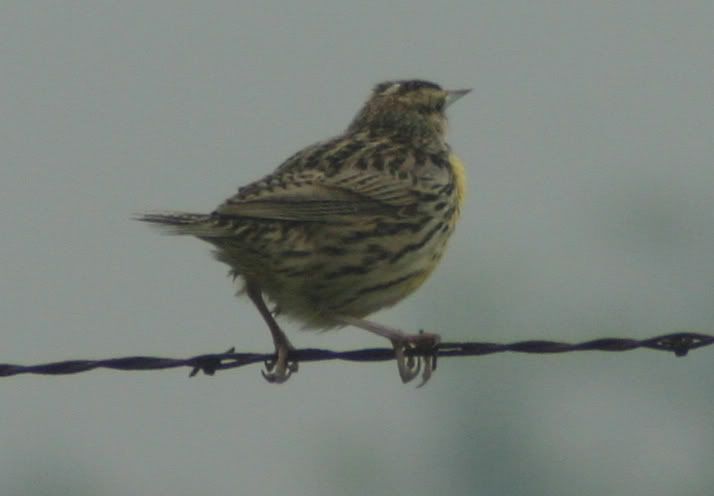
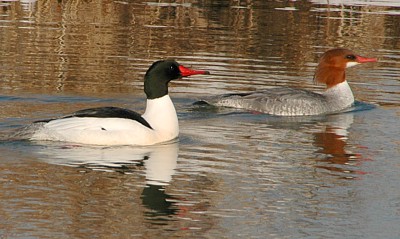
The drive from Aspen, Colorado to the Natural Bridges National Monument in Utah is about 6 hours. It's very pleasent driving, especially around Grand Junction, Colorado, and the birdlife at the roadside is plentiful. Before I left Colorado I saw FOY (first of year) Common Merganser, Osprey, American Kestrel (and lots of 'em), Wild Turkey and my first life bird of the trip, a Western Meadowlark:

Western Meadowlark from the back

At a small reststop in Kane Springs, UT I stopped to stretch my legs and was delighted to find a dozen or so White Throated Swifts cavorting in the air above. I've gotta say: these birds are stunning. Something about the black and white contrast of these birds really struck me. I went on to see hundreds more species on the rest of the trip but I don't think any were as beautiful as these swifts.

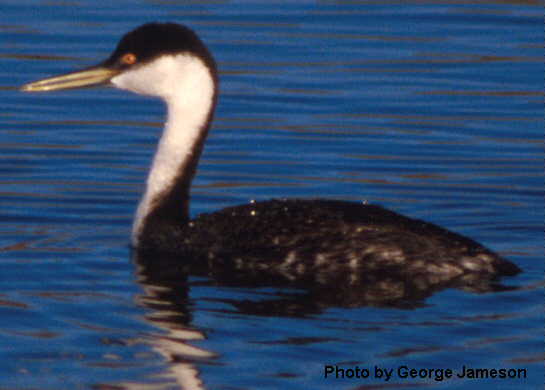
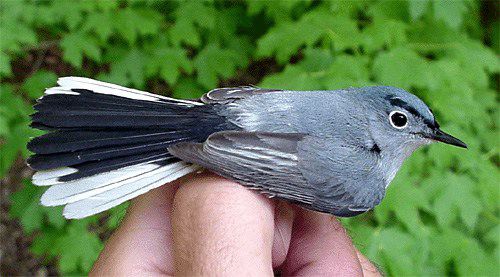
Anyway, I made one more stop before making it to NBNM. Somewhere on the outskirts of Montecello, Utah I spotted a group of large Grebes in a dammed reservior off the road. I pulled over and watched the small flock of Western Grebes float lazily on the water. Also making an appearance at the roadside were my FOY Blue-Gray Gnatcatcher and my lifer Rock Wren, which is much drabber than wrens I'm used to.

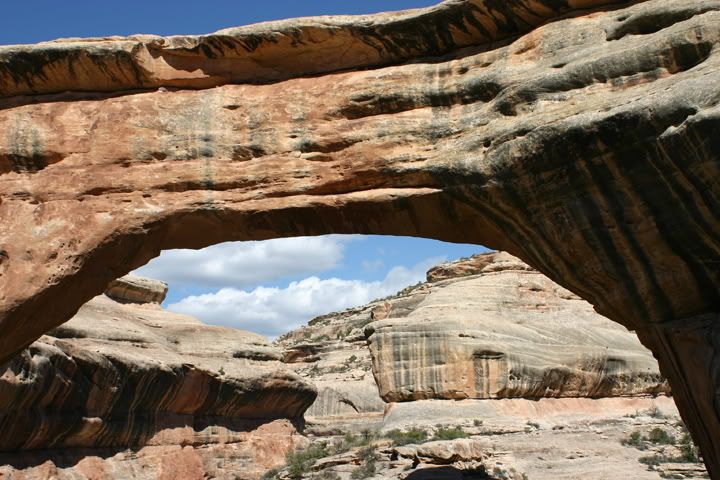
I rolled into the Natural Bridges National Monument at about 4pm...just enough time to set up my tent and get a good long hike in. I set off on the Loop Trail which would take me past at least 2 gigantic natural arches and along a hopefully birdy river. The trail, just to warn visitors, is not easy or well marked. Descending and ascending the canyon wall to the riverbed is also not easy and is definetly not recommended for anyone with problems walking.

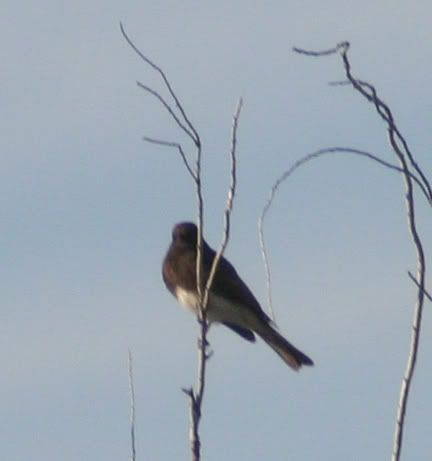
But it is certainly beautiful. Giant stone walls tower above as you follow the river. Birds were not overabundant, but were certainly around. My first was a lifer Spotted Towhee making a racket in the leaf litter...just like his eastern relative. Echoing off the canyon walls was the call of the Canyon Wren, a bird that I wasn't ever actually able to see. Further along I found three more life birds, a bunch of Virginia's Warblers (which looked a bit like my familiar Yellow-Rumped Warblers at first glance), a couple of ornery Bushtits and a beautiful pair of Black Pheobe.

One piece of advice for birding at the NBNM: know your birdcalls. I was on the trail as the day was getting late and there were a lot of birds calling. I am not used to birding in the west and most every single call was unknown to me. Had I known what I was hearing I've no doubt that I could have recognized 5-10 more species. Oh well.

After a rugged hike back out of the canyon I took the mesa trail back to my tent and on the way encountered my last new bird of the day: a pair of Juniper Titmice, a drabber cousin of my familiar Tufted Titmouse (in fact, a lot of these desert birds were pretty drab).

After about 5 miles of hiking in the Utah sun I finally made it back to my tent. Tired, satisfied and eager to get to Arzona, I fell asleep...and then woke up freezing because apparently the desert gets to like 20 degrees at night. Live and learn.

Birds:
Turkey Vulture
Raven (lots)
Cooper's Hawk
Black Pheobe
Virginia's Warbler
Rock Wren
Canyon Wren
Juniper Titmouse
Bushtit
Spotted Towhee
Hairy Woodpecker

Birds Missed:
hmm nothing really

Tomorrow: The Chiracahua Mtns and Coronado NF

Great American Birding Road Trip


Last Tuesday I left the lovely mountain town of Aspen, where I had been working for the winter, and began and epic journey across these United States back to my childhood home in Maine. Being an avid birder I could not resist the opportunity to pass through some of the country's most famous birding spots (during migration no less!), regardless of whether or not they were on a direct route to New England.

And so, loyal reader (haha), what is to follow will be the account of my journey. Over the next few days I will be writing about my experience at:
Natural Bridges National Monument, Utah
Coronado National Forest and Portal, Arizona
Lake Balmorhea, Texas
Pedernales Falls State Park, Texas
High Island, Texas
Dauphin Island, Alabama
Francis Marion National Forest, South Carolina

I write these in the hopes that other birders will come across it when they google something like "birding" + "lake balmorhea" and thus be given lots of helpful information and not fall into some of the pitfalls that I fell into. THUS BEGINS OUR JOURNEY!

OK well actually not yet. There are some things I'd like to thank for helping me come though in one piece.

-My 2002 Subaru Legacy sedan. This car was my trusty steed throughout the entire journey and never let me down. Whether it was whipping around the dangerous dirt roads of the Coronado National Forest or driving endless miles of our nation's highways, I always trusted that my car was there. The $1200 worth of exaust repair right before the trip didn't hurt either.

-My copy of The National Geographic Guide to Birding Hot Spots. This book was indespensible when it came to figuring out where I should go and what birds to expect there.

-The Sibley Guide to Birds. What can I say? Everything I need to know.

-My American Map 2006 Road Atlas. Very comprehensive. Never led me astray.

OK that's over with LET THE JOURNEY BEGIN!

Thursday, April 12, 2007

Updates


The winter is ending here in Aspen and I'm only a few days away from what I hope with be an epic roadtrip back to the east coast. It's spring, and as a birder I would not be able to forgive myself if I had driven back to Maine without going just a little bit out of my way to see some of the best spring migration sites in the US. So, tentative plans have me spending a day or two in the Chiricahua Mountains of Arizona, The Guadalupe Mountains National Park in west Texas, a night in Austin to look for Golden-Cheeked Warblers and a day or two at High Island. I'll try my darndest to post trip reports and pictures.

And if that wasn't enough I'm going to be heading to Ecuador, one of the most diverse birding countries on the planet, after just a few days in Maine. I got a field guide to the Birds of Ecuador off Amazon and it's HUGE. I'm extremely excited, and, like I said, I'll try to post reports and pictures.

Best,
Nick

Sunday, March 4, 2007

American Dippers


When I first saw American Dippers in Woody Creek I was told that they are skittish birds, and that I'd be lucky to get a good shot of them. My experience has been the complete opposite, though, and on one occasion I could have reached out and grabbed one of the birds, had I been hungry or a jerk or something. Here are some shots from today:


About Us | Site Map | Privacy Policy | Contact Us | Blog Design | 2007 Company Name