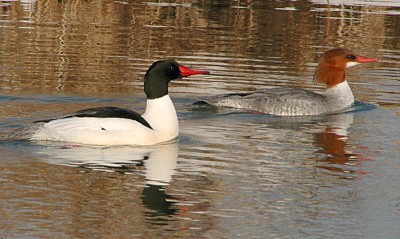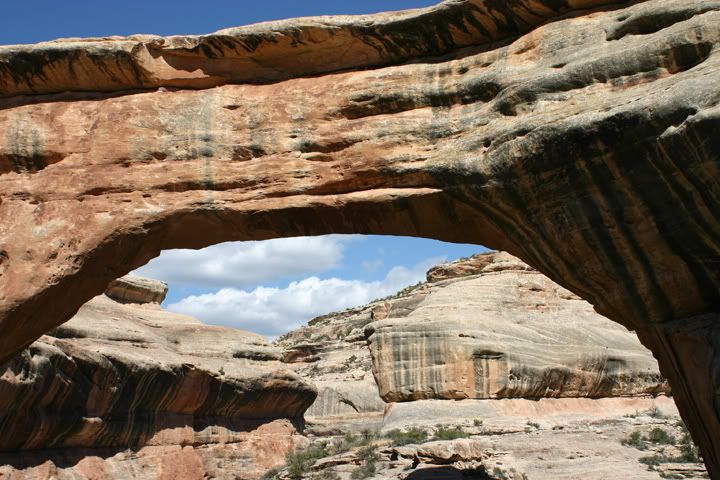
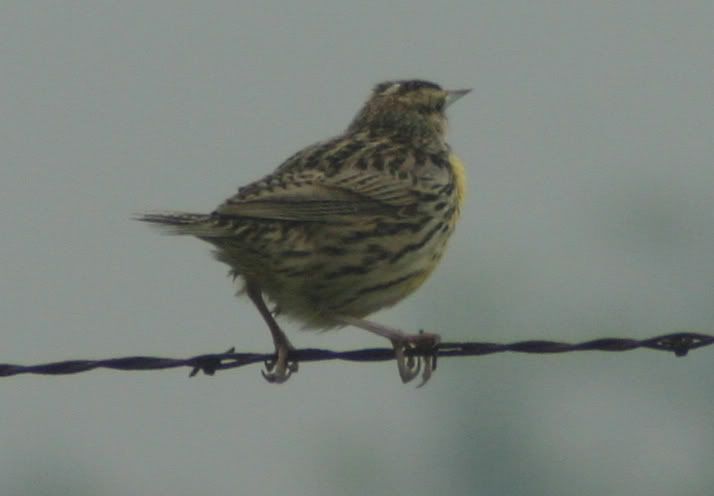
The drive from Aspen, Colorado to the Natural Bridges National Monument in Utah is about 6 hours. It's very pleasent driving, especially around Grand Junction, Colorado, and the birdlife at the roadside is plentiful. Before I left Colorado I saw FOY (first of year) Common Merganser, Osprey, American Kestrel (and lots of 'em), Wild Turkey and my first life bird of the trip, a Western Meadowlark:
At a small reststop in Kane Springs, UT I stopped to stretch my legs and was delighted to find a dozen or so White Throated Swifts cavorting in the air above. I've gotta say: these birds are stunning. Something about the black and white contrast of these birds really struck me. I went on to see hundreds more species on the rest of the trip but I don't think any were as beautiful as these swifts.
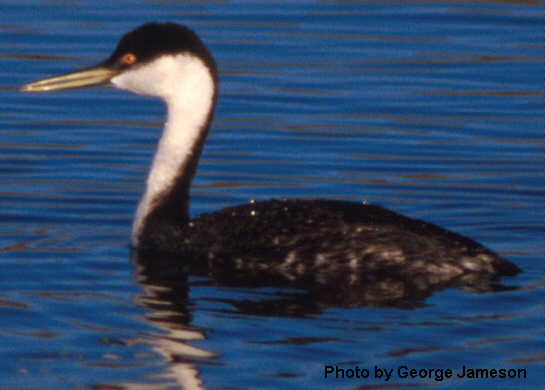
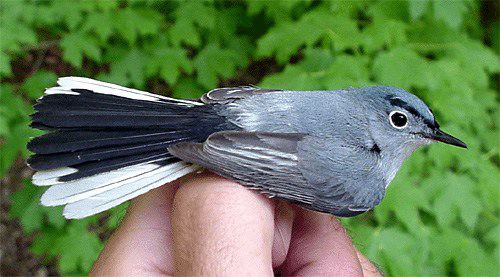
Anyway, I made one more stop before making it to NBNM. Somewhere on the outskirts of Montecello, Utah I spotted a group of large Grebes in a dammed reservior off the road. I pulled over and watched the small flock of Western Grebes float lazily on the water. Also making an appearance at the roadside were my FOY Blue-Gray Gnatcatcher and my lifer Rock Wren, which is much drabber than wrens I'm used to.
I rolled into the Natural Bridges National Monument at about 4pm...just enough time to set up my tent and get a good long hike in. I set off on the Loop Trail which would take me past at least 2 gigantic natural arches and along a hopefully birdy river. The trail, just to warn visitors, is not easy or well marked. Descending and ascending the canyon wall to the riverbed is also not easy and is definetly not recommended for anyone with problems walking.
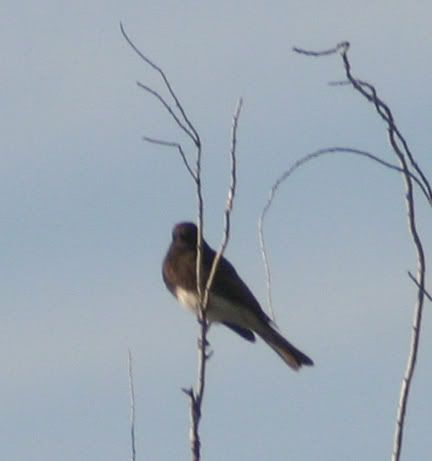
But it is certainly beautiful. Giant stone walls tower above as you follow the river. Birds were not overabundant, but were certainly around. My first was a lifer Spotted Towhee making a racket in the leaf litter...just like his eastern relative. Echoing off the canyon walls was the call of the Canyon Wren, a bird that I wasn't ever actually able to see. Further along I found three more life birds, a bunch of Virginia's Warblers (which looked a bit like my familiar Yellow-Rumped Warblers at first glance), a couple of ornery Bushtits and a beautiful pair of Black Pheobe.
One piece of advice for birding at the NBNM: know your birdcalls. I was on the trail as the day was getting late and there were a lot of birds calling. I am not used to birding in the west and most every single call was unknown to me. Had I known what I was hearing I've no doubt that I could have recognized 5-10 more species. Oh well.
After a rugged hike back out of the canyon I took the mesa trail back to my tent and on the way encountered my last new bird of the day: a pair of Juniper Titmice, a drabber cousin of my familiar Tufted Titmouse (in fact, a lot of these desert birds were pretty drab).
After about 5 miles of hiking in the Utah sun I finally made it back to my tent. Tired, satisfied and eager to get to Arzona, I fell asleep...and then woke up freezing because apparently the desert gets to like 20 degrees at night. Live and learn.
Birds:
Turkey Vulture
Raven (lots)
Cooper's Hawk
Black Pheobe
Virginia's Warbler
Rock Wren
Canyon Wren
Juniper Titmouse
Bushtit
Spotted Towhee
Hairy Woodpecker
Birds Missed:
hmm nothing really
Tomorrow: The Chiracahua Mtns and Coronado NF
Sunday, April 29, 2007
Birding Utah's Natural Bridges National Monument
Labels: birding, bushtit, natural bridges national monument, trips, utah
Great American Birding Road Trip
Last Tuesday I left the lovely mountain town of Aspen, where I had been working for the winter, and began and epic journey across these United States back to my childhood home in Maine. Being an avid birder I could not resist the opportunity to pass through some of the country's most famous birding spots (during migration no less!), regardless of whether or not they were on a direct route to New England.
And so, loyal reader (haha), what is to follow will be the account of my journey. Over the next few days I will be writing about my experience at:
Natural Bridges National Monument, Utah
Coronado National Forest and Portal, Arizona
Lake Balmorhea, Texas
Pedernales Falls State Park, Texas
High Island, Texas
Dauphin Island, Alabama
Francis Marion National Forest, South Carolina
I write these in the hopes that other birders will come across it when they google something like "birding" + "lake balmorhea" and thus be given lots of helpful information and not fall into some of the pitfalls that I fell into. THUS BEGINS OUR JOURNEY!
OK well actually not yet. There are some things I'd like to thank for helping me come though in one piece.
-My 2002 Subaru Legacy sedan. This car was my trusty steed throughout the entire journey and never let me down. Whether it was whipping around the dangerous dirt roads of the Coronado National Forest or driving endless miles of our nation's highways, I always trusted that my car was there. The $1200 worth of exaust repair right before the trip didn't hurt either.
-My copy of The National Geographic Guide to Birding Hot Spots. This book was indespensible when it came to figuring out where I should go and what birds to expect there.
-The Sibley Guide to Birds. What can I say? Everything I need to know.
-My American Map 2006 Road Atlas. Very comprehensive. Never led me astray.
OK that's over with LET THE JOURNEY BEGIN!
Labels: arizona, balmorhea, birding, dauphin, high island, louisiana, pedernales, south carolina, texas, trips, utah
Thursday, April 12, 2007
Updates

The winter is ending here in Aspen and I'm only a few days away from what I hope with be an epic roadtrip back to the east coast. It's spring, and as a birder I would not be able to forgive myself if I had driven back to Maine without going just a little bit out of my way to see some of the best spring migration sites in the US. So, tentative plans have me spending a day or two in the Chiricahua Mountains of Arizona, The Guadalupe Mountains National Park in west Texas, a night in Austin to look for Golden-Cheeked Warblers and a day or two at High Island. I'll try my darndest to post trip reports and pictures.
And if that wasn't enough I'm going to be heading to Ecuador, one of the most diverse birding countries on the planet, after just a few days in Maine. I got a field guide to the Birds of Ecuador off Amazon and it's HUGE. I'm extremely excited, and, like I said, I'll try to post reports and pictures.
Best,
Nick
Sunday, March 4, 2007
American Dippers
When I first saw American Dippers in Woody Creek I was told that they are skittish birds, and that I'd be lucky to get a good shot of them. My experience has been the complete opposite, though, and on one occasion I could have reached out and grabbed one of the birds, had I been hungry or a jerk or something. Here are some shots from today:

Monday, February 19, 2007
Aspen Update -- Feb. 07
I haven't been birding much at all here in Aspen. A bunch of factors contribute to this: no time, no car, not many species, and no idea where to go. I feel a little bit bad that I'm not our trudging through the brush everyday, but I'm planning to do a lot of spring birding in the southwest on my drive back to Maine, and I'm sure I'll make up for all the birds I'm not seeing here.
The only new bird I've seen in 2007 is the Pine Grosbeak...a lovely large finch that has flocked to the trees at the top of Buttermilk (where I work most days) a couple of times. It's a nice looking bird, one that reminds me a lot of a large red crossbill...without the crossed bill part of course.
I have been in conversation with Auden Schendler, the head of the environmental department for the Aspen SkiCo, about the possibility of putting a finch feeder on the top of Buttermilk to encourage the presence of Rosy-Finches. Mr. Schendler had been very helpful and has offered to pay for the cost of a feeder and its instillation. Unfortunately, the season is almost over, and I am not planning to stay in Aspen for the summer. If I can get a feeder installed in April or May it will have to be up to someone else to keep it stocked next season.
On another Rosy-Finch note, local birder Al Levantin has invited me to his house, which is probably the best spot in the world to see Brown Capped Rosy-Finches, as well as the other two species. Many birders know Mr. Levantin from the book The Big Year, in which his quest to see a record number of species in North America was chronicled. I credit The Big Year with inspiring me to become a birder, and I am very grateful to Mr. Levantin for having me to his home.
Wednesday, December 27, 2006
Aspen CBC List
If any of you are birdDC readers and have followed a link to here, you have earned my gratitude. Thanks for reading all this stuff I've written, and welcome to the place where I'll write some more.
Anyway, as I was saying back on BirdDC, I recently participated in the Aspen Christmas Bird Count. My partner was longtime Aspen birder Ken Toy, and he and I managed an impressive (for Colorado in December) 22 species. Here is the list:
Canada Goose - 55 (At the Aspen Center for Environmental Studies - ACES)
Mallard - 130 (ACES and the wastewater plant)
American Widgeon - 1 (ACES)
Ring-Necked Duck - 1 (ACES)
Barnyard Goose - 4 (Not counted officially, but found at the wastewater plant)
Bald Eagle - 1 (Woody Creek)
Golden Eagle - 1 (Woody Creek)
American Coot - 1 (ACES)
Northern Red-Shafted Flicker - 3 (Town of Aspen. Ken was very surprised at this high number. He wasn't sure we'd find this bird at all.)
Steller's Jay - 5 (Aspen)
Scrub Jay - 2 (Cemetary Lane wastewater plant overlook)
Black-Billed Magpie - 30 (everywhere)
Common Raven - 25 (also everywhere)
Black-Capped Chickadee - 16 (Aspen)
Mountain Chickadee - 2 (Aspen)
American Dipper - 1 (Woody Creek)
Townsend's Solitaire - 1 (Cemetary Lane wastewater plant overlook)
American Robin - 65 (Cemetary Lane wastewater plant overlook. An incredibly high count. Ken said we would be lucky to find one or two robins, but at the Cemetary Lane spot they were dripping off trees. From afar they looked like pine cones.)
Oregon Dark-Eyed Junco - 5 (Aspen)
Red-Crossbill - 19 (Sundeck, Ajax Mtn)
American Goldfinch - 5 (A real find up here, apparently)
House Sparrow - 10 (Aspen)
European Starling - 15 (Aspen)
NOTES:
-I've never looked to hard for Rock Doves and not seen them.
-I was disappointed that after two trips up the Aspen gondola I was unable to find Gray Jays or Siskins. If you are visiting Aspen, I can assure you that you stand a very good chance of seeing these species from the Sundeck.
-Ken was surprised that we were unable to find the Belted Kingfisher that lives near Woody Creek.
-Near the Wood Creek Tavern we heard soft hooting sounds that I believe were from Northern Pygmy-Owls, a common-enough bird 'round here. Evidence was inconclusive, though.