
A feast of Waders
3 days ago

I drove over a bridge from Maryland into Virginia today and on the big "Welcome to Virginia" sign was an image of their state bird, the Northern Cardinal - with a yellow bill. I should have scoffed - another Birds at Large on tap! - but it hardly registered. Everyone knows that state birds are a big damn joke. There are a million Cardinals, a scattering a Robins, and just a general lack of thought being put into the whole thing.
States should have to put more thought into their state bird than I put into picking my socks in the morning. "Ugh, state bird? I dunno, what're the guys next to us doing? Cardinal? OK, let's do that too. Yeah put it on all the signs. Nah no time to research the bill color let's just go." It's the official state bird! Well, since all these jackanape states are too busy passing laws requiring everyone to own guns or whatever to consider what their state bird should be, I guess I'll have to do it.
1. Alabama. Official state bird: Yellowhammer.
Right out of the gate with this thing. Yellowhammer? C'mon. I Asked Jeeves and it told me that Yellowhammer is some backwoods name for a Yellow-shafted Flicker. Sorry, but that's dumb. If you want a woodpecker, go for something with a little more cache, something that's at least a full species.
What it should be: Red-cockaded Woodpecker
2. Alaska. Official state bird: Willow Ptarmigan
Willow Ptarmigans are the dumbest sounding birds on earth, sorry. They sound like rejected Star Wars aliens, angrily standing outside the Mos Eisley cantina because their ID's were rejected. Why go with these dopes, Alaska, when you're the best state to see the most awesome falcon on earth?
What it should be: Gyrfalcon
3. Arizona. Official state bird: Cactus Wren
Cactus Wren is like the only boring bird in the entire state. I can't believe it.
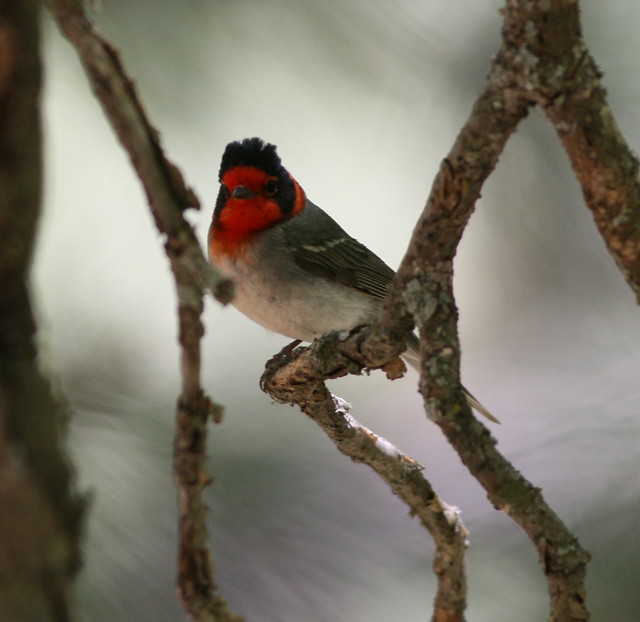
What it should be: Red-faced Warbler
Peregrine falcons are the world's fastest animal. WORLD'S FASTEST ANIMAL. They're amazing creatures, but I bet none of my sleep-eyed compatriots riding the early morning Metro between Pentagon and L'Enfant Plaza know that these birds can be seen almost every morning.
Between Pentagon and L'Enfant Plaza stations, the Metro goes above ground and crosses the Potomac on a bridge. It can be a dazzling moment for groggy passengers - bursting from the dark tunnel into a city sunrise over the river. It's good birding, too, with gulls and geese and ducks and what-have-yous. There are also, often, Peregrine Falcons, if you know where to look. Metro passengers looking downriver can often spot a bird sitting on the railroad trestle, usually at one of four spots: the edge of the VA side, the two edges of the middle section, and the edge of the DC side. Here are some maps (click to enlarge):


I pulled these screen shots off an episode this season called "Call Girl." Look, I'm not going to get in a huge debate over Family Guy. When it first aired it was some pretty cutting edge stuff, frankly, but it's settled into a rut where it settles for nastiness instead of nasty wit. Who cares. I'll watch it on Hulu once in awhile.
This episode had birds in it. Real birds? No.


Ah, March. I'm tired of all the winter birds, and spring birds haven't come yet. Plus, I'm stuck in the office most of the time and it's cold and it's raining probably. What's a bored birder to do but dream of birding in faraway lands and in warmer temps?
I was perusing Google Street View the other day when it dawned on my that it just might be the cure for my March birding blues. A car travelling all of America's roads taking 360 degree video must have seen a few birds along the way, right? How many could I find? My task instantly overwhelming my brain, I cancelled all my other appointments (none), asked my secretary to hold my calls (I don't have a secretary and no one was calling), and set to work.
Turns out, birding on Street View is a lot harder than I thought. Some of the images were taken more than 5 years ago, and the resolution isn't any good. Sometimes, the weather was bad. Mostly, though, there's just so many places to search! There's a new set of images every 10 feet or so, and scanning the images looking for winged needles in the haystack is quite the endeavor. I searched for gulls in Maine with no luck; Bald Eagles in Homer, AK but came up empty; couldn't even begin to think of where to look for roadside Red-tails.
I started to focus by looking for gulls on causeways, figuring gulls were big and easy to ID and often flew right next to bridges. Along Route 1 in the Florida Keys, I found my first hit: Laughing Gulls (click to enlarge).

Birders seems to have a bit of an inferiority complex in the world of outdoor recreation. Some of it I think is social (we lack the macho chest-puffing of hunters), some of it is institutional (we lack the political organization and historical traditions of hunting and fishing). I used to think that part of it was simply that there are fewer of us. But, apparently that isn't true.
I recently stumbled upon this US Fish & Wildlife Service's 2011 National Survey of Fish and Wildlife-Associated Recreation and, frankly, it's pretty amazing. [Apologies to all who wrote about it when it was released (I know 10,000 Birds did), but I somehow missed it.] For me, the highlight of the report was this simple statistic: There are 22.5 million "away-from-home" wildlife watchers in the U.S., compared to 13.6 hunters.
There are ten million more birders than hunters! Unbelievable. And the best part is, this report was smart about how it asked the question. In previous surveys of birders (that I know of), it was hard to distinguish between "birder on the road for a twitch" and "guy who glances out his window at his feeder." For me, that lack of distinction made be question statistics about the numbers of birders. This report, though, specifically identifies those who "took trips or outings of at least 1 mile from home for the primary purpose of observing, feeding or photographing wildlife." Sounds good to me.
Better yet, the report lays out the economic impacts of each of these hobbies. Hunters - with their NRAs and their Ducks Unlimiteds and their Federal Duck Stamps and their L.L. Beans and their million TV shows while birders have one (for now) - spend a total of $33.7 billion per year. Birders, on the other hand, spend a whopping $54.9 billion, even more than anglers ($41.8 billion). Incredible.
What does this mean? It means that it's time for us to flex our muscles a little bit. A great place to start is the proposed Wildlife Conservation Stamp. We've earned the right through our participation and our spending to have money put aside directly for the preservation of non-game birds. Birders need to be more vocal about their impacts, and use our numbers advantage to shift political priorities in our favor.
A few months back I posted on the particularities of bird photography. It seems to me a pretty utilitarian genre - concerned as it is with clarity and scientific definitiveness, but lacking that mysterious ingredient is necessary to be called "art."
The only bird photographer I know of who I would consider a great artist is Todd Forsgren. In his most famous series, Forsgren photographs tropical birds temporarily tangled in mist nets. The images are striking, and the viewer can't help but calculate his empathy for the birds with the value of scientific data gained from their confinement. Perhaps most interesting to birders is the conceptual link between Forsgren's mist net images and the artwork of James J. Audubon, whose globally-influential paintings were built upon the sacrifice of thousands birds unfortunate enough to meet the business end of his shotgun.
Todd was kind enough to let me talk with him over email about his idea on bird photography as art, how his series of photographs came about, and their reception.
