Thursday, March 24, 2022

700 Quest! Part I: 699 Quest


For as long as I've been birding in the U.S., 700 was the number. Hitting 700 meant that you'd been everywhere, and seen most everything. I've been on a slow march towards 700 for a long time now, but, as any birder knows, it gets harder the closer you get. I saw 500 species in my first 5 years of birding, getting a Kentucky Warbler for my 500th ABA species in north Mississippi in early 2011. 600 was two years later -- still a pretty good clip -- a Gray Vireo in southern California. 

Things slowed after that. I got 12 ABA birds in 2016, 11 in 2017, 1 in 2018, 0 in 2019, 3 in 2020, and 3 in 2021. There just weren't a lot of birds I could see without a lot of effort and expense, two things in short supply with a youngster in the house. At the beginning of 2022 I was sitting at 697 ABA birds and after two years of pandemic madness I was itching to get moving.

Plus, I wanted to hit 700 so I could start focusing elsewhere. In my younger birding days, international birding seemed somehow impossibly complicated and exotic. The U.S. was big enough. But that's changed, and the lure of totally unique birds and big trip lists has overtaken everything else. 

But I was within striking distance of 700, and wanted to cross that finish line. Texas obliged, and at the beginning of 2022 there were 4 lifers hanging around the Lower Rio Grande Valley pretty regularly - a Bat Falcon (!), Social Flycatcher (!), Golden-crowned Warbler, and Crimson-collared Grosbeak. I could do it in a long weekend, I thought. My wife acceded, and I booked it. 

I texted my birding dudes in case anyone wanted to join. They couldn't. I prepared to go alone. (I love birding alone and was fine with it, and it felt actually like a full-circle completion to U.S. listing, where I birded alone for years before meeting birding friends.) But the day before I left I texted the group again and talked about my preparations. My friend Ed texted back - wait are you actually going? I thought you were joking. No, I'm going. Want to come? Leaving tomorrow. Yes. Incredible. Ed's a great birder and one of the best guys and had never been to Texas before, and all of a sudden this trip just got a lot more fun.

The flights down were uneventful, and we met in San Antonio at about the same time despite taking different airlines. We grabbed a car and drove the always-long-than-you-remember trip straight south to McAllen. We headed straight to Santa Ana NWR hoping to catch the Bat Falcon at dusk, but missed. No matter, we were suddenly among the palm trees and cacti in South Texas and life was good. That night we dined at a auto-mechanic-turned-taco-shop, giddy that this was actually happening, happy to be out of the Maine winter, and ready to get some good birds. 

Bat Falcon at Santa Ana

We were up at dawn and headed back to Santa Ana. The Crimson-collared Grosbeak hadn't been seen for a few weeks, so now I needed hit all 3 of the remaining birds to make 700. A tall order, but they'd all been reliable. We waited along the entrance road in front of the Bat Falcon's favorite perch -- a telephone pole above a noisy road -- and - there it was. No one even saw it fly it, it was just there, suddenly, perched on the pole. 

Black-necked Stilt in the morning light at Santa Ana

An incredible bird. The first ABA record, and just an attractive species. We were pleased because sometimes it wasn't cooperative at the telephone pole and birders had to chase it all over the Refuge, but not us. We were in good spirits, and now had time to kill. The Valley Nature Center, where the Golden-crowned Warbler had been hanging out, didn't open for a few hours, so we explored Santa Ana.

young Gray Hawk at Santa Ana

We had the place to ourselves, and spent a beautiful morning walking the trails past spoonbills, stilts, pelicans, kingfishers, woodpeckers, Green Jays, Long-billed Thrashers, Gray Hawks, and a bunch of south Texas specialities. Ed saw the Rio Grande for the first time, and we pondered over this sleepy stretch of river that caused so much heartburn and heartache. 

We made the drive to Valley Nature Center, and walked to the back section into one of those scenes you hate to see as a twitcher: a bunch of birders aimlessly walking around shrugging, saying "haven't seen it yet, not sure where it is." Oh. We poked around for a few minutes and then -- there it was. This tiny warbler came chipping through the dense vegetation, briefly posing for good looks. Golden-crowned Warbler is rare but regular in the LRGV, and I was thrilled to connect. Sitting now on 699.

Golden-crowned Warbler at the Valley Nature Center, ABA 699

We had hit two of our three targets and it was Saturday at noon. We figured we'd walk right into the Social Flycatcher at the University of Texas RGV campus and then have a whole extra day to explore. Our minds raced. Should we head up to Laredo and get the seedeater? Should we go to Aransas NWR and get Whooping Crane, Ed's number one most wanted bird? We were dizzy.

We rolled up the campus and walked to the beautiful resaca habitat. There were a ton of birds around in what proved itself to be a perfect migrant trap, including my lifer Texas Black-throated Gray and Black-throated Green Warblers, and Fulvous Whistling-Duck. But ... there was no flycatcher, and no one had seen it that day. We waited, and walked around. The weather worsened. Brownsville is much closer to the Gulf than McAllen, one of the local birders said, and it's often much windier. It was howling, and raining. We spent six hours at the campus, and left birdless.

We were back at it the next morning, but decided to make a stop at dawn at nearby Eserto Llano before making the hour plus drive back to campus. EBird checklists showed that the Social wasn't really a morning bird, and we wanted to pick up Buff-bellied Hummingbird and White-tipped Dove so we stopped and enjoyed those birds and more before heading back south. 

We arrived to find another stomach-dropping scene: a bunch of birders celebrating and high-fiving after seeing the Social Flycatcher and then seeing "We just saw it, but it's not here now." We had missed it by maybe 10 minutes. At least it was around. We settled in with our hopes renewed.

the best sighting at UTRGV

Six hours later we still hadn't seen it. We'd seen every goddamn bird (and Bobcat) in every goddamn bush in the whole park, but not the Social. Our legs were sore from walking laps. We wanted to do something else. So, stuck on 699 and with no clear next lifer in sight, we bailed. I was so ready. 

Unburdened from the wait, we have a great afternoon of birding. We drove out to Old Port Isabel Rd. and got distant looks at Apolomado Falcon, as well as a number of trip birds including Long-billed Curlew and a bunch of waders. Then we scooted up to a Red-crowned Parrot roost in Brownsville and reveled at the squawking mass on telephone wires right over our heads. We listened to the Super Bowl in Spanish on the way back to the hotel, reveling in the not-Maine-ness of it all. 

Green Jay /heart eyes emoji

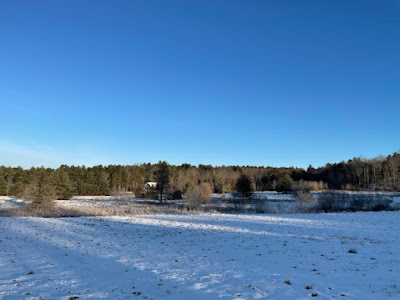
We got up early the day of our flight out but didn't have time to head back down to Brownsville, so cranked up towards San Antonio, stopping at a few out-of-the-way places en route. We scored some distant Mountain Plovers (only my second ever) at a random farm field in Frio County, and picked up some nice little common state birds in a park in Castroville. 

I left Texas sitting on 699 with no clear answer for 700. How long would it take? What bird would it be? Connecticut Warbler was the most likely possibility - though would still require a ton of effort - and everything else was a wild card. I'd have to wait and see. 

Turns out, it didn't take long at all. TO BE CONTINUED!

Tuesday, January 11, 2022

Steller's Article for National Audubon


The vagrant Steller's Sea Eagle is still in Maine and still a sensation. National Audubon asked me to write a summary of the bird's incredible path to Maine, and here it is


It's been so fun to play such a weirdly visible role in this bird's journey, from first cajoling the NYT into the first major article on the bird, to all kinds of press around the eagle's appearance in Massachusetts, to helping organize the ongoing response from Maine Audubon helping people safely see the bird. What a fun ride.

In more depressing news, my wife and I had to pull out of the long-planned trip I was supposed to be on RIGHT NOW to Costa Rica with a cadre of birding friends due to COVID concerns. We couldn't risk leaving our young son with my mom. Turns out just today, the day we were supposed to have left, our son's preschool emailed us to say that he had a close contact somewhere at school and now needs to quarantine until Jan. 24. Awful. Birding trips with friends are my absolute favorite thing on Earth, and I've been working really hard over the past two years (on this and this and other announcements to come), and really wanted this break. I'm kinda taking it like a big baby but oh well, there'll be other trips. 


Saturday, January 1, 2022

Steller's Sea Eagle in MAINE


I was having a pretty crummy day. My wife had given me the green light to go birding on 12/30, but I was striking out on all my targets. I wanted one last Maine year bird but couldn't connect. I whiffed on American Pipits at Scarborough Marsh, and Iceland Gulls along the Portland waterfront, and Yellow-breasted Chat downtown. My last hope for a new bird was a Lark Sparrow reported a few days earlier with House Sparrows behind an auto mechanic shop. 

So I sat in my car in the muddy back lot of a Subaru mechanic and watched some dumb House Sparrows fart around in a small bush next to an old rusting Outback. No Lark Sparrow. I felt like a goddamn loser, but then I checked my email.

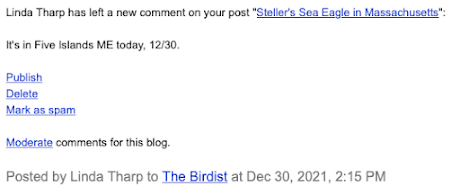
I'd hoped for a last minute eBird Needs Alert but instead I found something much more interesting. A comment moderation message from this very web-blog, alerting me that someone named Linda Tharp had posted a note to my post about the Steller's Sea Eagle in Massachusetts. It read, "It's in Five Islands ME today, 12/30."


That was it. No photos. No contact info. No exclamation marks. 

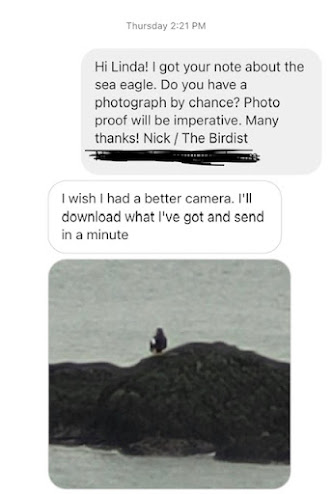
"Probably someone just looking at a juvenile Bald Eagle," I thought to myself. There are plenty of people who, when there's a rare bird in the news, come out with a story of seeing it at their backyard feeder a few weeks before or something. It happens. Still, I was sitting in a stupid parking lot feeling stupid, and may as well try to get some more info. I searched for the name Linda Tharp on Instagram and immediately found a woman whose bio mentioned Five Islands, Maine. Her DMs were open so I gave it a shot. This is six minutes after she posted the comment to the blog.


WHELP. WHEEEEELLLLLLP. That's a Steller's Sea Eagle. You can see that I sent the first message at 2:21. What you can't see is that she responded with her message and that cell phone pic at 2:22, almost instantly. It's not suitable for framing, perhaps, but it was pretty clear that the Steller's was in Maine. 

I left the parking lot, my squealing tires probably dousing the House Sparrow flock in mud. I went right home. The next moves were to a) Hopefully try to get a better image from Linda to confirm the bird (ie there's no yellow bill visible in that pic; b) Understand if it is publicly accessible, if it's still being seen, how long it's been around, and any other useful information before; c) Getting the word out to as many people as possible.

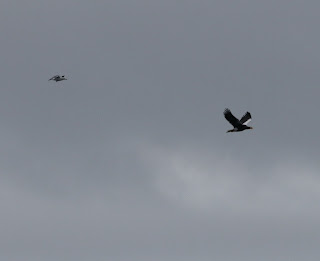
Linda was fantastic. She was responding to my questions, and I spoke with her on the phone while I was in the car. Yes, it had a huge yellow beak, she said. It was hanging around with Bald Eagles, she said, indicating she could differentiate between the two species. At 2:48 she sent two other cell phone photos, still distant but enough to confirm. She said I could try to view the bird from her back deck if I could get there before dark. What a wonderful interaction. 

I texted my friend and Maine Audubon colleague Doug Hitchcox and others on our small birder friends group text, first to get their confirmation that this bird was the Steller's and wasn't some other species that just wasn't ringing a bell. I didn't hear anything different, and we all went for our cars. I stopped at home and quickly typed up messages for the Maine Birds Listserv and the Maine Rare Birds FB group getting word out about the eagle and including Linda's photos. The FB post was made at 3:10 PM, less than an hour after first hearing from Linda. 

The rest is still-developing history. I and a handful of other birders cranked up to Five Islands that afternoon but didn't find the bird before darkness. It was refound on the morning of 12/31, however, and I saw it that day. It was seen again today, Jan. 1, and will hopefully linger for many birders to come. If you've found this website in pursuit of information about the eagle I'm sorry but I don't really have that, please check Maine Audubon's updating blog post here, and please please please be respectful of the locals at Five Islands and be at times aware of yourself and whether you (or your car) is some place that it shouldn't be. Thanks. 

I was glad to play a tiny role in this bird being enjoyed by so many. I don't know how Linda found my blog -- she must have been aware of the bird somehow already in order to search the internet for a place to comment about it, right? -- but I'm glad she did. 

This Steller's Sea Eagle is such an incredible individual, I'm so glad I've now seen it in two states, including my home state. No one knows what the future holds for this bird but I'm excited to see what happens next.


Monday, December 20, 2021

Steller's Sea Eagle in Massachusetts


5:45 AM - I left my house in Cumberland, Maine and drove an hour south to York, to meet other birders for the York County Christmas Bird Count.


7:40 AM - We were counting! Things were going pretty well. We'd just seen a Northern Flicker, apparently the first one ever on the York count, and now we were walking through the cold and quiet but beautiful Highland Farm. Here's that.


Then I got a text from Doug Hitchcox: "Steller's was just found."

He was referring to the Steller's Sea Eagle. The species had never before been seen in North America outside of western Alaska, but one individual had been spotted in interior Alaska in August of 2020 has been disappearing and appearing all over North America since then. It was photographed in southern Texas in the spring -- a baffling sighting that was initially chalked up as an escaped bird or a hoax -- when all the way up in Quebec, New Brunswick, and Nova Scotia in the summer and into November, when it disappeared again. I spoke to the New York Times about the bird in mid-November after it had just gone missing again, and I told them I hoped it would fly to Maine. Apparently it did - but we all missed it. 

We learned yesterday, Dec. 19, that a photographer in Massachusetts had photographed the bird a week earlier, on Dec. 12. Not sure why word hadn't gotten out but the Taunton River area was searched yesterday without luck. This morning they had luck, and I got a text in York County.

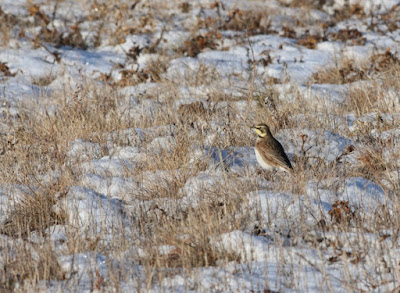
8:48 AM - I abandoned the Christmas Bird Count. Sorry, York County, but there's a goddamn Steller's Sea Eagle two hours away. They had enough counters without me and I heard later that things went great. Doug and Fyn also paused their seawatch from Nubble Light. I picked up a Horned Lark (a year bird for Maine) along Short Sands Beach while we waited for Ed to come down from the Portland area.


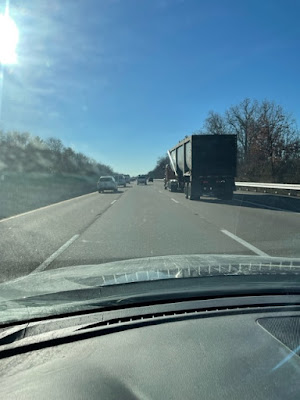
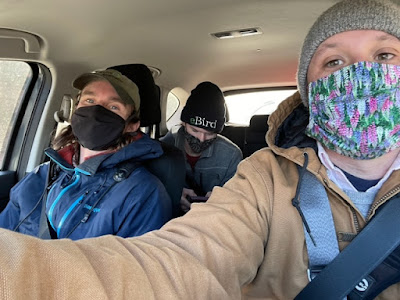
10:32 AM - We are barreling through southern Massachusetts. I forced everyone listen to the Adam Sandler "Toll Booth Willie" skit after we passed the turn to Worcester and it was even dirtier than I remember. We were all shot up and boosted and wore masks in the car.


11:02 - We pull up to the tiny, private beach where the bird was last seen to the dreaded "you just missed it!" A birder's nightmare. It flew upriver somewhere and no one knows where it is. My gas light is on with 22 miles left until empty. We follow the roads upriver.


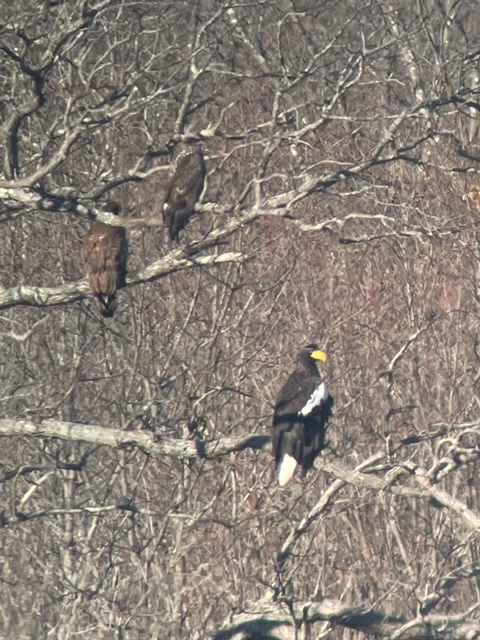
11:37 AM - We get word that the bird is being seen from Dighton Rock State Park. We go, park haphazardly, and there it is, across the river with a bunch of Bald Eagles. Holy shit. We're screaming.


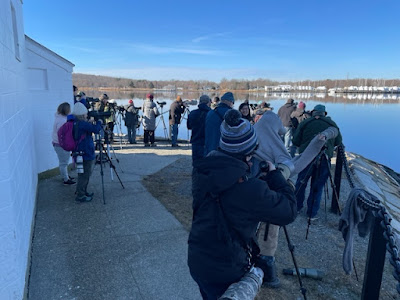
We're not particularly close to the bird, but it sits still and gives great views through the scope. The orange bill is visible with the naked eye. The size stands out -- a pair of juvenile Bald Eagles perch just above it but are dwarfed by the Steller's. An absolute dream to be all of a sudden standing in this random park in southern Massachusetts looking at a wild, rare Russian monster. There are about 200 birders there by noon. We leave.


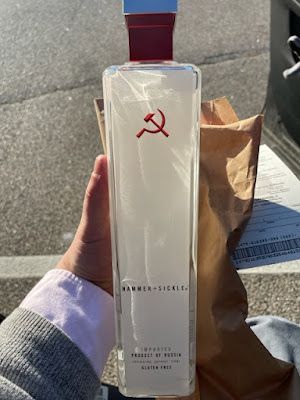
2:23 PM - Obligatory stop at the New Hampshire State Liquor Store to buy some vodka to commemorate our new comrade. I am home in plenty of time to pick up my son.


An amazing day. I never in my life thought I'd see a wild Steller's Sea Eagle, and may never again. This bird is my 699th ABA Continental species. It appeared healthy and was seen eating earlier in the day, and so hopefully it'll stick around to entertain many more birders.

9:25 PM - I sit down to write this blog and hit publish at, let's see, 10:57 PM, which is righhhhhhhhtttttt now.


Sunday, October 10, 2021

Interview with Birder / Pro Skateboarder Dave Mull


Skateboarding is the best thing in part because I don't know what kind of thing it is. A sport? Not really. A hobby? Doesn't seem strong enough. A ... thing?

Whatever it is, it's the best. It's athletic, but not competitive. It's as technical as gymnastics and as dangerous as football, but isn't full of meatheads. It's artistic, in that there are different ways to execute the same thing and each skater has his own style, or take on the same trick. Plus, as artists do, skaters look at the world differently than the rest of us - seeing the inescapable built environment as things to slide down or jump over or whatever. I just love it.

My brother, Alex, is a great skateboarder. Always has been. I am not, because I have no balance. But we've always enjoyed skateboarding together, and he regularly sends me videos and clips to watch to keep my appraised of the latest. A couple of years ago he started sending me clips from a company called Worble, who was putting out videos based around a dude named Manramp: an anonymous guy in overalls who carried around a piece of plywood to act as a moving feature. A man ramp. They videos ruled, and had a great soundtrack, and featured a long-haired skater named Dave Mull.

Alex sent me a couple more Worble videos and Dave Mull clips and I kept noticing something: there are, like, a bunch of birds in here. There was that Manramp intro where he's got a hawk on his arm. There was an Acorn Woodpecker in the stump jump B-side video, there was a young Red-tail ... I am used to seeing 0 birds in skate videos but now I am seeing birds. Then, Alex send a 2018 interview Mull did with Thrasher (uh, the skate magazine, not the Mimidae), and my suspicions were confirmed: Dave Mull is a birder.

I immediately knew I needed to interview him for Audubon, as I firmly believe in the mission of frantically pointing and waving when I find a birder who is outside whatever you want to think the traditional stereotype of a "birder" is. Dave Mull, pro skateboarder, is certainly outside it. I really enjoyed interviewing him for the National Audubon website.

<iframe width="560" height="315" src="https://www.youtube.com/embed/kWhyPZgiXI8" title="YouTube video player" frameborder="0" allow="accelerometer; autoplay; clipboard-write; encrypted-media; gyroscope; picture-in-picture" allowfullscreen></iframe>


Friday, August 6, 2021

Birds at Large: The Bourne Identity (2002)


I don't know why this clip was recommended to me on YouTube. I have never seen the Bourne Identity and have never searched for clips of it, and don't care much for Matt Damon, and uhhh I just don't know. But I saw that there were birds in the thumbnail so I gave it a watch. You should too, for the purposes of this blog post!

<iframe width="560" height="315" src="https://www.youtube.com/embed/5JVMxzV1Kw4" title="YouTube video player" frameborder="0" allow="accelerometer; autoplay; clipboard-write; encrypted-media; gyroscope; picture-in-picture" allowfullscreen></iframe>

OK so this dude shoots some barrels and they explode immediately. I don't know if that's actually something that can happen (Mythbusters in 2005 apparently found that "It has already been proven that when shot by a normal bullet, a gasoline tank will not explode. However, if a gasoline tank is shot by a tracer round from a great enough distance so that the round can ignite with air friction, it will cause the gasoline to catch fire. By the time this happened, the tank was so riddled with bullets [from previous tracers that were fired too close to ignite], there was no contained pressure, but the MythBusters surmised that had the tank been properly enclosed, it might have exploded." Great!), but (still with me?) the thing I took from that explosion shot is "this movie is not set in the United States." Those are Europe homes!

So, I thought to myself, inner monologueingly, it seems likely that if there are any birds singing in the vicinity (if they haven't fled in terror from the massive explosion) they are likely to be ones that I cannot identify. I don't know the vocalizations of European birds, dear friends! I believed myself to be up the proverbial creek SANS paddle! 

Imagine my surprise then, when just a few moments later, the perfectly enunciated song of an Eastern Wood-Pewee bounded through my ear drums or canal or however it works. Surely I must be imagining things, I monologued to myself, innerly! An Eastern Wood-Pewee, in the snow, in Europe? There must be some mistake! I took off my headphones to check if there was some poor, lost Eastern Wood-Pewee stuck somehow in my basement office, but no. This was IN THE FILM. 

Look, I continued internally monologuing, everyone makes mistakes. It's OK! The wrong bird sound just slipped in there! It's the audio equivalent of a typo. Nothing to make a big deal out of!

But then in rapid succession came the vocalizations of Blue Jay, American Crow, and Black-capped Chickadee! Ain't none of these birds in France unless there was some kind of avian class trip? They were on a passing bus on the way to Normandy? No, no, no ("my inner monologue is arguing with itself now," I thought in an inner aside, a kind of even deeper, even inner-er monologue), birds don't take class trips. This was just a shitty job from the sound guy or gal.

Then Matt Damon goes over and shoots into the air and a ton of birds take off from the field. What the shit was that. Why didn't those birds flee during the earlier massive gas explosions and/or gunshots? What even were those things? Too skinny to be doves but does France have huge winter fields filled with snipe? 

This clip sucks and the movie looks like shit and if Matt Damon's character is supposed to be so smart why doesn't he know a single bird call? GOODBYE.

Tuesday, June 8, 2021

A quick post about Pat Hentgen, Major League Baseball player


As longtime readers (?) of this interblogsite know, I like to think about sports teams named after birds. Good times fun times all is well. But one angle I've never considered in all of this how the players feel about playing for a team named after a bird. 

And I still don't know that and can't really pursue it because I'm too busy and too lazy at the same time.

But if I were to talk to anyone I'd talk to Pat Hentgen, a Cy Young Award winner and three-time all-star pitcher who played between 1991 and 2004. He was a really good player and, for our purposes, has the unique status in major league baseball history as being the ONLY player to play for all three teams named after a bird (the Toronto Blue Jays, Baltimore Orioles, and St. Louis Cardinals), and ONLY those teams.

Every time Pat Hentgen put on a major league uniform there was a bird on it somewhere. Pretty cool.


UPDATE


About Us | Site Map | Privacy Policy | Contact Us | Blog Design | 2007 Company Name