I am pretty confident at this point that the What The State Birds SHOULD Be post I did a couple years ago will be the most-read thing I ever write. I'm OK with that; it's had a life far beyond what I expected and as been a lot of fun.
An though it's just a little article, I feel a little paternalistic to the topic of fixing the state bird situation. There's a lot of room in the debate, of course, and a few days ago the folks at Mercenary Ornithology weighed in. WITH SCIENCE.
Mercenary Ornithology used mathemagics to figure out which bird should be the state bird for each state. They used some formulas to figure out a bird's Outlier Value, basically how much more likely you are to see a certain bird in one state compared to all others. The results are great, and much more specific than most of the choices I slopped together. There are blue-winged teal involved now, and red-cockaded woodpeckers and upland sandpipers. It's a much more diverse list, weighted towards state-specific birds, with nary a cardinal in sight.
But it ain't perfect. What's the problem? Well, at the risk of sounding exactly like old fogey baseball writers railing against the influx of so-called "advanced stats" like WORP and PECOTA: This list ain't got no heart! Where's the human touch? While some of the results of the mechanical approach are perfect, other results range from awkward (a Kentucky warbler for Arkansas?) to depressing (European Starlings shouldn't be a state bird anywhere, even a place as boring as Indiana [j/k Indiana I love you]).
Ya gotta leave some room for debate, and you've got to embrace quirks. Let Rhode Island keep their dumb chicken, it's their thing. Let Maryland keep the oriole...it's a Baltimore Oriole! There's fun in the details, and room for states to pick birds that aren't very common or easily found in their states.
No matter what other lists people come up with, everyone can agree on one thing: the current lineup of state birds is a national shame, and we gotta do something about it.
Monday, February 9, 2015
Thoughts on the Mercenary Ornithology State Birds Post
Labels: math, official state bird, science, state birds
Tuesday, July 16, 2013
Debating The De-Extinction of the Passenger Pigeon with Rick Wright
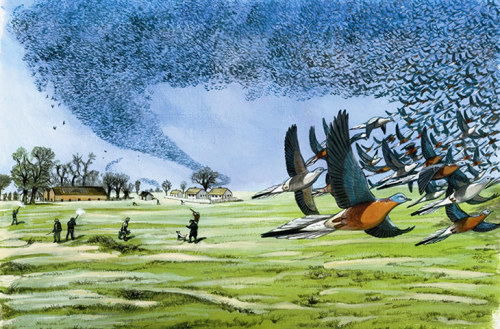
You've probably seen the news in the past couple weeks about some biologists talking seriously about "de-extincting" the Passenger Pigeon. The idea is to take DNA from museum specimens of the birds - nearly a century gone now - and inject them into Band-tailed Pigeon stem cells, eventually resulting in birds that are nearly pure Passengers.
Despite the scientific salaciousness, though, many birders seem to think that this ain't the best of ideas. One of them is mega-birder, ABA blogger and owner of probably the best-researched birding blog on the innernet, Rick Wright, who posted on his Facebook page that this Passenger Pigeon hoopla was nothing more than "short-sighted gimmickry."
One of these nay-saying birders is NOT, however, me, who loves the idea of our skies once again darkened with Passenger Pigeons - and any other long-dead feathered friends we can reconstitute. I got in touch with Rick and he kindly agreed to swap emails discussing the practical and moral implications of bringing back the birds. I had a blast, and I thank Rick for hashing it out with me. Find our exchanges below the jump.
Labels: biology, de-extinction, debate, history, passenger pigeon, rick wright, science
Wednesday, September 19, 2012
Interview with Rosemary Mosco of Bird and Moon Comics
Artists and scientists have something of an uneasy alliance. Both pursuits find kinship in being frequently maligned by the public for their high-mindedness, but true bonds are hindered by the openness and aloofness that characterize artists, and the density and seriousness that characterize scientists. To use a completely random an unnecessary analogy, they're like Jackie Chan and Chris Tucker in Rush Hour: perceived opposites forced to join up to compete against larger foes.
Anyway, into this fray comes a peacemaker: Rosemary Mosco. Rosemary is an artist and she's also a science communicator, someone who, in her words, works to connect people to science through creative communication projects. Very cool.
Rosemary's comics - which are collected at Bird and Moon - bridge the gap between biology and art with joy. She does for biology what XKCD does for math and Hark! A Vagrant does for history: pull out the humorous voice from a field not known for expressing itself with much gusto. Rosemary agreed to answer a few questions for me about her comics and the gaps between science and art. (By the way, her brand new "Birding Is My Favorite Video Game" piece is my favorite of all things.)
Did your passions for science and art develop at the same time? Did you ever feel that you had to choose between the two?
I think I've always been into both science and art. As a kid I liked to learn science facts and then tell them to people (my parents were really patient!). Drawing was just another way to share these facts, and I could do it in a way that made people laugh at the same time.
As I got older, I definitely felt like I had to choose between science and art. When I was starting college I asked my advisor if I could major in both of them, and he looked at me funny and said "Absolutely not". I've always tried to squeeze space for both of them into my schedule, which can be tough at times, but it's always rewarding.
Thursday, October 13, 2011
Learning Bird Flight Through .GIFs
I saw lots of Wilson's Storm-petrels before I ever saw a Leach's. In the Gulf of Maine, though, a Leach's was always a possibility. In those summers a couple years ago I would ride a $45 Odyssey Whale Watch out of Portland about once every two weeks, always keeping a close eye on storm-petrels. After taking many trips without seeing a Leach's, that fear began to haunt me: were they out there and I was just missing them?
"They fly like nighthawks," people said. "They bound. You can't miss them." Can't miss them? I knew their wings are longer, but would it be obvious? I understood that they flew differently, but would I be ready to see that when presented with it?
The trouble with identifying birds by their flight pattern is that it's difficult to study ahead of time. You can say the words or put a dotted line behind a drawing in a field guide, but you need to see the flight to understand.
GIFs, those ubiquitous, ridiculous tools of meme culture, may help. GIFs (Graphics Interchange Format) aren't movies, really, but electronic flipbooks: a bunch of images in a row that make an animation while taking up much less file space than movie files. Many of them loop, creating an endless repetition that might just be really handy for studying.
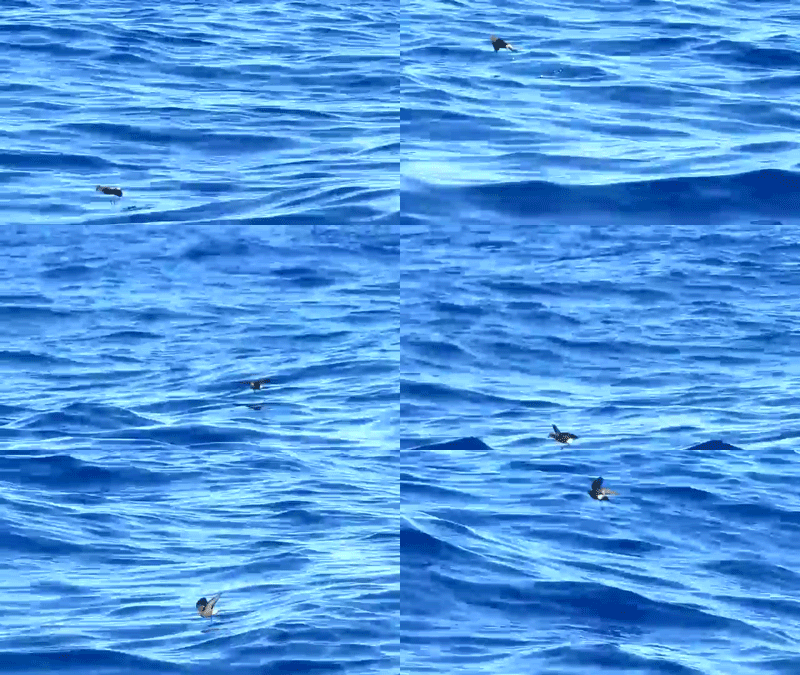
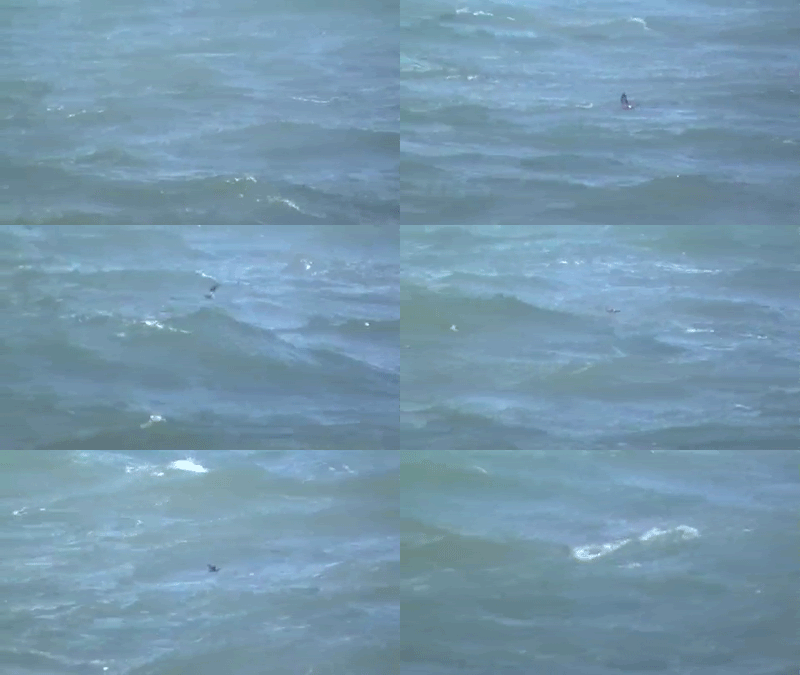
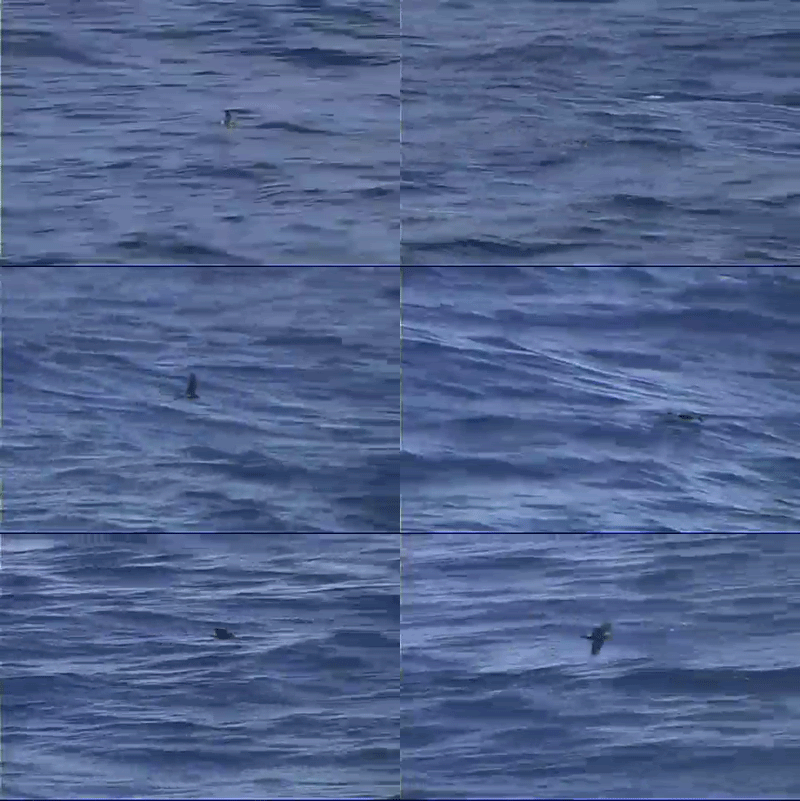
Below are some storm-petrel GIFs that I created using videos from YouTube. Wilson's, Leach's and Band-rumped are represented, each showing (to the limited extent that I could - and I'll talk about that in a minute) each species flight characteristics.
A quick disclaimer: I am still a GIF newbie. They tend to play much more quickly than they should, and I don't know what to do about it. Yet.
Wilson's Storm-petrel. This bird is picking along the surface of the water, as WISP often do. This image is helpful in showing the relationship of the wing size to the rest of the bird.
Leach's Storm-petrel. The wings are clearly longer, and the bird is flying steadily, if erratically, above the water, unlike the Wilson's.
Band-rumped Storm-petrel. This image shows the Leach's-sized wings, but the more casual, shearwater-like flap-and-glide.
Many identification issues could be helped by GIFs, from sparrows to finches to woodpeckers to raptors.
The difficulty is getting the videos to make GIFs from. YouTube really lacks for good quality bird videos, especially birds in flight. Once those videos can be obtained, then making GIFs and sharing them among novice birders is a snap.
By the way, I finally saw my first Leach's Storm-petrel on a pelagic out of Bar Harbor, Maine, in August of 2010. It was pretty obvious once I saw it...
Labels: birding, cats falling off things, GIFs, identification, science