Traditional propellor turbines are not the only possibile solution for harnessing energy from wind. Here are a couple more designs, along with my unscientific musings on how they will effect bird strikes.
WingWing
The WindWing was developed by W2 Energy Corporation in California. Wind pushes two sets of wings (it looks like the Wright Brothers' plane) up and down and...well...just read the diagram.
How will it affect birds? Well the real question, when thinking about a traditional turbine, is: Do the blades kill the birds or does the tower? As far as I can tell, it's the tower (and the lights associated with it) that's the most dangerous part. However, I think it's safe to work with the assumption that bird strikes are roughly proportionate to the amount of surface area on a structure.
How does that bode for the WindWing? Well the surface area of the blades has been consolidated into the wings, and so overall the total surface area of a WingWing is probably at least the same as a traditional turbine. If lights are mounted atop the tower, bird strikes may increase as birds are attracted to those lights because more of the structure exists closer to the tower than on a traditional turbine.
Completely unscientific conclusion: At least the same amount of strikes.
FloDesign
FloDesign "is a Contract Engineering Corporation built around the application of aerospace technology to new product development." I'd tell you more, but I don't have the login to get into their super exclusive website. Their efficient turbine design just won a prize from MIT.
Birds? Hmm. Well the blades are gone, and now the majority of the surface area is placed at the very top of the tower. My worry about this design is that aviation lights are also usually placed at the top of the tower, depending on what the FAA decides. If birds are attracted to your lights, and there's a lot of mass around the lights, there may be more collisions.
Completely unscientific conclusion: Probably about the same number of strikes.
Selsam Superturbine
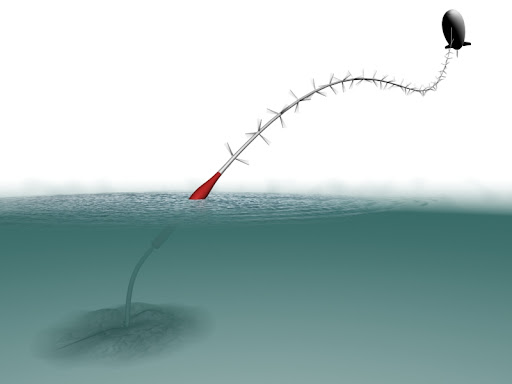
Holy cow look at that thing! California-based Selsam is a small company with big dreams. That website has a lot more photos, but the basic idea is to replace large, single turbines with a whole bunch of little ones. They can be put in the water, they can be put on top of buildings, and, as seen above, they can be attached to bimps.
Operating from my "strikes = surface area" theory, the Selsam turbine would have about the same number of strikes as a traditional turbine. The surface area of the two styles is (roughly) the same, it's just broken into smaller bits on the Selsam turbine. I gotta think, though, that it would be easier to devise a system to repel birds from a relatively contained rope of turbines than from one with a wider reach.
Completely unscientific conclusion: Slightly fewer strikes.
M.A.R.S. (Magenn Power Air Rotor System)
Magenn Power Inc. wants to float lighter-than-air balloon turbines up to 1000 feet in the air, where wind speeds are stronger and more consistant.
According to The Always-Reliable Awesome EverythingSite, Wikipedia, most birds migrate at altitudes between 500 and 2000 feet. If this is correct, the Mangenn turbine may just float right smack into the middle of the majority of migrating birds. This factor, combined with the consolidation of the mass around aviation lights may have the effect of increasing bird strikes.
Completely unscientific conclusion: More bird strikes.
So, there you have it. Any other turbine designs out there? Disagree with my off-the-cuff reasonings? Let me know.
Monday, July 21, 2008
Birds and Other Types of Turbines
Labels: birds, turbines, wind energy
Friday, July 18, 2008
Birds and Offshore Wind Energy II
NASA's Jet Propulsion Laboratory has recently released this map showing global wind energy potential. I didn't realize how much of a difference there was between summer and winter winds.
Looking quickly, it appears that the best sites in terms of sustained yearly wind speeds are: off the coast of Northern California, around Australia and New Zealand, Southern Chile, Somalia, Southern Vietnam, and the Caribbean.

How does this affect birds? Well I think that's still kind of up in the air. Offshore (in federal waters, more than 3 miles from land) wind development would avoid many of the problems usually attributed to migrating birds (especially raptors, which don't migrate over water at all), but could still pose problems for birds that do migrate or travel well offshore.
Here is a satellite tracking map showing a Black-Footed Albatross meandering off the coast of Northern California, one of the areas I mentioned above as having sustained yearly wind speeds and a possible area for deepwater wind farms:
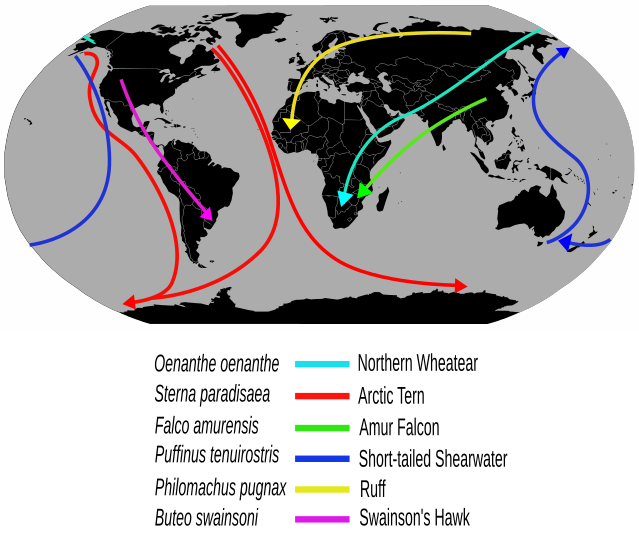
Similarly, some of the migrations shown on this Alaskan USGS site - a really fantastic website - show Brant and Red-Throated Loons migrating well off the coast of California, likewise for Short-Tailed Shearwater and Arctic Terns on the map below (not sure how precise it is).![]()
How would deepwater offshore wind farms affect seabirds? No idea. The only study I know of focuses on wintering Common Eiders. The birds were lured through the turbines using decoys set deeper and deeper into the farm. The fact that these birds were overwintering is important, I think, because their flight patterns are different than birds that are migrating (like the Brant) or foraging (like the Albatross).
For example, most birds - except raptors - migrate at night. Though it is likely that nocturnal migrants fly high enough to avoid rotating blades, lights placed atop turbines for navigational purposes may prove to be a much bigger problem ("In the Gulf of Mexico, a 2005 showed that 300,000 birds die in collisions with pipes and wires each year"). Technological developments in lighting may help.
Birds that feed at sea, storm-petrels, albatross, shearwaters, etc., may also be at risk of hitting turbines. These birds don't generally fly at night, but birds on the lookout for food are not on the lookout for structures. This reasoning has been used to help explain the large numbers of raptor mortality from the Altamont Pass wind farm. It's unclear if there will be a similar effect among seabirds (most sea foragers rely on their noses rather their their eyes), but the topic certainly needs to be studied.
The effects of offshore turbines on seabirds - and maybe more importantly on marine mammals, who may be seriously affected by increased underwater noise and vibration - needs to continue to be explored. I still believe that large offshore wind farms will, in the long run, be easily more environmentally sound than our current sources of electricity, but finding sites that minimize impacts while maximizing energy is key.
Labels: alternative energy, birds, turbines, wind energy
Saturday, June 14, 2008
Birds and Wind Power
I love wind power. It's cheap and it's clean and there is enough wind in the open oceans around this country to more than fulfill our current electricity needs. Historically, birding groups were opposed to wind turbines. As more information is gathered, though, people are finding that the danger to birds isn't nearly as extreme as feared.

(If you're having trouble viewing the image, click here)
See how the ducks' flight patterns shift to avoid the turbines? The early data seems to show that seabird mortality due to turbine strikes will be low with offshore wind. Other factors, such as how to site the turbines to avoid feeding grounds, still need to be looked into.
Labels: birds, turbines, wind power