Thursday, February 13, 2014

The New Orleans Pelicans Should Be The Official Team of Birders


As you may know, the exclusive club of sports teams named after birds got an unexpected new member this year, the New Orleans Pelicans of the NBA.  The oft-moved team had been called the Hornets (the only member of the club of teams named after insects!), but Charlotte, NC wanted that name back (it had been the original name of their NBA team, now called the Bobcats [sorry, mammalogists]), so New Orleans decided to change.

Surprise of surprises, they didn't go with something stupid, they went with Pelicans.

I've covered this ground before, discussing how pleased I am with choosing such a not-really-tough nickname and mascot.  But I think it's more than that.  I think the birding community should adopt the New Orleans Pelicans as our official sports team.

What does it mean to be the official sports team of birders?  I don't know, really, I'm doing this off the top of my head, but I don't think it's much different than any city's fanbase liking their team.  It's a rallying point, a vehicle for unification.  A method for the various subspecies of birder - listers, feeder-watchers, gull-dorks, banders, chasers, old cranks, bread-throwers, migratiphiles, radar-watchers, patch-listers, night-flight-nerds, photographers, pelagic seafarers, Sunday strollers, museum specimen perusers, shorebird geeks, subspecies maniacs, car birders and others - to come together and support a common cause.

It'll be a secret handshake.  See that guy in the park wearing a cool Pelicans hat?  We're nowhere near Louisiana, must be a birder.


Sunday, February 9, 2014

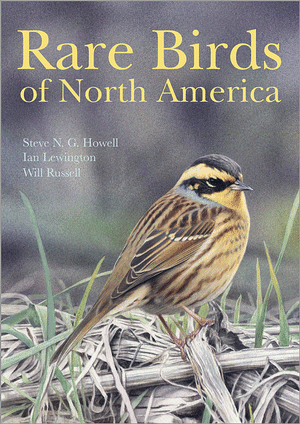
Book Review: Rare Birds of North America


I've never met Steve N. G. Howell, but if I had the opportunity I think I might be too intimidated, and beg off with a fake illness or a made-up death in the family.  You think you're a good birder?  Well, this guy wrote the book on molt.  He literally wrote a book about molt.

At a time when most field guide authors are aiming for the sweet-spot middle with general American bird guides, Howell has cast off ornithological (and financial?) conventions and found a niche taking on especially difficult or outlier birding topics: gulls; petrels; hummingbirds; molt.  He's a bird guide writer's bird guide writer, someone who seems to feel no need to dumb things down for new birders.  He's back at it with Rare Birds of North America, a guide to avian vagrants and vagrancy.

It's mouthwatering ground to cover.  Howell, along with coauthors Ian Lewington and Will Russell, cover 262 species of American vagrants, detailing their plumage and habits, of course, but more importantly the potential reasons behind their vagrancy patterns.  In fact, the "Migration and Vagrancy in Birds" chapter at the beginning is worth the sticker price all by itself.  For hardcore birders, it's the kind of book that makes you want to stop reading, and I mean that in a good way.

But it ain't perfect.  As with some of Howell's other titles, especially Gulls of the Americas, it's organized fairly unhelpfully.  [A quick note on Gulls of the Americas: can we please get a reworked and updated edition?  No group needs a comprehensive ID guide more than gulls, but GotA needs a lot of fixing.  My two cents: better photos (with illustrated plates for guidance), better organization, and drop the South American birds.] In Rare Birds, species are broken up into groups, such as Wading Birds or Aerial Landbirds, and then those groups are typically broken up again into those species originating in the Old World and the New World.  The effect of the New World/Old World split is disorienting - for example, there are sections of flycatchers separated by 58 pages of Old World robins, warblers and wagtails - without being useful.  Additionally, the book lacks usefulness as an identification guide because of its sparse treatment, both in plates and in print, of "similar species."

Rare Birds of North America continues Howell's brave exploration into areas of birding heretofore unknown in print.  Though this book is imperfect, and will likely become outdated as a reference as new records pile up, it's a bold examination of the science behind vagrancy, and will hopefully push some birders to find noteworthy additions of their own.


Monday, January 27, 2014

Birding With Others


Here's a chart I made to explain what it's like to bird with different people. [Click to enlarge] No judging, just explaining.  An audio snapshot of a point on the left side of chart would be like this:
"OK so like I'm looking at the third tree in, the one with that kinda like splits into two trunks right off the ground?  Do see that one?  Yeah it's like the third big one back there, not that little one with that yellow bunch of leaves or whatever those are, the biggish one.  Yeah OK so, like, up on the left side of the split trunk there's a branch that goes off to the left probably likeeee 25 feet up?  Like right horizontally off to the left, straight, and it's got...yeah there's that cloud - the only cloud - like right behind it right now.  Yeah that one with the cloud behind it.  Just to the left of that cloud is a bird on the branch, do you see that?  You do?  Awesome yeah that's the woodpecker, a downy woodpecker.  OK so downys look just like this other woodpecker, the hairy woodpecker, but you can tell this is a hairy by the..."
But a point on the right side of the chart sounds like:
"Yup I'm on it.  Yeah man you're right there it is.  Wow.  Awesome."
It's fun to bird with different people.  Birding with experts saves your voice. 

Friday, January 24, 2014

Where Do Birds Sleep?


New article up on Slate.com last night about sleeping birds, brains, chimneys, fatness, middle schools, and sleeping upside down.  Hope you like it!


Wednesday, January 22, 2014

A Series of Images Showing Commuters Unknowingly Walking Directly Below a Snowy Owl in Downtown Washington DC


I saw this bird in McPherson Square tonight from 7:15 to 7:45.  Several folks were watching with me.  Others were just passing through.


Thursday, January 16, 2014

How to Draw Field Sketches When You're Not a Good Artist


I have only birded outside North America once, in 2006.  I had just finished a winter ski-bumming in Aspen, Colorado, and I was flush with cash from a winter spent hustling vacationers as one of those on-mountain photographer guys.  My friends were also flushed, and we decided to go on a trip.

One of my friends knew a guy in Ecuador, and tickets were cheap, and so we went.

My friends were not birders, and we were not going to a particularly birdy part of the country.  In fact, although it sounds unbelievable for a country containing more than a thousand bird species, I came home after ten days in Ecuador only identifying 56 species.

I bought the enormous Ridgley Field Guide to the Birds of Ecuador before I left, but had not nearly enough time to really get a handle on what birds I might see in my travels.  Plus, the book weighs like 10 pounds and was too much to carry around with me.  Instead, when I'd sneak off to go find birds, I'd bring along a little notebook and make quick sketches of things I saw, returning home to figure out IDs later (I didn't have a camera, did I mention that?).

I expected to be frustrated by my lack of knowledge, but this kind of birding was far and away the most fun I've had birding maybe to this day.  I didn't know what to expect, I wasn't jaded to anything.  Every bird needed to be examined for possible differences from other, similar birds.  It was birding again for the first time.

I recently found my notebook in a box of old things and wanted to share the crappy little drawings I made.  They're a far cry from the detailed, shaded, dog-bottle watercolored (!) images that real artists can produce, but I think there's a certain charm in my rushed scribbles.  The pictures didn't scan very clearly, sorry, but click to enlarge.


The airline lost my bags on the flight to Guayaquil, and my buddy and I were stuck for three days shuttling back and forth between the airport and the beautiful Iguanazu Hostel that we picked at random (I think it's changed since 2006, those rooms are a lot more expensive than what we paid).  All the waiting around provided some good opportunities for birdwatching.  The page above contains birds I saw from a little outdoor seating area on one end of the airport.  Nothing fancy, but I remember being dazzled by the Saffron Finches and enjoying seeing the first of what seemed like a million similar-looking kingbirds.  

Sunday, January 5, 2014

Birds at Large: Rice Owls Baseball Jerseys


Rice University has got itself some new baseball jerseys, and they've got owls on them.  It's a logical choice, because Rice's sports teams are all named the Owls.  Rice has got owls on its seal, and on its logo, and the kids apparently do an "owl" hand signal to let you know they're Ricers.  Owls are a thing, understand?

As far as I can tell, no specific species of owl is used for the Rice Owl owl.  The use of owls comes from their seal, which uses stylized versions of the old Owl of Athena image, representing "wisdom."  Without a specific species to base its designs on, Rice has taken liberties with its use of the owl, employing this thing, whatever the heck this is, and this come-hither bird.


The new jerseys are a nod to the classic "birds on the bat" logo of the St. Louis Cardinals in the pros.  It looks pretty nice - lovely stitching and I love how the bat goes through the top of the R.  Gotta admit, it really bothers me that the birds aren't a real species.  Why not?  Why not just do it?

That's the thing that bugs me most about these Birds at Large posts.  It takes so little effort to just make it a real bird.  This guy was obviously modeled after Great Horned Owls...why not just slap a little orange around the eyes?  Great Horned Owl plumage is not copywrited!  I dunno.  Maybe they didn't want to introduce another color for cost reasons and fine (though you could probably fleck with the yellow and brown), but if you're gonna do something, do it right.  Rice you were close to something perfect, but it looks like your streak of owl insanity will continue.


About Us | Site Map | Privacy Policy | Contact Us | Blog Design | 2007 Company Name