I don't care what you think. I don't even. I know it's almost two full months into 2015. I know this is a birding blog. Deal with it. There are lot of cool living things out there, and birds are just the best way to get to them all. Plus, if you're going to lug a heavy camera around all day you might as well point it at stuff, you know?
Here are cool non birds I saw in the two-thousand-and-fourtteenth period that the Earth made one full rotation around the sun, counting from the time that a certain magical baby was born in a stable in Bethlehem (Judea, not Pennsylvania).
Mammals
5. Richardson's Ground Squirrel - Fort Union Trading Post NHS, North Dakota
Saturday, February 21, 2015
Mammals and Reptiles of 2014
Monday, February 9, 2015
Thoughts on the Mercenary Ornithology State Birds Post
I am pretty confident at this point that the What The State Birds SHOULD Be post I did a couple years ago will be the most-read thing I ever write. I'm OK with that; it's had a life far beyond what I expected and as been a lot of fun.
An though it's just a little article, I feel a little paternalistic to the topic of fixing the state bird situation. There's a lot of room in the debate, of course, and a few days ago the folks at Mercenary Ornithology weighed in. WITH SCIENCE.
Mercenary Ornithology used mathemagics to figure out which bird should be the state bird for each state. They used some formulas to figure out a bird's Outlier Value, basically how much more likely you are to see a certain bird in one state compared to all others. The results are great, and much more specific than most of the choices I slopped together. There are blue-winged teal involved now, and red-cockaded woodpeckers and upland sandpipers. It's a much more diverse list, weighted towards state-specific birds, with nary a cardinal in sight.
But it ain't perfect. What's the problem? Well, at the risk of sounding exactly like old fogey baseball writers railing against the influx of so-called "advanced stats" like WORP and PECOTA: This list ain't got no heart! Where's the human touch? While some of the results of the mechanical approach are perfect, other results range from awkward (a Kentucky warbler for Arkansas?) to depressing (European Starlings shouldn't be a state bird anywhere, even a place as boring as Indiana [j/k Indiana I love you]).
Ya gotta leave some room for debate, and you've got to embrace quirks. Let Rhode Island keep their dumb chicken, it's their thing. Let Maryland keep the oriole...it's a Baltimore Oriole! There's fun in the details, and room for states to pick birds that aren't very common or easily found in their states.
No matter what other lists people come up with, everyone can agree on one thing: the current lineup of state birds is a national shame, and we gotta do something about it.
Labels: math, official state bird, science, state birds
Tuesday, February 3, 2015
Important Answers to Major Questions: What Kind of Binoculars Was Robert Kraft Using During the Super Bowl?
Needless to say, as a lifetime fan of the New England Patriots, I enjoyed this weekend's Super Bowl. For those of you non-sports-types that might be reading this, the Patriots defeated the Seattle Seahawks (props for the bird-themed name, though) thanks to a miraculous goal-line interception. It was fantastic.
During a cutaway shot of the Owner's Box, Patriots owner Robert Kraft lifted binoculars to his face to look, presumably, at some action on the field. As a birder, this was an extra little bonus, as I enjoy seeing what looks like people birdwatching. I jumped to Twitter to register my delight:
Friday, January 23, 2015
Google Street View Birding IV: Florida
It's easy to look down upon Google Street View Birding. "It's for lazy people," they say. "It's not real birding if you're just using a computer," they whine. "Get a goddamn life," they snort.
This installment brings me to Florida. I was in the Sunshine State over the holidays and was reminded what a fantastic place it is to bird. There are birds in every pond. There are birds at every feeder. There are birds covering the beaches. I'd venture to guess that there are more birds per square inch in Florida than anywhere else in the states.
So it stands to reason that there would be birds in Google Street View. I found some downtime and took a look.
Beaches
For most of Street View's history, the images were all captured from cars. This made Street View Birding quite the challenge because, like, how often to birds fly right next to cars, right? Telephone wires and bridges were really the only places to look. Recently, more mapping is being done by folks on foot. This was clearly a boon for SV Birding on Midway Atoll, still the best vicarious internet birding experience available.
And it's also come to Florida. Some folks have taken it upon themselves to strap on the ol' backpack and walk nearly the entire walkable coast of the state. It was clearly a Herculean task, but it resulted in some better images of birds that I had found anywhere else.
Thursday, January 15, 2015
Upon The Discovery of the Semiplumbeous Hawk - A True Story
The year is 1848. The place is the Columbian jungle, at the end of a long, hot day. Two naturalists in khaki safari suits and pith helmets are sitting around a table, sorting through the bird specimens they collected that day. They pull a crow-sized raptor from the canvas gunny-sack and place it on the table.
Naturalist 1: "I say! My good man, a striking specimen we have here."
Naturalist 2: "Quite striking, yes! Accipitridae, would you agree?"
Naturalist 1: "Yes, my good man, I do believe it is Accipitridae or some genus thereabouts."
Naturalist 2: "Yes some genus thereabouts, but we'll let the chaps back in London sort through particulars, eh chap? Eh?"
Naturalist 1: "Ha! Indeed! 'Tis the life of the field for us! Striking creature, though, certainly."
Naturalist 2: "Indeed."
Naturalist 1: "Right, well, shall we commence with the description? Keen to take notes, ol chap?"
Naturalist 2: "Right, sir, dictate away, my good man."
Naturalist 1: "Right. Dictation commencing! Medium-size falcon, shot in these Columbian woods on this, the day of June the 5th, the year of our Lord 1848. Got that?"
Naturalist 2: "Got it, dear chap, continue away."
Naturalist 1: "Commencing physical description of the specimen. The bird appears to be forty centimeters from beak to tail. Snow white belly. Feet and beak of rich orange. Back and head of a stormy plumbeous."
Naturalist 2: "Hold up, butch."
Naturalist 1: "Yes? What's the trouble?"
Naturalist 2: "Plumbeous?"
Naturalist 1: "Yes, a head and back of plumbeous gray, what of it?"
Naturalist 2: "That's no plumbeous."
Naturalist 1: "What! Of course it's plumbeous. Look at it: the dull gray color of lead. Plumbeous."
Naturalist 2: "Not in the least, sir. Too dark. It's castor gray, the color of wet muscovite."
Naturalist 1: "Wet muscovite! Are you mad? Has the damp air affected your vision? It's plumbeous or I'm the queen!"
Naturalist 2: "With all due respect, sir, I grew up with plumbeous. I had a plumbeous coat as a child. Our carpets were plumbeous. The soot from the factory in our neighborhood sent plumbeous plumes into the sky, and the soot settled on the houses in a thick plumbous snow. Growing up, I had a dog such the color of plumbeous that when we brought him home as a puppy the only name we could think of for him was Plumbeous. I know plumbeous, sir, and this bird is no plumbeous!"
Naturalist 1: "Right, well, I didn't realize you had such a connection to the subject. I do apologize."
Naturalist 2: "No need sir, really."
Naturalist 1: "Well then. Hmm. Listen, you do agree that there's at least a bit of plumbeous in this bird, eh?"
Naturalist 2: "Sure well of course it's a bit plumbeous. More plumbeous than cinereous, that's for certain!"
Naturalist 1: "Ha indeed. Well perhaps we could describe this bird in such a way as to reflect the fact that, while it's clearly not entirely plumbeous, it does indeed have a bit of the ol' plumbeous upon its plumage."
Naturalist 2: "Sure, I suppose describing this bird in such a manner as to reflect the true fact that its coloration - while not entirely plumbeous - does contain certain pigments that, on a sort of gradient scale from white to black could, with a few extra drops, eventually reach the pigment known as plumbeous."
Naturalist 1: "Excellent! It's settled then. Well negotiated, dear boy. Now then! Take a look at this plover, what should we name him?"
Naturalist 2: "The Entirely-palmated Plover."
AAAAAAAnnnndddd scene.
Wednesday, January 7, 2015
Contractually-obligated 2014 Wrap-Up Post
You've probably never read the Terms and Conditions section of Blogspot, have you? Yeah it's OK, most people haven't. I'm not most people, of course. I've read those things from top to bottom, check for updates twice a month, and have run it through Google Translate and read it in German to check for discrepancies.
When you're as familiar as I am with the particularities of this here ol' web logging service, you'll be acquainted with Section 10.4(g)(1). This nifty little provision states (and I'm putting it in layman's terms for you, no need to thank me) that every Blogspot-hosted birding-themed blog MUST (no uncertain terms here) have a post in the last two weeks of December or first two of January summarizing the prior year's birding efforts. The penalty for noncompliance is fifteen broken image links scattered through old posts and an additional year's worth of mysterious, unsolvable formatting errors.
Being the upstanding, law-abiding citizen that I am (Falmouth High School's Most Likely To Walk The Straight And Narrow 2001), please enjoy the following dump of information, images, maps and whatever else I can come up with about the glorious birding adventures I undertook in that already-half-remembered lurching spin 'round the Sun known to the kids searching Wikipedia as 2014 AD.
1. I Saw More ABA Species This Year Than Any Previous Year
Last year I ended at 399 goddamn birds, an annoying number that somehow lessened the whole thing, like a photograph with one person's eyes closed. I panicked after dipping on the reliable (before and after) Black-headed Gull near Baltimore and floundered around for the last days of the year, unable to get over the hump. The lesson learned was that such unsatisfying proximity would not be repeated. I was determined to hit 400. LONG STORY SHORT my girlfriend-now-fiancee (thank you) agreed to a road trip to Florida, one thing led to another, and I landed at 413.
[Quick funny story: Once I hit 400 I immediately did as birders do and took aim at my buddy Jake's record of 413. I spend Dec. 31 in a frantic dash across southern Florida looking to pick up birds, succeeding at least to tie the record...that is until Jake told me his record was actually 423 not 413 and that I was an idiot.]
Anyway here's a chart of my now 10th full year of birding. The blue bars show my year-end ABA number, and the orange line showing my cumulative ABA life list, now sitting at 639.
Labels: 2014, birding, birds, blogging, obligations
Wednesday, December 10, 2014
Ranking the Bird Beers
There is a chain of stores in northern Virginia called Total Wine and More, and, if you haven't been there, the "More" part stands for "tons and tons of beers from everywhere." It's a goddamn paradise.
I was cheerfully strolling down the aisles of their Alexandria store the other week when my eyes, as they are wont to do, started finding beer labels adorned with our feathered friends. This may not come as a surprise, but there are a heck of a lot of beers that use birds in their names or labels. As a staunch supporter of avian-themed things, I applaud these beer companies in their thematic choices. But that doesn't help me much at the register. With so many bird-themed beers out there, what's a thirsty birder to choose? I am here to help.
Regular readers of this blog (are there those?) will know that I am a stickler for avian accuracy in my products. It's not enough for some company to just slap some winged thing onto the label (I'm looking at you, Akron RubberDucks), ornithological accuracy is important. At the same time, I don't want to drink something that tastes like crap. It could be called Coastal (Gray-Cheeked or Hepburn's) Gray-crowned Rosy-Finch Life Bird Ale, but if it tastes bad then it ain't worth it.
So to grade these things I am using a hybrid solution. To judge the quality of the suds I am using the BeerAdvocate Overall Score (BOS) from the famous Beer Advocate website. BOS scores on the site run from 0 (garbage) to 100 (world class). I am not taking the type of beer into consideration. To that number I will add another 0-100 score of my own subjective determination, judging the overall use and presentation of the bird at hand. Then I'll divide the number by 2 to get a final 0-100 score. Ya good?
Quick caveat: I'm going to miss probably a lot of beers. There are, conservatively, a trillion different beers in the world, and some of them are not forthright about their use of birds. If I didn't see it on the shelf, or can find it easily online or YOU DON'T LET ME KNOW OF THEM, then I can't rate them. Doing the best I can. Let's go.
UPDATE 3/1/2015: I've added Birdhouse Pale Ale from Brewer's Art at the bottom.
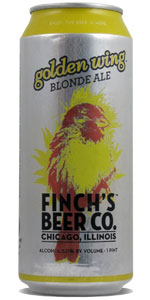
Golden Wing Blonde Ale - Finch's Beer Co.
BOS score: 76
Birdist score: 50
Total score: 63
So, I can't really knock it because it's at least a real image of a bird. Like, it's not some anthropomorphic cartoon mess, it's an actually-proportioned bird. But, it's a sparrow, not a finch. A Harris' sparrow, I think. It's not, say, a golden-winged warbler - which would make sense for the beer name - or a finch, which would make sense for the company name. I can only do so much.
Beer review quote: "It has been a long time since I have had this beer. But from what I can remember this beer was ok. " Can't argue with that.
Cardinal Pale Ale - Nebraska Brewing Company
Birdist score: 25
Total score: 54
Cardinals have orange beaks, not yellow. Cardinals have orange beaks, not yellow. Cardinals have orange beaks, not yellow. Cardinals have orange beaks, not yellow. Cardinals have orange beaks, not yellow. Cardinals have orange beaks, not yellow. Cardinals have orange beaks, not yellow.
Beer review quote: "Drinkability was good, my can was gone quickly, and If I'd a had another, I woulda drank it."