Saturday, August 17, 2013

Nick's Paradise


One of my favorite things about birding in Mississippi was that there are so few other birders around.  Every time I went out - especially into the Delta - I felt like James Audubon, ready to discover some new species or hotspot.  The east side of Mississippi is still unbelievably underbirded.

The lack of known birding spots in the Delta, along with the fact that I am friends with the state eBird reviewer, mean that I had a lot of sway when it comes to suggesting new hotspots.  I named one after myself, thereby ensuring ornithological glory for the eternity.

Next time you're in Tunica, follow the dirt road over the levee behind the Hollywood Casino and find yourself on the banks of the mighty Mississippi, in Nick's Paradise.  Tell me how you did. 


Wednesday, August 7, 2013

Ornitholgical Accuracy of the New Orleans Pelicans


When the Atlanta Thrashers packed their sweaty skates and headed to Winnipeg to become the Jets in 2011, the Bird-Named Big 4 Sports Team Club was down a member.  Last year 11 of the Big Four teams ran behind a flapping mascot:

  • NBA's Atlanta Hawks
  • NFL's Baltimore Ravens, Philadelphia Eagles, Atlanta Falcons, Arizona Cardinals, and Seattle Seahawks
  • NHL's Pittsburgh Penguins and Anaheim Ducks (I don't count the Chicago Blackhawks, who were named for a leader of the Sauk tribe, or the Detroit Red Wings, who were apparently named after a Montreal Cycling Club), and
  • MLB's St. Louis Cardinals, Baltimore Orioles and Toronto Blue Jays
Much to my surprise, though, events conspired over the NBA winter to restore the club membership to an even dozen.  Back in 2002, the under-attended Charlotte Hornets shipped their franchise to New Orleans.  Just two years later, however, all was apparently forgotten and Charlotte unveiled a new basketball squad, the Bobcats.  Well, the Bobcats suck, and worked a deal with New Orleans to bring the Hornets name back to Charlotte, where people still hardly give a crap.

That left the New Orleans team nameless, and after contemplating Mosquitoes (haha ok), Swamp Dogs (ughhhh), Bullsharks (cool) and Rougarou (what), the team owner went with the New Orleans Pelicans.

Fantastic!  I love this for so many reasons.  First, as I've said before, I just associate Brown Pelicans with Louisiana and always give bonus points for teams named after local birds (see: Baltimore Orioles).  Second, I also love it when teams pick birds that aren't typically "fierce" like hawks or eagles.  Third, the Pelicans name has New Orleans roots, once being the name of a minor league baseball team with this adorable logo.  Good times all around.


The Pelicans unveiled their logos a couple months ago, and I think now that the initial excitement about the name is over I want to look at these items with a critical eye.  Frankly, from an ornithological perspective, the jury is out.

The concern here is that they're not using the correct species.  There are two species of pelican in these United States: the American White Pelican and the Brown Pelican.  While White Pelicans can be found in Louisiana, it's usually in the winter, when they huddle in big groups in the middle of big lakes and reservoirs.  I've seen it.  They're cool birds all, but they're pretty pathetic in the winter time, and certainly not worthy of naming a cool NBA team after.

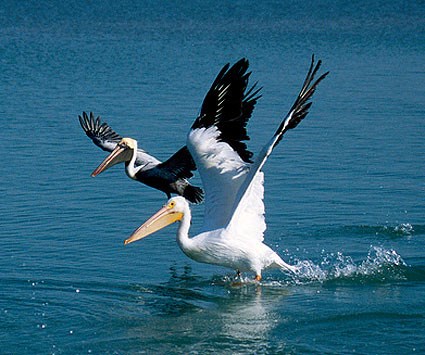
The New Orleans Pelicans need to be modeled after Louisiana's state birds, the Brown Pelican.  These are the cool pelicans: the ones that hang out at the beach cruising low lookin' at babes, the pelicans who will tell you they hung out with Dr. John before he went to med school.  If you know what I'm saying. [Below photo shows a Brown Pelican on the above left, and an American White Pelican below, with its feet in the water]


Looking at the logos, I'm not sure.  The baseball logo, linked to above, shows a white pelican, but it's old and colorless so I don't know.  The logos shown above are ambiguous.  The underwings don't match either species: White Pelicans are white and black, while Brown Pelicans are (mostly) just brown.  The face, shown head on, is white for both species, so we're good there.  The beak, I suppose, could match either species, but the red coloring in the logo looks more like a breeding Brown Pelican than the orange of a White Pelican.  Deal.

I just want to make sure everyone knows that it's a Brown Pelican, not a White.  Grantland's recent post on nicknames for the Pelicans illustrates the thing with a White Pelican.  I was unsuccessful in conveying jovial sarcasm when pointing this out to the author of the piece, but hey, it was his mistake, not mine (and who doesn't check the photos that go with the post?)


[Also, a not on the cap photoshopped onto the pelican in the linked-to blog post above: that isn't listed as an official logo or in the NBA team store for the Pelicans.  I don't know where that hat came from but if it's real, it's a White Pelican and completely inaccurate, speaking from a birding perspective.]

All in all, I'm thrilled to have the Pelicans in my life.  Louisiana's got a great birding history and reputation, and I look forward to seeing LA birders crank around Grand Isle in Pelicans gear.  I hope it's also used to teach non-birders about their state bird: a big cool bird, a survivor of hurricanes and oil spills, and just the kind of goofy mascot the an eccentric populace can get behind.  Go Pelicans.


Sunday, July 28, 2013

I Love the Maryland Biodiversity Project


It's a common sentiment among birders that this hobby isn't really about the birds.  We want to connect with nature, and birds provide the best experience.  Unlike mammals, there are a lot of birds and they're relatively easy to see - and less dangerous.  Unlike insects, bird species can be readily distinguished in the field.  Unlike fungi and slimes, birds aren't disgusting. 

But while birds are Goldilocks' "Just Right" porridge of the animal world, it doesn't mean birders aren't interested in everything else out there.  That's why I think the Maryland Biodiversity Project is such a cool idea.  The idea is simply to catalog all the living things in Maryland.  So far they've got more than 10,000 species in their checklists - more than 3,300 with photographs.  The volume of life is incredible - from fish to ferns to fleas and fungus.

A real sense of wonder and excitement pervades the site - headlines in the news section breathlessly report a new bee record or that 217 species of scarab beetle have been added.  It's a lot of fun, and enough to make a jaded mid-summer birder want to get back out there and turn over logs.  If you've got a bunch of hours to kill, lose yourself in the species photos of some random classification, and remember what it feels like to have your eyes opened to a world of creatures you didn't even know existed.

Monday, July 22, 2013

Dumbness of State Birds: Visualized


A reader named Hannah D. has come up with a cool way to visualize the dumbness of state birds as laid out in my State Birds: What They SHOULD Be post. Check out the map below, and see what your states' "dumb score" is. Thanks, Hannah!


Tuesday, July 16, 2013

Debating The De-Extinction of the Passenger Pigeon with Rick Wright


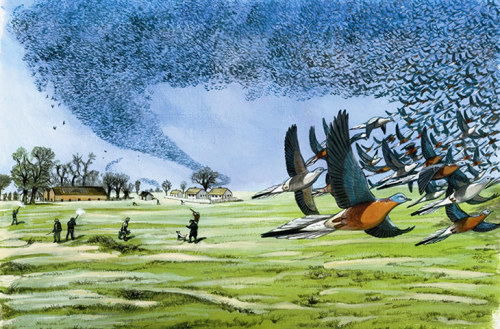
You've probably seen the news in the past couple weeks about some biologists talking seriously about "de-extincting" the Passenger Pigeon.  The idea is to take DNA from museum specimens of the birds - nearly a century gone now - and inject them into Band-tailed Pigeon stem cells, eventually resulting in birds that are nearly pure Passengers.

Despite the scientific salaciousness, though, many birders seem to think that this ain't the best of ideas.  One of them is mega-birder, ABA blogger and owner of probably the best-researched birding blog on the innernet, Rick Wright, who posted on his Facebook page that this Passenger Pigeon hoopla was nothing more than "short-sighted gimmickry."

One of these nay-saying birders is NOT, however, me, who loves the idea of our skies once again darkened with Passenger Pigeons - and any other long-dead feathered friends we can reconstitute.  I got in touch with Rick and he kindly agreed to swap emails discussing the practical and moral implications of bringing back the birds.  I had a blast, and I thank Rick for hashing it out with me.  Find our exchanges below the jump.

Sunday, July 14, 2013

Birds At Large: Werner Herzog's Happy People


Werner Herzog is an absolute golden god of cinema.  His fiction films are uncompromised and ballsy in a way that no other filmmaker's are.  Of all the great things about these films, my favorite is that Herzog harnesses the seemingly long-lost joy of cinematic spectacle, eschewing computerized special effects for much more incredible, honest-to-goodness realism - whether it's the unending parade of South American trekkers at the beginning of Aguirre: The Wrath of God, the African coast signal flaggers in Cobra Verde, or the insane meta-joke that is the pulling of the steamboat in Fitzcarraldo. 

For birders, many of his documentaries (his more recent ones, especially) are special for a different reason - because they exhibit a deep interest - a loving interest, I think - in the perversities of the natural world.  He films insane penguins running inland toward certain death in Antarctica in Encounters at the End of the World, and an insane man following Alaskan bears in Grizzly Man.  Herzog imbues these documentaries with a sense of fascination that other "nature" documentaries don't.

Which is why I was dismayed recently when I was watching his 2010 documentary Happy People.  The film focuses on the lives of fur-trappers in the remote taiga of north-central Russia.  It's a beautiful film, providing a glimpse into a lifestyle that I didn't think existed anywhere in the world.  The Russian taiga looks a whole lot like a much bigger, wilder version of Maine, where I grew up, and so I relished in the sights and sounds of the deep woods.

But my idyll was disrupted by those sounds.  There are two very faint bird songs in this Vine I took of a scene in the film, where a trapper is knocking out a new window in one of this hunting cabins:


If you listen VERY carefully, you can hear both song types of a Black-throated Green Warbler (both the "zoo zee zoo-zoo zee" and the "zee zee zee zoo-zee" songs).  What's the problem?  Of course, that Black-throated Greens don't live in Russia.  It's an after effect.

Now I can't be sure that this was done with Herzog's OK.  I'm a bit confused on how it all worked, but Happy People was actually filmed by a Russian named Dmitry Vasyukov and then re-edited in to its present form by Herzog.  I am not sure when the sound effects were added, but added they were.

I thought that of all the world's filmmakers, the last I'd be doing a Birds at Large piece on was Werner Herzog.  His documentaries, I thought, were above these kinds of cheap, unthinking tricks.  Alas.

__
Special thanks to Derek Lovitch - the only birder I know who has been to Russia - for help with BTNW range questions.


Tuesday, July 9, 2013

A WORD ON THE CAPITALIZATION OF BIRD NAMES


It's always bothered me that most media outlets don't capitalize the common names of birds.  I've just never understood why.  It's unnecessarily confusing  - does "I saw a yellow warbler" mean you saw the species Setophaga petechia or that you saw a warbler of the color yellow, like a Prothonotary or Pine Warbler?  

It also strikes me - as a birder - as disrespectful.  Birders are a species-centric bunch.  Field guides are divided into species, each one seeming to be its own separate brick - distinct but accommodating - in the birdlife structure.  Our lists are built by species one-by-one; the Carolina Chickadee only counts once no matter how many individuals you've seen.  To us, the combination of words creating a species' common name is the carrier of meaning, it's the it, it creates - quite literally - a proper noun. (Sometimes even capital letters at the start of the words aren't enough, and we distinguish species in bold or in all-caps.)

To cast that combination of words back among the unwashed lower-case, then, is to rob it of its magic.  To a birder it seems undignified.  To a scientist, though, treating species not as icons but as data (or, more likely, with a much better understanding of the muddy fluidity that is the "species" concept), or to a layperson, who couldn't give a crap either way, the common name is meaningless,  unworthy of extra typeface.

An English professor would explain that the difference is common vs. proper nouns.  The argument is that, basically, the common name of a bird species is not capitalized because there are lots of individuals of that bird.  So, while the words Eastern Bluebird refer to a unique species, they don't refer to a unique bird, and it should be just eastern bluebird.  

I think this is garbage.  Say what you will about common nouns, but there's nothing common about Common Goldeneye: the uncommon combination of those words means the author wasn't referring to some common goldeneye but a Common Goldeneye, an uncommon bird among all birds but one distinct from - and more common than - the uncommon Barrow's Goldeneye.  The "common-ness" of a common noun falls away when it refers to something specific.  

The academic distinction erodes further when talking about brand names.  Under most style guides, Jeep Golden Eagles and Plymouth Road Runners get the royal treatment but golden eagles and greater roadrunners don't.  Why is that?  Like a bird's common name, saying "Plymouth Road Runner" doesn't refer to a single car but a group of alike cars that are somehow distinguishable from others.   You're telling me that some stupid marketer's focus-grouped baloney gets capital letters but living creatures that have literally reshaped their own bodies over thousands of years to better survive harsh and changing environments are "common"?

Look, just capitalize your common species names, OK?  Show a little respect.

About Us | Site Map | Privacy Policy | Contact Us | Blog Design | 2007 Company Name